


 For all latest news, follow the Daily Sun's Google News channel.


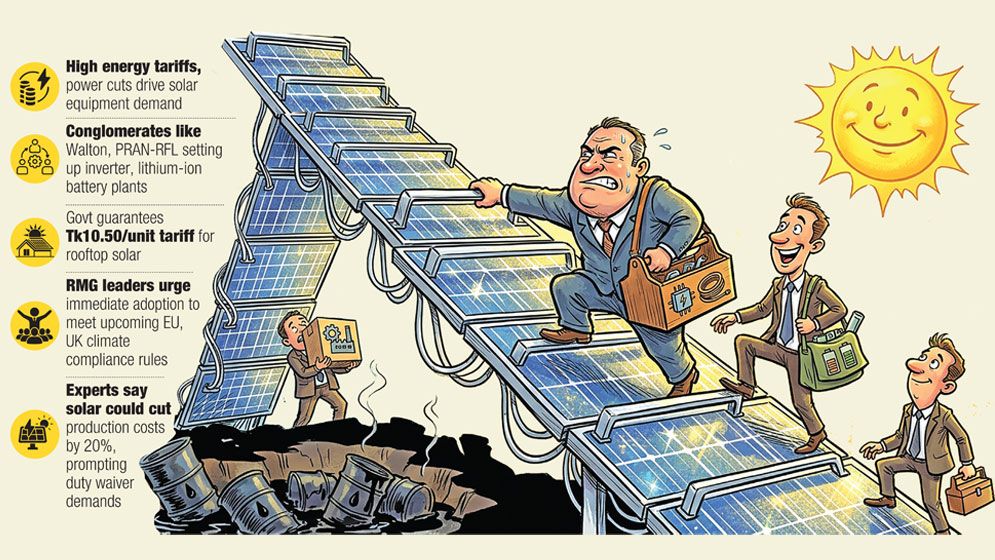
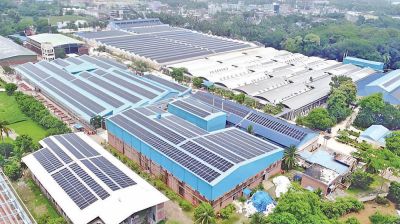
A worsening national energy crunch and soaring electricity tariffs have sparked a major investment push by local conglomerates into manufacturing and assembling renewable energy equipment.
With residential, commercial, and industrial consumers facing spiralling costs and persistent grid instability, demand for solar power systems has surged.
In response, at least eight major local industrial groups, including Walton, PRAN-RFL, Rahimafrooz, Panna Group, Hamko, Super Star, Rimso, and Navana, are expanding aggressively into backward linkage industries, specifically targeting solar inverters, lithium-ion storage, and electrical components.
The investment wave comes as the government rolls out incentives to expand rooftop solar installations equipped with battery storage.
Under a newly established scheme based on Power Division benchmarks, the base cost of rooftop solar generation is pegged at Tk8 per unit.
To draw private capital into the market, the government has tacked on a 20% profit margin alongside an 11.25% premium, setting the final purchase tariff at Tk10.50 per unit.
Industry insiders say the sector holds immense potential for high-skilled job creation across battery technology, electric vehicle (EV) servicing, installation, and research.
Industrial giant PRAN-RFL Group has already commenced work on a $1 million solar inverter manufacturing plant in Palash, Narsingdi.
Kamal Kamruzzaman, the group’s marketing director, said the facility will begin commercial production within four months, targeting a monthly output of 1,000 inverters in the 1kW-5kW range alongside storage units.
“We plan to establish a second $4 million inverter plant in Habiganj,” Kamruzzaman added. “Having already invested around Tk100 crore to generate 40MW of solar power, we aim to scale our total generation capacity to 100MW by the end of this year.”
Similarly, Walton Group has invested over Tk113 crore to establish an inverter unit in Chandra, Gazipur, alongside a newly completed lithium-ion battery plant slated to launch within a month, according to Walton’s Chief Business Officer Mahfuzur Rahman Russel.
The structural shift reflects changing consumer behavior.
Nawaz Abdur Rahim, head of sales and marketing at Rahimafrooz Distribution Limited, noted that buyers are moving away from temporary load-shedding backups toward long-term energy independence.
“Customers want an integrated energy ecosystem – from panels and Smart IPS to lithium batteries – backed by professional installation and after-sales support,” Abdur Rahim said.
Export markets are also opening up.
SM Muzibul Alam, chief operating officer of Panna Group, revealed that the company already exports batteries to over 40 countries under brand names such as Volvo, Krank, and Adixin, and is now scaling up production for EV storage and solar components.
Economic analysts argue that localizing green energy production yields substantial macro benefits.
Dr Khondaker Golam Moazzem, research director at the Centre for Policy Dialogue (CPD), pointed out that diverting funds away from expensive LNG imports into local renewables directly reduces industrial overheads.
“The ready-made garment (RMG) sector alone can slash production costs by 15% to 20% through renewable adoption,” Dr Moazzem observed.
RMG leaders agree that the transition is no longer optional.
Vidiya Amrit Khan, vice president of BGMEA and deputy managing director of Desh Garments Ltd, warned that upcoming EU and UK environmental directives will soon enforce strict compliance.
“We have very little time left,” she said. “We need a 0% tax structure without an additional 15% VAT on renewable tech. The National Board of Revenue must align with this vision.”
Mostafa Al Mahmud, president of the Bangladesh Sustainable and Renewable Energy Association (BSREA), warned that despite a 10,000MW national renewable target, severe policy bottlenecks, including NBR import duties and VAT exceeding 50% on core solar components, continue to hamper growth.
“Unless the government makes bold, out-of-the-box decisions to remove these fiscal hurdles, the country risks heading toward a far more severe energy crisis,” Mahmud warned.