


 For all latest news, follow the Daily Sun's Google News channel.


Despite official assurances that the country holds ample stocks, farmers across several districts face artificial shortages, inflated prices, and distribution anomalies that continue to destabilise the fertiliser market.
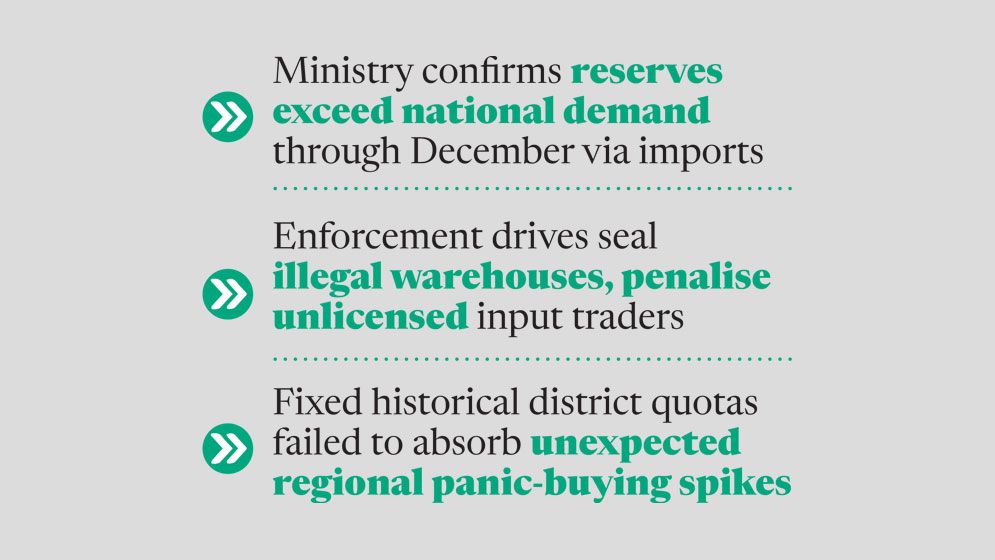
While government data confirms sufficient reserves to meet demand through December, continuous enforcement drives by mobile courts have exposed widespread racketeering, including sales above official rates and illicit hoarding.
Law enforcement authorities have seized significant quantities of fertiliser, sealed illegal warehouses, and fined unscrupulous traders across multiple districts in recent days.
The sharp disconnect between national stock reports and field-level availability has raised serious concerns over whether systemic bottlenecks are preventing supplies from reaching farmers at fixed prices.
Agriculture Secretary Md Selim Khan told the Daily Sun that there is no structural deficit of fertiliser anywhere in the country.
A high-level monitoring committee led by two secretaries has been established, alongside the deployment of tag officers across every district to oversee sales, Selim said.
He noted that stringent administrative measures are underway, with four to five officials already transferred over allegations of neglect and procedural failure.
The ministry is also moving swiftly to address market friction resulting from the newly introduced fertiliser dealer policy, Selim added.
He alleged that vested interests are deliberately creating artificial scarcity to obstruct the implementation of the new dealership framework, which will see new agents appointed by the end of this month.
The government is expanding the dealer network across rural hubs to streamline supply chains and ensure seamless field delivery, according to the secretary.
Selim Khan stressed that while national reserves remain solid, the ultimate metric of success lies in whether smallholders receive inputs at government-mandated prices without delay.
According to ministry figures, current stockpiles exceed total agricultural requirements through December 2026, bolstered by steady imports under government-to-government agreements.
An official ministry report claimed that field allegations reported in local media do not accurately reflect the macro supply position on the ground.
Joint teams from upazila administrations, the Department of Agricultural Extension (DAE), and specialised inspectors maintain daily oversight to strictly enforce government price caps.
Despite these assurances, enforcement logs compiled from Gaibandha, Bogura, Rajshahi, and Joypurhat detail persistent malpractice throughout the middle market.
In Bogura alone, magistrate-led teams confiscated 1,675 sacks of urea and sealed a commercial warehouse for operating without regulatory clearance.
Similar drives in neighbouring districts penalized unlicensed vendors for price gouging, failing to display mandatory rate boards, and diverting subsidized stocks.
Md Abdur Rahim, director general of the DAE, characterized the current market distortion as unprecedented in his three-decade career in the agricultural sector.
In my 31 years of public service, I have never witnessed such volatility in the fertiliser market during the month of Bhadra, he told the Daily Sun.
He conceded that localized supply deficits have surfaced in key agricultural belts, most notably across Rajshahi and Chapainawabganj.
Abdur Rahim clarified that current field demand remains concentrated on urea, whereas requirement for Di-ammonium Phosphate (DAP) and Muriate of Potash (MOP) should logically remain muted.
He explained that premature buying by anxious farmers for the upcoming Rabi season – which only commences in October – is exacerbating local market pressures.
Growers cultivating early potato, winter vegetables, mustard, maize, and wheat are procuring non-urea fertilisers weeks ahead of schedule to guard against potential shortfalls.
Abdur Rahim assured that additional government allocations will be dispatched to district hubs well before the Rabi planting season begins in earnest.
Sharing this assessment, Bangladesh Fertilizer Association Chairman Mosharaf Hossain confirmed that aggregate national supply remains robust and secure.
Mosharraf stated that state reserves are intact, pipeline shipments remain on track, and private importers have been granted fresh letters of credit to secure additional tonnage.
He attributed the localised crunch to panic-buying driven by unverified market rumours and speculative hoarding.
Unfounded fears of an impending crisis have pushed individual purchase volumes up by 2 to 5 percent above baseline seasonal norms, Mosharraf noted.
He highlighted that state allocations were calculated on historical consumption data, which failed to absorb this sudden surge in speculative demand.
Mosharraf Hossain argued that district-level agricultural officers and deputy commissioners should have performed real-time field audits to forecast this localized demand spike earlier.
Had field administrators identified these regional shortfalls in advance, the ministry could have reallocated emergency quotas to stabilize regional prices instantly, he added.
What began as localized anxiety in northern districts is now spreading to adjoining regions through market chatter and speculative trader behaviour, Hossain warned.
He pointed to widespread hoarding by unlicensed intermediaries, including medicine and pesticide vendors who are illegally stocking agricultural inputs in rice mills.
Hossain urged the ministry to immediately pump extra buffer stocks into high-demand districts to break the psychological cycle of panic-buying.
For primary producers on the ground, paper surpluses mean little if retail outlets demand premiums above state-sanctioned rates during critical planting windows.
The government now faces the urgent task of defending its distribution network against hoarding and illegal arbitrage while keeping panic from derailing the upcoming planting cycle.