


 For all latest news, follow the Daily Sun's Google News channel.


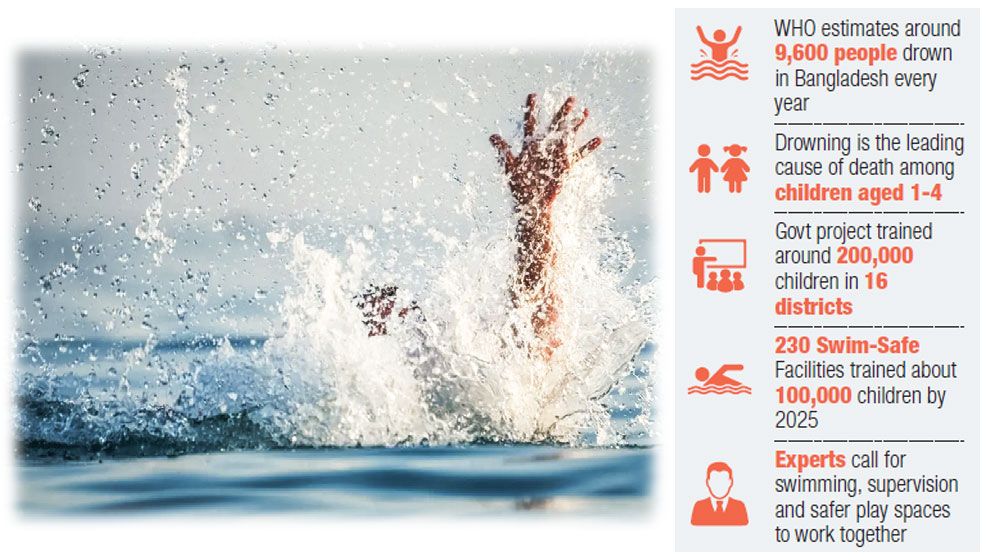
Swimming should be taught to children as an essential life-saving skill in Bangladesh, a country crisscrossed by rivers, ponds, canals and other water bodies, experts say, as drowning continues to claim thousands of lives every year.
According to the latest estimates from the World Health Organization (WHO), around 9,600 people die from drowning in Bangladesh annually, with drowning reportedly the leading cause of death among children aged 1-4.
Globally, more than 300,000 people die from drowning each year, with children under five accounting for nearly one in four such deaths.
The risk is particularly high in rural and low-income communities, where ponds, canals, ditches and other water bodies are often close to homes.
Among children under five, drowning incidents most commonly occur near the household, often within about 20 metres.
Experts stress that swimming education alone cannot prevent drowning. Active adult supervision, safer play areas, barriers around dangerous water bodies, community awareness and water-safety education are also essential.
For millions of Bangladeshi children, water is never far away. A pond may be beside a home, a canal may run through a village, or a child may encounter a water body on the way to school. During the monsoon, rising water levels can make familiar surroundings particularly hazardous.
A child who falls into water may have a better chance of survival if they know how to float, control their breathing, remain calm and move towards safety.
Child-safety advocates therefore argue that swimming should be treated as a survival skill rather than merely a recreational or competitive sport.
Age-appropriate programmes can teach children basic floating, safe movement in water, recognising dangerous situations, calling for help and reaching safety.
But even children who can swim may panic, become exhausted, suffer injuries or encounter currents and submerged vegetation. Swimming lessons must therefore complement, not replace, adult supervision.
For children under five, supervision remains the first line of defence. Young children can drown within minutes and may not make any sound. Parents and caregivers should never leave them unattended near ponds, canals, rivers, ditches, buckets, water-filled containers or other sources of water.
The Bangladesh Shishu Academy has already taken steps to expand swimming education through the government’s Integrated Community Based Center for Child Care, Protection and Swim-Safe Facilities (ICBC) project.
Implemented from January 2022 to December 2025, the project covered 16 districts and 45 upazilas, with an allocation of Tk272 crore to provide swimming training to around 200,000 children. The academy implemented the programme with support from NGOs, deploying swimming instructors and supervisors across the project areas.
Bangladesh Shishu Academy Director General Mst Arzu Ara Begum said teaching children to swim from an early age was essential to preventing drowning deaths.
“Swimming is not only a physical activity but also an important life skill that can help children survive in water-related accidents,” she said.
She said survival swimming should be prioritised over making children expert swimmers, enabling them to remain afloat for some time after accidentally falling into deep water.
“If a child can survive for some time after falling into water, someone may notice and rescue the child,” she said, adding that making swimming a priority in the national education system would be a matter for the education authorities.
NGOs have also played a role. Padakhep, which was involved in the ICBC initiative, operated 2,577 Child Care Centres serving around 80,000 children and 230 Swim-Safe Facilities where around 100,000 children completed swimming and water-safety training by the end of 2025. The training included drowning prevention, safe movement in water, rescue techniques and basic CPR awareness.
Experts believe schools could provide a major platform for expanding water-safety education. Where pools are unavailable, schools could teach children how to identify dangerous water, remain afloat, respond to emergencies and seek help. Where safe facilities exist, supervised practical lessons could be introduced, particularly in high-risk areas.
Children should also be taught never to jump into deep or unfamiliar water to rescue someone, as they could become a second victim. Instead, they should alert an adult, call for help and, where safe, throw or extend a floating object towards the person in danger.
Experts say Bangladesh needs a coordinated national approach combining swimming education with broader drowning-prevention measures, including safe play areas, barriers around high-risk water bodies, closer supervision, first-aid and CPR training, risk mapping, monsoon awareness campaigns and affordable swimming facilities.
Dr Muhammad Risalat Siddique, deputy executive director of Padakhep, said swimming should be considered an essential life skill for every child in Bangladesh.
“As a riverine country with immense Blue Economy potential, swimming should be considered an essential life skill for every child in Bangladesh – not only for safety and survival, but also as an important step towards building a confident, capable and resilient generation,” he said.