



 For all latest news, follow the Daily Sun's Google News channel.


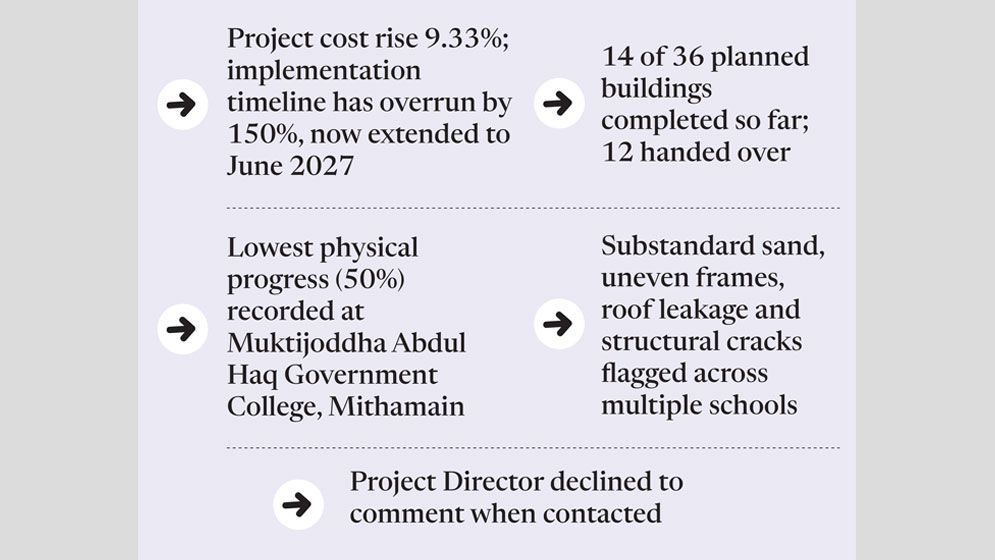
The Implementation Monitoring and Evaluation Division (IMED) has identified substandard construction, including uneven plaster, cracked walls and misaligned door and window frames, at several schools built under a government development project in the haor area of Kishoreganj district, alongside 14 unresolved audit objections involving Tk34.24 crore.
The “Development of Selected Educational Institutions in the Haor Area of Kishoreganj District (1st Revised)” project was approved by the Executive Committee of the National Economic Council on 16 January 2020.
Funded by the Government of Bangladesh, its revised estimated cost stands at Tk43,012.78 lakh, with an implementation period running from January 2020 to June 2027.
The project has undergone one revision and three time extensions, without any increase in cost beyond the original 9.33% revision, though the time overrun has reached 150%.
Core activities include land development at 14 institutions and construction of six five-storey, 200-bed dormitories; six five-storey, 100-bed dormitories; four six-storey multipurpose buildings; and 21 five-storey multipurpose buildings, along with furniture and ICT equipment for the new structures.
As of May 2026, cumulative financial progress stood at Tk25,754.38 lakh, or 59.88%, while physical progress reached 73.5%. Of 36 buildings under the project, 14 have been completed, of which 12 have been handed over.
Progress on the remaining buildings ranges between 50% and 98%, with the lowest recorded at Muktijoddha Abdul Haq Government College in Mithamain at around 50%, followed by the six-storey building at Austagram Rotary Club Government College and the girls’ hostel at Austagram Girls’ High School, both at 60%.
According to the IMED report, the fineness modulus of plaster sand used at the Muktijoddha Abdul Haque Government College building was found below the fixed standard of 1.5.
Uneven door and window frames and inconsistent plastering were recorded at Bairati and Kanchanpur High Schools, along with slight signs of leakage at roof corners and hairline cracks in the plaster. At Austagram Girls’ High School, an improper roof slope, uneven flooring tile joints and excessive gaps between bricks were found. Abdul Wadud High School in Austagram upazila showed uneven plastering, cracks in wall masonry and gaps above door and window lintels.
At Maheshchandra Government Model Shikkhaniketon School in Itna upazila, hairline cracks and peeling paint were found on the girls’ hostel’s internal partition wall, and low-quality wood was used for door frames, some of which already showed cracks.
Bricks used in ongoing wall masonry work at Mohantala High School were found below the desired standard.
Tk34 crore in audit objections unresolved for years
The audit identified 14 objections involving Tk34.24 crore across fiscal years 2020-21 to 2024-25.
In 2020-21, Tk60.14 lakh was paid for additional piles, casting work and MS rods beyond the approved design, and Tk0.37 lakh was paid for MS rods not due for payment.
In 2021-22, Tk117.97 lakh was paid for rods exceeding approved specifications. In 2022-23, Tk7.43 crore was paid for soil-quality testing conducted before the contract was signed. In 2023-24, Tk2.50 crore was paid despite the absence of a test report.
In 2024-25, Tk5.58 crore was spent on rods without the required bend-and-rebend test, while Tk33.39 lakh in government losses arose from non-realisation of delay penalties.
Further objections include Tk6.37 crore in excess payment, Tk0.90 lakh in VAT revenue loss on insurance premiums, Tk24.94 lakh in late-approved expenditure, Tk7.43 crore paid without extending the performance security period, Tk1.24 crore paid despite a fake test report, Tk0.33 lakh in unpaid soil royalty, and Tk1.31 crore spent beyond contract value under a revised estimate instead of a variation.
Md Shahjahan Ali, Superintending Engineer of the Education Engineering Department and Project Director (additional charge), declined to comment when contacted.
Read More