


 For all latest news, follow the Daily Sun's Google News channel.


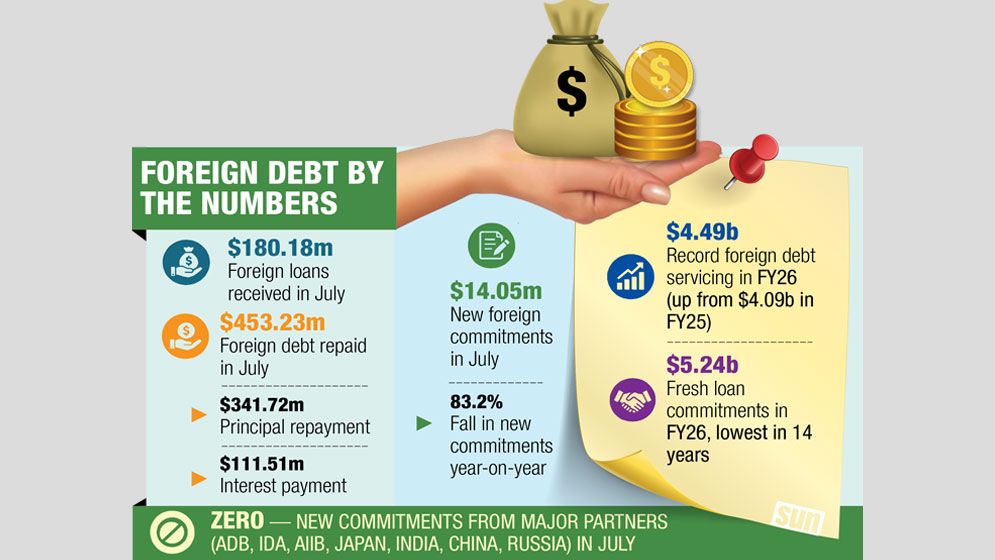
Bangladesh repaid foreign loans amounting to two-and-a-half times what it received in July, as new financing commitments collapsed at the start of the 2026-27 fiscal year, official data show.
According to the latest figures from the Economic Relations Division (ERD), Bangladesh received $180.18 million in foreign project loans and grants during the month, against $453.23 million paid out in principal and interest on existing external debt.
Of the amount repaid, $341.72 million was principal and $111.51 million was interest, taking the total debt-servicing bill to roughly Tk5,588 crore in local currency.
The gap between what came in and what went out points to a widening strain on Bangladesh’s external finances, with fresh commitments from lenders drying up even as repayments on older loans climb.
Bangladesh secured just $14.05 million in new foreign assistance commitments in July, all of it from smaller sources rather than the country’s principal development partners. The figure marks an 83.2 percent fall from the $83.46 million committed in July last year.
None of Bangladesh’s major partners – the Asian Development Bank (ADB), the World Bank’s International Development Association (IDA), the Asian Infrastructure Investment Bank (AIIB), Japan, India, China and Russia – signed any new commitments during the month, the ERD data showed.
Even so, disbursements continued to flow under agreements struck in earlier years. The ADB was the largest source of funds in July, disbursing $65.45 million, followed by the IDA with $47.53 million.
Japan provided $38.66 million and India $26.69 million, while other sources contributed $1.86 million, taking total ERD-recorded disbursement to about $180.19 million – broadly in line with the $180.18 million reported in the monthly assistance figures.
Overall loan disbursement also slipped compared with a year earlier, falling 13.4 percent from $208.04 million in July 2025. Debt servicing, by contrast, edged up 1.5 percent over the same period, from $446.68 million.
The July numbers follow a record $4.49 billion in foreign debt servicing for the full 2025-26 fiscal year, up from $4.09 billion the previous year. Principal repayments accounted for $2.95 billion of that total and interest for $1.54 billion.
Fresh loan commitments for FY26 fell to $5.24 billion, their lowest level in fourteen years. Bangladesh last secured a smaller sum in FY12, when commitments came to $4.76 billion.
Despite the decline in new pledges, the country still received $8.07 billion in foreign assistance over FY26 as a whole, comprising $7.52 billion in project loans and $553.95 million in grants.
Former Bangladesh Bank chief economist Dr Mustafa K Mujeri said the July figures largely reflect obligations on loans contracted in earlier years rather than a fresh financing crisis.
“The loans have to be repaid, including both principal and interest,” Mujeri told the Daily Sun, noting that such loans must be serviced on their agreed terms regardless of current inflows.
He said the repayment burden is likely to grow further in the coming years as more foreign-funded projects move past their grace periods and into active repayment, requiring the government to keep sufficient foreign exchange on hand to meet its obligations.
Bangladesh, he added, needs to take a cautious approach to new external borrowing and ensure loans go towards projects capable of generating economic returns, foreign exchange earnings or savings.
Mujeri linked July’s weak commitment figures partly to the new government’s ongoing negotiations with development partners and international financial institutions.
Incoming administrations typically need time to negotiate project financing and budget support with lenders, he said, and differences over terms and conditions can delay new agreements.
He expects commitments to pick up as those negotiations progress.
The ADB, IDA, Japan and India together accounted for nearly all disbursements from major partners in July, underlining Bangladesh’s continued reliance on a small circle of lenders even as new commitments stall.
Mujeri called for stronger project appraisal and implementation to ensure borrowed funds generate adequate economic benefit, along with tighter control over project costs and more efficient use of external financing going forward.