



 For all latest news, follow the Daily Sun's Google News channel.


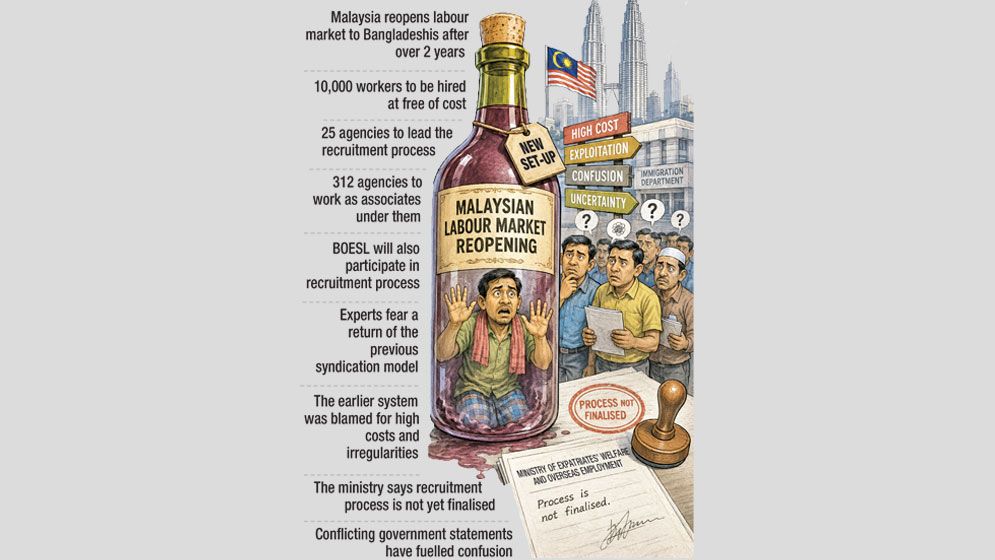
Malaysia’s reopening of its labour market to Bangladeshi workers has revived fears that the country’s recruitment system is heading back to the syndication model blamed for excessive migration costs, corruption and worker exploitation, as 25 agencies are set to control recruitment with 312 others working under them, while the government is yet to finalise the process.
New recruitment is expected to continue through the Foreign Worker Centralised Management System (FWCMS), controlled by a Malaysian businessman of Bangladeshi origin.
The initial process will involve state-owned Bangladesh Overseas Employment and Services Ltd (BOESL) and 25 recruiting agencies selected by Malaysian authorities, while 312 other agencies will operate as associates under them.
A similar recruitment arrangement was in place when Malaysia last opened its labour market to Bangladeshis.
The system was eventually blamed for syndication, irregularities, corruption and bribery, contributing to the closure of the market on 31 May 2024. “What happened in the past is happening again with Malaysia’s labour market. They are determining the terms from the Malaysian side. Workers are going to be recruited under the old bilateral memorandum of understanding and Bangladesh is fully accepting the conditions set by Malaysia. You cannot expect a different result after doing the same mistake,” migration expert Asif Munier told the Daily Sun.
“The influential players who have always pulled the strings from behind the scenes in this labour market remain in place. Their influence is clearly visible in the Malaysian labour market. We are seeing nothing new here; only some faces are changing under different agency names,” he added.
New label, old system?
When the Malaysian labour market was last open, Malaysia allowed 25 recruiting agencies to control the recruitment process, although around 1,400 recruiting agencies were registered under the system.
The FWCMS published a list of 25 agencies on 21 August. Recruiting agency owners who could not confirm their inclusion subsequently described the arrangement as a “syndicate”.
Later, on 27 August, 250 agencies were designated as “associate recruitment agencies”, with 10 agencies operating under each of the 25 lead agencies. Another 62 agencies were identified as associates of the government-run BOESL.
This brought the number of associate agencies to 312, with 338 agencies in total involved in the structure alongside BOESL.
The Ministry of Expatriates’ Welfare and Overseas Employment, however, said the process for reopening the labour market had not yet been finalised.
In a press release, the ministry urged people to refrain from making financial transactions, undergoing medical tests or submitting passports until an official notice or directive is issued.
Fakhrul Islam, former joint secretary general of the Bangladesh Association of International Recruiting Agencies (BAIRA), questioned how the new arrangement would work.
“Will these 338 agencies be able to operate directly? In the past, nearly 1,400 agencies were registered with FWCMS, but only 10 agencies initially, followed by 25 and later 100 agencies, were allowed to send workers directly. It is not clear what role the 10 agencies operating under each of the 25 agencies will play this time,” he told the Daily Sun.
“The 25 agencies will retain overall control, while the others will work under them as sub-agents. This is similar to what happened in the past, when around 600–700 other agencies operated under the 10-, 25- and 100-agency syndicates. This time, however, the number has been reduced to 338,” he added. The former BAIRA leader said the arrangement was essentially an attempt to present the old system under a new structure.
Confusion over recruitment
Uncertainty over the mechanism has been compounded by conflicting statements from government officials.
After the FWCMS published the list of 338 agencies alongside BOESL and the 25 lead agencies, the Ministry of Expatriates’ Welfare and Overseas Employment described the development on Friday as a “historic achievement”.
Yet the ministry has not issued detailed instructions on how recruitment will actually be conducted.
The Daily Sun repeatedly contacted the minister and secretary for comments, but neither responded. The minister also avoided answering questions about the issue during a briefing at Hazrat Shahjalal International Airport on Thursday after receiving the bodies of Bangladeshi nationals repatriated from Saudi Arabia.
The minister left Dhaka for the United States on Friday night to attend the 40th FOBANA Convention in Los Angeles, California.
Meanwhile, State Minister for Local Government Mir Shahe Alam said on Sunday that Malaysia would begin recruiting Bangladeshi workers from September and planned to take 200,000 workers within six months.
“They will hire about 200,000 workers. Of them, they will hire 10,000 workers free of cost,” he told reporters after a courtesy meeting with Malaysian Ambassador Mohd Shuhada Othman at the Secretariat.
Recruiting agencies listed on the FWCMS, however, said they were unaware of the details.
“So far, we have not received any instructions regarding sending workers. When we contacted the ministry, they too could not provide us with any information,” said Abdus Salam, proprietor of Bangladesh One Overseas Limited.
A senior official of the Bangladesh High Commission in Kuala Lumpur, speaking on condition of anonymity, told the Daily Sun that the state minister’s remarks about the Malaysian labour market were misleading.
Fears of higher costs
Ovibashi Karmi Unnayan Program (OKUP) Chairperson Shakirul Islam accused the government of presenting the reopening as an achievement while providing contradictory information about the process.
“First, the minister announced in Sylhet that the market is going to be reopened. Then the ministry issued an official notification urging aspiring migrant workers and recruiting agencies not to make any financial transactions until the government formally announces,” he said. Calling the 25 lead agencies an “integrated part” of the FWCMS, Shakirul said adding 312 more agencies could amount to an extension of the previous syndication system.
“This is the second layer of the syndicate. These 312 agencies will definitely ensure their interests first and then facilitate the 25 agencies. This will increase migration costs further, paving the way for irregularities, corruption and opacity,” he added.