


 For all latest news, follow the Daily Sun's Google News channel.


When Bedana Akhter joined UBF Bridal Ltd at the Adamjee Export Processing Zone three and a half years ago, a wedding gown was a complete enigma.
Coming from a conventional garment factory, she entered a world that demanded an entirely different level of craft: delicate fabrics, intricate stitching, and painstaking detail.
“At first, everything seemed overwhelming – I had no idea where to start,” Bedana recalled. “My supervisors walked me through it step by step, teaching me how to inspect the garments, attach tags, and manage the complex finishing processes. Today, I feel completely in my element.”
Bedana is now part of a specialised workforce crafting high-end bridal and evening wear for international runways.
Her personal evolution mirrors a quiet revolution within Bangladesh’s apparel sector: line workers once trained strictly for low-margin mass production are stepping up to master the complex, design-intensive techniques required for high-value fashion.
Building skills from scratch
UBF Bridal, a German-invested company, began operations under the Bangladesh Export Processing Zones Authority (BEPZA) in 2022 after starting construction of its factory in 2020.
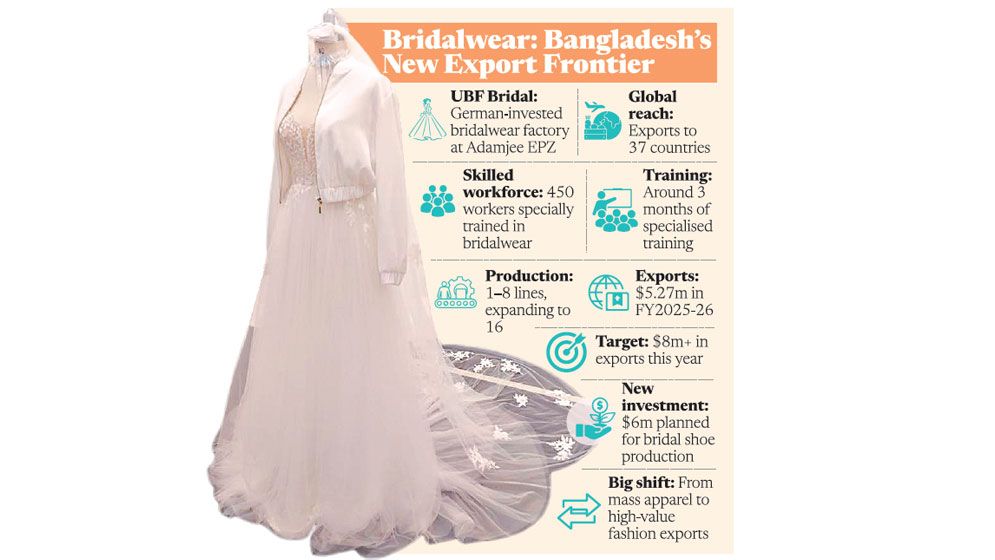
The company produces wedding dresses, evening dresses, wedding suits, veils, boleros, jackets, petticoats and bridal accessories. Its products are shipped to Germany and distributed through the group’s central warehouse in Berlin to around 37 countries.
But establishing the operation was not straightforward.
Bridalwear requires workers to handle delicate materials such as organza and soft lining, along with intricate lace, embroidery and decorative elements.
“There were many challenges at the beginning because we could not find workers with experience in this type of product,” said Md Robiul Hoque Siddiki, chief operating officer of UBF Bridal.
The shortage of specialised skills extended to management. The company trained managers for around six months with support from its global production team, using video conferences, visiting specialists and overseas production managers to transfer expertise.
Workers recruited from conventional garment factories were then trained in bridalwear-specific techniques.
The investment in skills has gradually improved productivity. Factory efficiency has risen from around 30% initially to about 60%, with management targeting 80%.
The factory started with one production line and has expanded to eight. The company plans further expansion, potentially reaching 16 lines, with around 23 operators on each line.
“We recruit gradually, train them and then increase the number of production lines,” Siddiki said. “That allows us to build the skills we need.”
From conventional garments to bridalwear
New recruits generally receive around three months of training before being assigned to specific production processes.
Rather than seeking workers with previous bridalwear experience, the company recruits operators who already know conventional machines such as overlock and single-needle machines. They are then trained to apply those skills to delicate bridal garments.
“The difference between my previous job and this factory is huge,” Bedana said. “When I started here, I did not understand these things. My seniors taught me step by step. Now I can do the work much better.”
For Bangladesh’s apparel industry, the model is significant. Conventional garment production often prioritises speed, volume and repetition, while bridalwear requires precision, craftsmanship and close attention to detail.
The company is therefore building a specialised workforce largely from existing garment workers rather than relying on a completely new labour pool.
From Adamjee to global markets
UBF Bridal’s growth is also reflected in its export performance.
According to BEPZA data, the factory had around US$3.66 million in actual investment and 357 local employees as of July 2026. It exported products worth $5.27 million in the 2025-26 financial year.
Company officials said the workforce has since grown to around 450.
Siddiki said Bangladesh initially supplied around 20% of the group’s total demand. That share has now risen to about 40%.
The group also has production facilities in Poland and the United States, but Bangladesh is emerging as its main destination for future expansion.
“Poland and the United States are much more expensive in terms of labour costs,” Siddiki said. “Our plan is to gradually shift more production to Bangladesh.”
That could bring additional investment, employment and specialised manufacturing capabilities to the country.
Building a local supply chain
UBF Bridal is also trying to localise more of its supply chain.
The factory currently imports some specialised lace, including from Myanmar. It has, however, begun developing its own embroidery section and plans to manufacture more components locally.
“Our chairman’s plan is to make each and every component ourselves, including the smallest components, and then convert them into the final product,” Siddiki said.
The company is also planning a bridal shoe manufacturing facility at Adamjee EPZ, involving an additional investment of around $6 million and an initial workforce of about 45 people.
The plan could gradually transform the operation from a garment factory into a more integrated bridalwear manufacturing hub covering both garments and accessories.
Higher-value products
Bridalwear remains a relatively small segment compared with Bangladesh’s vast conventional apparel industry. But it offers access to a higher-value market.
According to company officials, UBF Bridal’s products can sell internationally for around $400 to $500, with some high-end pieces exceeding $1,000.
The average value of products manufactured in Bangladesh currently ranges from around $120 to $178, depending on the product.
The opportunity, therefore, is not simply to produce more garments, but to produce garments with greater value.
For Bangladesh, which has long relied heavily on high-volume ready-made garment exports, moving into specialised and design-intensive products could help diversify the apparel sector and strengthen its position further up the value chain.
Why Adamjee matters
Adamjee Export Processing Zone in Narayanganj was established in 2006 on the former site of Adamjee Jute Mills.
The 292.62-acre zone has since developed into a major export-oriented industrial hub. According to BEPZA, it employs more than 76,000 people, has attracted around $847 million in investment and generated more than $11 billion in cumulative exports.
UBF Bridal adds a specialised product to that industrial base.
The company also says it benefits from relatively reliable utility services inside the EPZ. Its production does not depend on gas because its boilers are electrically powered, helping shield the factory from some of the gas shortages affecting industries elsewhere.
The human side of diversification
For Bedana, however, the transformation is less about investment figures and more about learning a new trade.
She arrived with experience in conventional garment production but without the skills needed to make bridalwear. Through training and years of practice, she has acquired expertise in a specialised field.
“At first it was very difficult,” she said. “Now, Alhamdulillah, things are much better. My supervisors and managers have taught us and given us opportunities. We are doing well.”
Her experience illustrates a crucial but often overlooked part of industrial diversification: investment does not automatically create skilled workers.
Companies entering new manufacturing segments often have to build that expertise themselves through training, technology transfer and gradual expansion.
That is the story unfolding at Adamjee.
UBF Bridal arrived in Bangladesh with a specialised product, found that the necessary skills were scarce and began building its workforce from the ground up.
The factory has grown from one production line to eight, with plans for further expansion.
For Bangladesh’s apparel industry, the significance lies not only in the wedding gowns being shipped to customers around the world, but also in the skills being developed on the factory floor.
Bridalwear may be a niche today. But the ability to make intricate, design-intensive and higher-value products could become an important part of Bangladesh’s next chapter in manufacturing.