


 For all latest news, follow the Daily Sun's Google News channel.


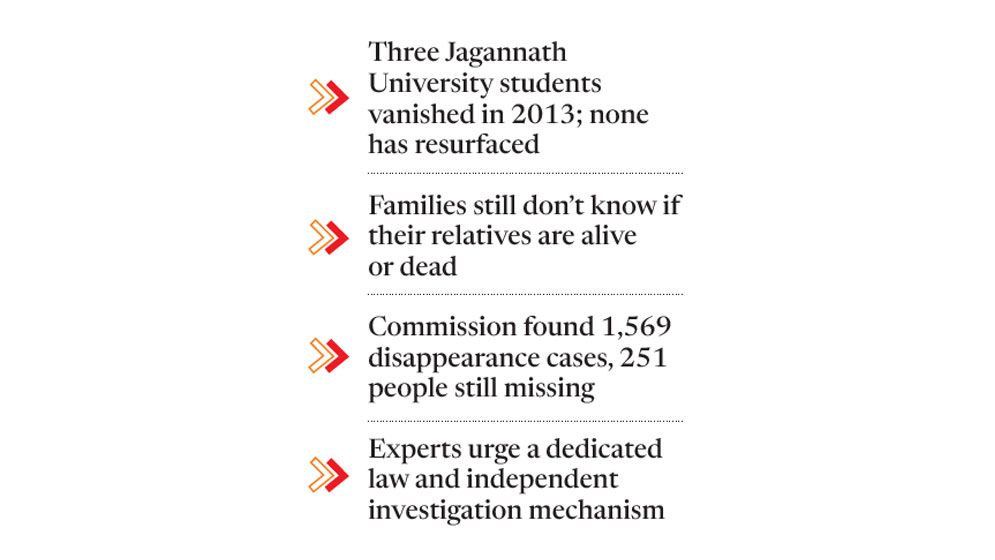
Thirteen years after three Jagannath University students vanished without a trace, their families say they still cannot mourn properly – because they do not know whether their loved ones are alive or dead.
Asaduzzaman Rana, Mazharul Islam Rasel and Al Amin, all students from the 2005-2006 academic session and activists of Jatiyatabadi Chhatra Dal, were picked up by a group of plainclothes men on 4 December 2013 from an area under Vatara police station. None of them has been seen since.
“When a person dies, they are buried, and you know where they are. But in his case, we cannot even pray properly. We cannot even find out what to pray for because we do not know whether he is dead or alive,” Minara Begum, Rana’s elder sister, told the Daily Sun by phone on Saturday.
Rana had been living at Minara’s residence in Mugda while studying philosophy at Jagannath University. He left home to meet three friends on the day he disappeared and never returned.
“Rana used to live at my house. That is why his disappearance hurts me the most,” Minara said.
She added that she visited numerous places in search of her brother in the aftermath, while her husband, a police officer, was left tormented that he could not help locate him. He died two years after Rana went missing.
The family later learnt of Rana’s involvement with Jatiyatabadi Chhatra Dal, though they say they were unaware of it before he disappeared, and believe he was forcibly disappeared over his political affiliation.
Minara said she had hoped her brother would return following the 2024 uprising, along with others who resurfaced, but that hope has not been realised.
“These days, we are invited to different programmes and sometimes honoured. That is all. Somehow, our family is carrying on. But the absence of my brother remains,” she said.
Two more families, the same question
Al Amin’s younger brother, Ruhul Amin, said the family was still searching for basic answers. “We are still living just to know what they did with my brother. If he was killed, where is his grave? For what reason was he picked up, and who did this?” he asked, noting that Al Amin had disappeared shortly after sitting the civil service examination.
Rasel’s sister, Nusrat Laboni, said the family’s situation was unchanged since 2013.
“Earlier, I demanded my brother’s safe return. Now, even if, God forbid, he is no longer alive, I want to know what happened to him and where his body was taken. Whether he was buried in the Buriganga, the Shitalakhya, or somewhere else, we at least deserve an answer,” she said, adding that her mother’s health had deteriorated under the strain.
“My mother started dreaming after the 2024 uprising, as she hoped that, like others, Rasel would also come back. But that dream was also buried.”
Scale of the crisis
The three students are among thousands of documented cases. The final report of the Commission of Inquiry on Enforced Disappearances in Bangladesh identified 1,569 cases during the over-15-year fascist Awami League rule, of which 251 people remain missing.
Legal experts call for safeguards
Legal experts and rights activists say a robust legal framework and independent investigations are needed to prevent enforced disappearances recurring.
Ain o Salish Kendra has said legislation alone will not be sufficient – independent and impartial investigations into every allegation, sustained efforts to locate missing persons, and the right of victims’ families to know the truth are equally essential.
Supreme Court lawyer Manzill Murshed said numerous allegations of enforced disappearance and killing in Bangladesh had since been substantiated, though disputes remain over the exact number of victims.
He noted that allegations against law enforcement agencies had fallen markedly since 5 August, but said the principal challenge now was to enact dedicated legislation against enforced disappearance, backed by an independent and impartial investigation mechanism – a step he described as one Bangladesh should take on this International Day of the Victims of Enforced Disappearances.