



 For all latest news, follow the Daily Sun's Google News channel.


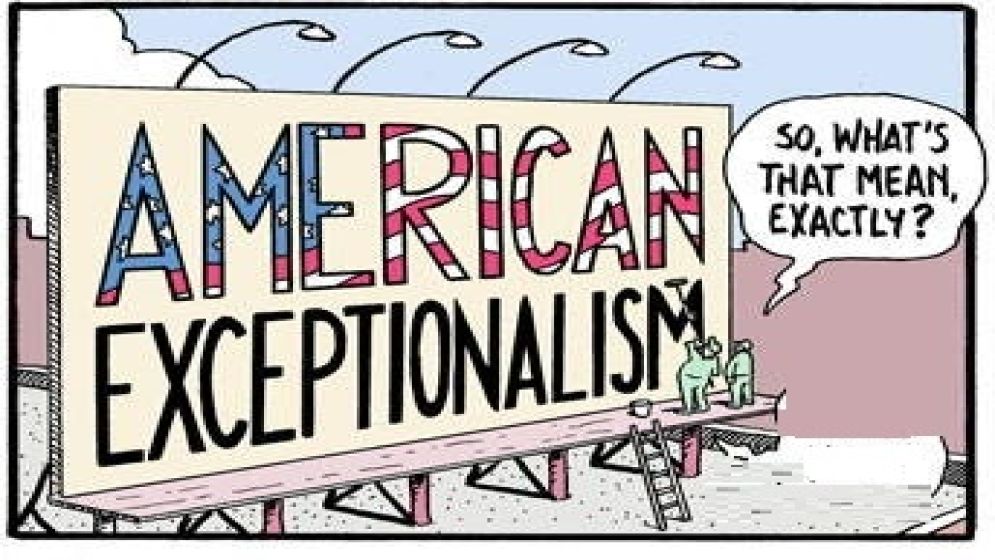
Illustration: Cagle
What gives America the right to exempt itself from the rules it insists the rest of the world must follow? This is a more fundamental question than whether “the United States has chosen the right policy towards Israel, Iran, Russia, China or any other foreign adversary”, which people around the globe have long raised and Americans have now begun asking.
For generations, Americans have been taught to understand their country as exceptional. Yet the impulse to regard one’s nation as distinctive is hardly unique to the US. A nation may reasonably claim exceptionalism because of the principles it embraces, the institutions it builds, the freedoms it protects, or the responsibilities it accepts. But there is another, more troubling version of exceptionalism: America’s actions must be judged by a different standard simply because America is America. Is that version morally defensible?
The most generous interpretation of American exceptionalism is also the most defensible: America is exceptional because, on paper, it aspires to universal principles: human dignity, individual liberty, equality before the law, self-determination, opposition to aggression, assistance to other nations facing catastrophic natural or human-made disasters, and accountability for atrocities.
Those principles cannot be genuinely universal if they apply only when America’s adversaries violate them. Washington has spent decades constructing and defending what it calls a rules-based international order. It invokes international law against aggressors and hostile governments, demands accountability for war crimes and imposes sanctions on governments accused of violating human rights.
Yet when those same principles threaten an American ally, or American interests, the language changes. Suddenly there are questions about jurisdiction, sovereignty, legitimacy and whether international institutions have overreached. Such questions can be legitimate. But when raised selectively, they become intellectually incoherent. If a rule is valid only when it constrains America’s enemies, it is not a rule. It is an instrument of geopoliticonomic power.
Nothing has exposed this contradiction more dramatically than Gaza. The US can condemn Hamas’s atrocities, support Israel’s security, oppose antisemitism and insist upon Palestinian rights simultaneously. There is no contradiction in doing so. The contradiction arises when America’s commitment to universal standards becomes conditional upon whom those standards threaten.
In June, the United Nations’ Independent International Commission of Inquiry said that Israeli authorities and security forces had deliberately targeted Palestinian children in ways amounting to genocide, crimes against humanity and war crimes. Israel rejects the allegations. The appropriate response to allegations of such gravity should be investigation, evidence and accountability, not a predetermined verdict. If the allegations are false, credible investigation should establish that. If they are true, the world should know. If the evidence is contested, investigate further. Yet Washington’s increasingly aggressive opposition to international institutions investigating Israeli conduct has created a different impression.
On 18 August, the US sanctioned International Criminal Court President Tomoko Akane and senior trial lawyer Abdoulaye Seye. Washington says that the ICC has exceeded its jurisdiction and threatens American sovereignty. The ICC says sanctions are an attack on its independence. The United Nations has expressed serious concern, while other governments, including Japan and the Netherlands, have defended the court.
Washington does have legitimate grounds for questioning ICC jurisdiction over Americans. The US is not a party to the Rome Statute, and successive administrations have objected to the court asserting authority over American personnel. That argument can be made in good faith. But America also expects other countries to accept international rules governing war crimes, aggression and crimes against humanity.
So, what happens when an international institution investigates an American ally? If the institution suddenly becomes illegitimate, politically motivated or dangerously overreaching, the world is entitled to ask whether Washington would make the same argument if the defendant were an adversary. If not, the objection is no longer simply about jurisdiction. It becomes a question of whose conduct America is willing to subject to scrutiny.
Russia violates international law. China abuses human rights. Iran supports armed groups. Hamas commits atrocities. All these criticisms can be valid. But none provides an exemption for America or its allies. Someone else’s hypocrisy does not make our own hypocrisy principled.
If Russia violates international law, condemn Russia. If China violates human rights, condemn China. If Iran violates international law, condemn Iran. If Hamas murders civilians, condemn Hamas. And if an American ally violates international law, apply the same standard. That is not moral equivalence. It is moral consistency.
This is not merely an ethical question. It is also a question of power. Great powers rarely sustain influence through military force alone. They also depend upon legitimacy, persuasion and the willingness of other countries to believe that the rules being defended are rules rather than instruments selectively deployed against adversaries.
When that belief weakens, the geopoliticonomic cost accumulates. Coalitions become harder to build. Diplomatic pressure becomes less persuasive. Governments that might otherwise align with Washington become more willing to hedge between competing powers. Even legitimate American criticisms of adversaries become easier to dismiss because the credibility of the messenger has deteriorated.
America is extraordinarily powerful. But power does not establish moral correctness. A nuclear arsenal does not make a bombing campaign lawful. Economic dominance does not make a sanction just. Military superiority does not make civilian suffering irrelevant. Political influence does not make international investigation illegitimate.
The temptation of great powers throughout history has been to confuse the ability to impose a judgment with the authority to make that judgment. America’s extraordinary power makes resisting that temptation more important, not less.
Indeed, the stronger a country becomes, the more consequential its exceptions become. Smaller states can violate principles and damage individual victims or neighbouring countries. A superpower can weaken the legitimacy of the very international order it helped construct. When Washington appears to insist that rules constrain everyone except itself and selected allies, the damage extends beyond a single war or investigation. It erodes confidence in the universality of the system.
That is the paradox at the heart of American exceptionalism. If exceptionalism means adherence to a higher standard, it can strengthen American leadership. If it means exemption from standards imposed upon others, it ultimately weakens that leadership.
The more powerful a nation becomes, the greater its responsibility to demonstrate that its principles constrain its own conduct. Otherwise, American exceptionalism becomes little more than American exemption. And once exceptionalism becomes exemption, principle has already become privilege.
The writer is a former physicist and nuclear engineer at the BAEC and Professor Emeritus of Economics at Eastern Michigan University, USA. He can be reached at ([email protected])