


 For all latest news, follow the Daily Sun's Google News channel.


Bangladesh to launch $2b fund in Hong Kong
Equity-based fund aimed at diversifying financing, reviving capital market and reducing bank borrowing
Daily Sun Report, Dhaka
Published: 23 Aug 2026, 12:00 AM
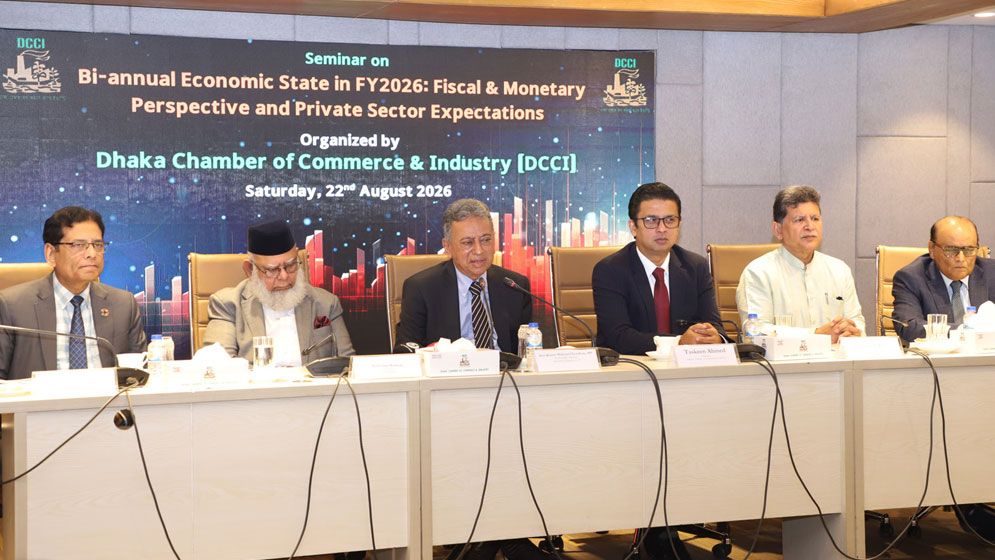
Bangladesh will launch a US$2 billion dedicated equity fund in Hong Kong to diversify financing sources, revive its stock market, and ease reliance on domestic borrowing, Finance and Planning Minister Amir Khosru Mahmud Chowdhury announced Saturday.
Speaking as chief guest at a Dhaka Chamber of Commerce and Industry (DCCI) seminar on the fiscal year 2026 economic outlook, Khosru stressed that the fund is strictly equity, creating no national debt obligations.
“We are going to have a dedicated fund for Bangladesh in Hong Kong... This is equity and not a loan,” Khosru said, adding that global fund managers are showing strong interest as market reforms take hold.
Khosru said the initiative would create an alternative channel for mobilising international capital at a time when the government is seeking to reduce pressure on domestic financing sources.
He said Bangladesh has been exploring alternative financing as the capital market remained weak for a considerable period and access to financing for the private sector needed to be strengthened.
“As there was virtually no functioning capital market in Bangladesh for quite some time, we are trying to revive it as one of the alternative sources of financing,” he said.
The minister said significant changes had already been made to the capital market’s regulatory framework, particularly through the appointment of new leadership at the Bangladesh Securities and Exchange Commission (BSEC).
He said a chairman and four commissioners had been appointed to the BSEC through a transparent selection process.
Khosru said the government was already seeing the impact of the reforms, with the capital market gradually recovering and investor confidence returning.
“I won’t say that the capital market has recovered completely, but confidence is coming back. The market is gaining ground and moving upward,” he said.
He stressed that restoring investor confidence alone would not be enough. Companies seeking to raise capital through stock market listings must also have confidence in the market.
“Good companies will come for listing only when they have confidence in the market,” he said.
The minister criticised the previous state of the capital market, saying it had effectively turned into a “casino” where ordinary investors could lose while a section of market players benefited.
“The capital market had become like a casino. At the end of the day, when you play in a casino, the casino owner makes the profit,” he said.
He said the government was now seeking to change that culture by ensuring greater transparency, professionalism and institutional governance.
Khosru said the reforms were also attracting the attention of international fund managers.
“We are seeing global fund managers coming forward. That is very good,” he said.
He said the proposed $2 billion Hong Kong fund was among the initiatives being pursued to channel international equity capital into Bangladesh.
He clarified that the fund would not create a debt obligation for the government or the country because it would be structured as equity rather than a loan.
The finance minister said the government was also considering other instruments to diversify Bangladesh’s sources of foreign financing.
“We want to go for dollar bonds. We will go for panda bonds and samurai bonds,” he said.
According to Khosru, such instruments would allow Bangladesh to tap different international capital markets rather than rely excessively on domestic banks and other traditional sources of financing.
He said the government was particularly focused on reducing its dependence on domestic financing so that private businesses could gain greater access to credit and investment resources.
“We are trying to reduce borrowing from the private sector through alternative financing,” he said.
Khosru said the government had already taken steps to reduce bank borrowing to some extent, although shifting towards alternative financing would take time.
“We have already brought down bank borrowing somewhat. But the process will take time. We are moving in that direction,” he said.
He said the government would continue pursuing alternative financing mechanisms to create greater space for private-sector investment.
On taxation, the finance minister said the government’s objective was not to increase the tax burden on existing taxpayers but to expand the country’s tax base.
“When we talk about increasing taxes, we are not talking about increasing taxes on those who are already paying. We are trying to expand the network,” he said.
He said a broader tax base was essential for increasing government revenue sustainably and stressed the importance of automation in tax administration.
Reducing physical contact between taxpayers and tax officials, he said, would improve transparency and reduce opportunities for corruption.
He said a revitalised capital market, international equity funds, diversified bond financing and a broader tax base would help Bangladesh build a more sustainable financing structure and support private-sector-led economic growth.
DCCI proposals
In view of the ongoing energy crisis, DCCI President Taskeen Ahmed proposed introducing low-interest financing facilities to help small and marginal farmers invest in solar-powered irrigation systems.
The chamber also proposed reviewing power purchase agreements to reduce unnecessary subsidy burdens while ensuring stable and affordable electricity prices for consumers in the long term.
To address the multidimensional challenges facing industries, the DCCI proposed increasing cash flow through digital scoring instead of conventional collateral-based lending, along with establishing special funds for affordable machinery and equipment.
Prof Mustafizur Rahman, distinguished fellow of the Centre for Policy Dialogue (CPD), stressed the urgent need to reform monetary policy to address the current economic situation.
He also expressed concern that taxes paid by people were not being fully deposited into the government treasury. He advised the government to exercise greater caution in obtaining foreign loans and repaying existing debt.