


 For all latest news, follow the Daily Sun's Google News channel.


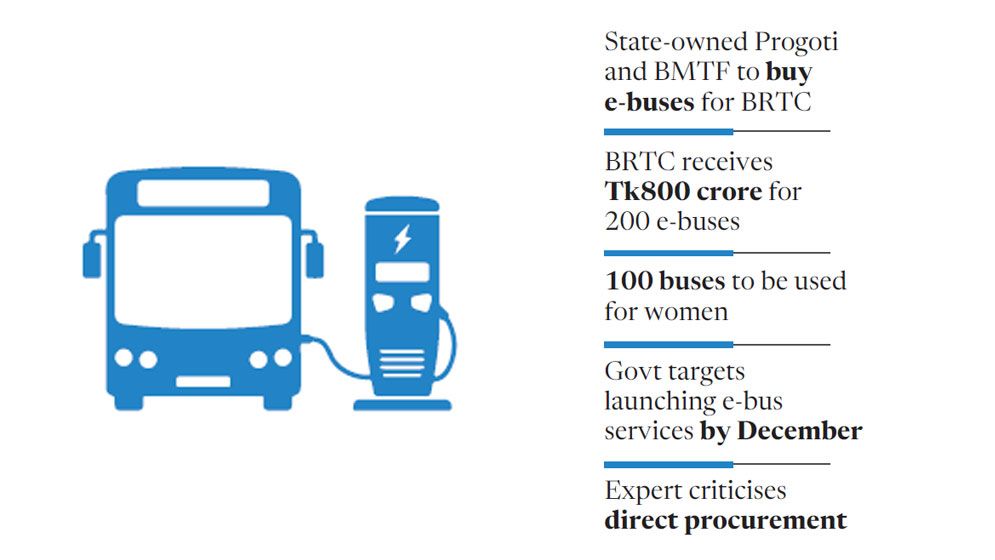
Bangladesh Road Transport Corporation (BRTC) is procuring 100 electric buses from two state-owned companies – Progoti Industries Ltd and Bangladesh Machine Tools Factory (BMTF) – through direct procurement instead of open tendering.
Sources within the corporation said Progoti and BMTF have been verbally asked to procure 50 buses each, which may be imported from China.
When contacted, a top official at Progoti confirmed that the company had received a verbal order to procure 50 electric buses.
“As we do not manufacture [electric buses], we sought price quotations from local suppliers and received responses from 14-15 companies,” said the official, adding that BMTF has also forwarded its requirement for 50 buses to Progoti.
“We are yet to decide on the proposals offered by the supplying companies,” the official added.
To learn about the procurement process, this correspondent initially visited the BRTC office in the capital last Wednesday, but none of the corporation’s Director (Technical) Colonel Kazi Ayub Ali, General Manager (Technical) Major Nusrat Shahnaz and Deputy General Manager (Planning) Md Abu Bakar Siddique agreed to comment.
Public procurement researcher Mohammad Tauhidul Islam, also a director at Transparency International Bangladesh, voiced concern over the procurement method.
He said a product manufactured by a government entity can be purchased by another government entity under the direct procurement method.
“Progoti and BMTF are government entities, but they do not manufacture electric vehicles. They will purchase the buses from another supplier and make a profit from the contract. If the BRTC could handle the contract itself, public money could be saved,” said Tauhidul.
Talking to the Daily Sun over the phone, BRTC Chairman Abdul Latif Mollah said on Thursday that they have received Tk800 crore at 1% interest from the Finance Division for 200 buses and decided to purchase 100 buses in the first phase.
Of the 200 buses, 100 will be used for women, the BRTC chairman added.
Regarding the procurement method, the BRTC chairman said they had no choice as the Cabinet Committee on Economic Affairs had fixed Progoti and BMTF as suppliers of the buses, which are being introduced as part of the government’s electoral commitment.
Additionally, he said opening an international tender would take time.
“We are all working unofficially to expedite the purchase and installation process,” he said.
Regarding the BRTC chairman’s justification, Tauhidul said, “The DPM is followed when there is an emergency or disaster, when services or goods are needed to save lives and protect the public interest, but a bus is not such a product. There is no natural disaster; fulfilling a political promise is not a case for which the DPM could be followed. The speedy implementation is not justified.”
BRTC Chairman Latif said several companies had approached him with proposals, but the government wanted the procurement to be completed quickly because it had set a target of launching electric bus services by December.
He said the BRTC will procure 9- and 12-metre-long buses, with the latter having a capacity of 80 passengers and being popular for its standing facility.
He added that they are still working on the technical specifications of the buses and the terms of the contracts, which will be finalised within five to seven days.
Apart from the buses, Latif said the BRTC is targeting setting up at least five charging stations at five existing depots, including one in Gazipur. The number will gradually be increased, he added.
He said the corporation will also need to provide training to bus staff, as electric buses are a new concept in Bangladesh.