



 For all latest news, follow the Daily Sun's Google News channel.


Bangladesh remains heavily dependent on imported vegetable oils to meet domestic demand, leaving the country’s edible oil market exposed to changes in global production, prices, trade policies and consumption trends.
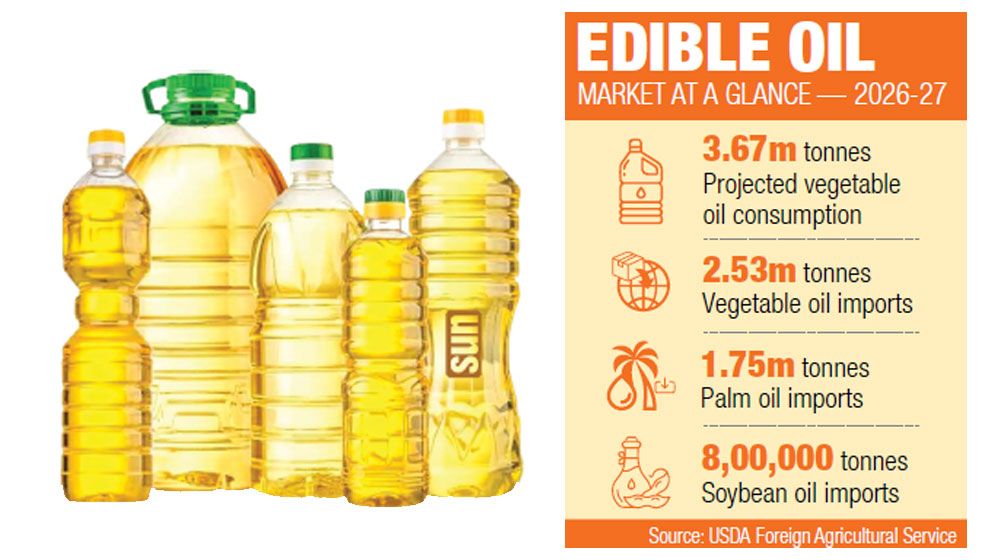
The latest US Department of Agriculture (USDA) Foreign Agricultural Service report projects Bangladesh’s vegetable oil imports at 2.53 million tonnes in 2026-27, slightly below the 2.55 million tonnes estimated for 2025-26 but higher than the 2.30 million tonnes recorded in 2024-25.
At the same time, domestic consumption of vegetable oils is projected to rise to 3.67 million tonnes in 2026-27, up from 3.53 million tonnes in 2025-26.
The figures highlight Bangladesh’s vulnerability as demand for edible oil continues to grow while the country remains reliant on international markets for a large share of its supply.
Palm oil continues to dominate Bangladesh’s import basket
According to the USDA, Bangladesh is expected to import 1.75 million tonnes of palm oil in 2026-27, unchanged from 2025-26.
Domestic palm oil consumption is projected at around 1.72 million tonnes, broadly unchanged from the previous year.
Bangladesh was the world’s fifth-largest palm oil importer among the countries listed in the USDA table for 2026-27, behind India, China, Pakistan and the European Union.
The country’s dependence on palm oil is particularly significant because global supply is concentrated among a handful of producers.
Indonesia is forecast to produce 47.5 million tonnes of palm oil in 2026-27, while Malaysia is projected to produce 19.6 million tonnes. Together, the two countries account for the overwhelming majority of global production.
Indonesia is also consuming more of its own production. Its domestic palm oil consumption is projected to rise to 23.825 million tonnes in 2026-27, while its exports are forecast to fall to 23.7 million tonnes from 24.15 million tonnes in 2025-26. The USDA attributes the lower export forecast to higher domestic use.
For an import-dependent country such as Bangladesh, any reduction in exportable supplies from major producers can have implications for international prices and, ultimately, the domestic market.
Agro-economist Dr Jahangir Alam told the Daily Sun that dependence on imports is highly detrimental to Bangladesh, while concerns also remain over the quality of imported edible oils and their potential health risks.
“Bangladesh should now place greater emphasis on producing its own edible oil, particularly mustard oil. Over the past few years, efforts have been made to increase the area under mustard cultivation and boost production, and projects have also been undertaken for this purpose. If we can produce at least 50 per cent of our requirement through mustard and other oilseeds, while also making progress in soybean and other oilseed production, we can meet around half of our edible oil demand domestically. This would reduce our dependence on imports and help reduce the wastage of foreign currency,” he said.
“In such a situation, special projects should be undertaken to increase domestic oilseed production, and investment should be made in this sector. Farmers should be encouraged and, if necessary, provided with subsidies so that they allocate a portion of their land to oilseed cultivation. To encourage farmers to produce oilseeds and ensure that they receive a fair price, the government should announce a support price in advance,” the economist said.
“Excessive dependence on imports means uncertainty and, in such a situation, importers and traders can sometimes exploit the market through oligopolistic practices and excessive profit-taking. As a result, ordinary consumers suffer,” he said.
Soybean oil demand rises
Soybean oil is another major component of Bangladesh’s edible oil market.
The USDA forecasts Bangladesh’s soybean oil imports at 8,00,000 tonnes in 2026-27, up from 612,000 tonnes in 2025-26.
Domestic soybean oil consumption is projected to reach 1.24 million tonnes, compared with 1.10 million tonnes a year earlier.
This means Bangladesh’s soybean oil demand is expected to increase even as global soybean production reaches another record level.
World soybean production is forecast at 442.25 million tonnes in 2026-27, up from 429.46 million tonnes in 2025-26. Brazil is expected to remain the largest producer at 186 million tonnes, followed by the United States at 122.99 million tonnes and Argentina at 50 million tonnes.
China is projected to import 115 million tonnes of soybeans in 2026-27, intensifying competition in the global market.
However, higher global production does not necessarily mean lower prices for Bangladeshi consumers.
US soybean export prices rose sharply in the first half of July, briefly exceeding $500 per tonne, driven partly by large Chinese purchases and dry conditions across US growing regions. Prices subsequently eased as expectations of rainfall improved. Soybean oil prices followed a similar pattern.
Why the global market matters for Bangladesh
The numbers point to a simple reality for Bangladesh’s edible oil market: global supply conditions increasingly become domestic market conditions.
When Indonesia or Malaysia change their export volumes, when China increases soybean purchases or when drought affects production in the Americas, the effects can eventually pass through international prices and import costs to Bangladesh’s wholesale and retail markets.
The USDA expects global vegetable oil production to reach 244.95 million tonnes in 2026-27, compared with 238.75 million tonnes in 2025-26. Global vegetable oil consumption is projected at 238.61 million tonnes, also a new high in the series presented in the report.
Palm oil remains the largest component of global vegetable oil production, with projected output of 81.44 million tonnes in 2026-27. Soybean oil production is expected to reach 75.03 million tonnes, while sunflowerseed oil production is forecast at 23.57 million tonnes.
Bangladesh’s consumption continues to expand
Bangladesh’s vegetable oil consumption has followed a steady upward trajectory in the USDA estimates.
Total consumption is projected to increase from 3.12 million tonnes in 2022-23 to 3.67 million tonnes in 2026-27.
That represents an increase of roughly 550,000 tonnes in four years, reflecting rising demand for edible oils among households and the food-processing sector.
The country’s imports have also remained high, rising from 2.32 million tonnes in 2022-23 to a projected 2.53 million tonnes in 2026-27.
The widening consumption base means that even relatively small movements in international prices can have significant consequences for Bangladesh’s consumers and importers.
World production of major oilseeds, including soybeans, rapeseed, sunflowerseed, peanuts, cottonseed, copra and palm kernels, is projected to reach 721.02 million tonnes in 2026-27, compared with 700.61 million tonnes in 2025-26.
Soybean production alone is forecast at 442.25 million tonnes. Global oilseed crushing is also projected to increase to 609.54 million tonnes.
Expanding domestic oilseed production, improving yields of mustard and other oilseed crops, increasing crushing capacity, strengthening storage and ensuring transparent import and distribution systems could help reduce Bangladesh’s exposure to global market shocks, said the economist.
At the same time, Bangladesh cannot immediately eliminate its dependence on imported palm and soybean oils. The country’s projected consumption of 3.67 million tonnes against imports of 2.53 million tonnes shows the scale of the challenge. Recommended Stories