


 For all latest news, follow the Daily Sun's Google News channel.


Govt targets 8.5% GDP growth by FY31
Five-year plan outlines banking, revenue, infrastructure and employment reforms
Daily Sun Report, Dhaka
Published: 21 Aug 2026, 12:00 AM
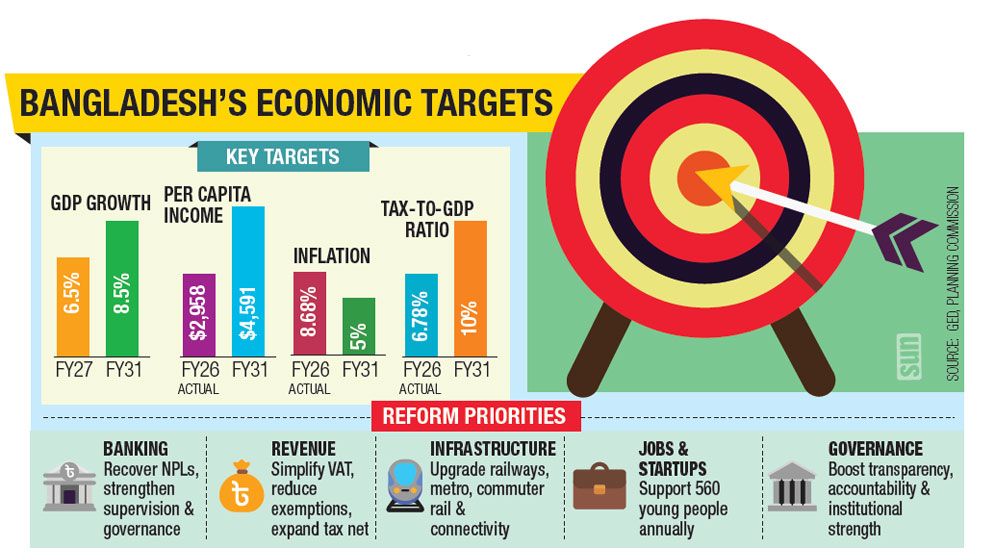
The government has set an ambitious target of raising Bangladesh’s GDP growth to 8.5% and per capita income to US$4,591 by 2030-31 fiscal year, with wide-ranging reforms planned in the banking, revenue, infrastructure and employment sectors.
The targets are outlined in a five-year plan titled Transforming Economy from Fragility to Prosperity, prepared by the General Economics Division (GED) of the Planning Commission for FY27 to FY31.
Bangladesh’s per capita income stood at $2,958 in the outgoing fiscal year. The government aims to raise it to $4,591 over the next five years while bringing inflation down to 5% by FY31 from 8.68% in FY26.
GDP growth is projected to rise gradually from the current target of 6.5% to 8.5% by FY31.
The GED has divided the economic transformation plan into three phases. The first year will focus on recovery and stability, including stabilising the exchange rate, containing inflation and strengthening the banking sector.
The first to third years will focus on restoration through higher revenue collection, more effective public spending and improved debt management.
The final phase, covering the third to fifth years, will prioritise restructuring, investment and employment to put the economy on a stronger growth path.
Banking sector reform is a major priority under the plan. The government intends to tackle non-performing loans, strengthen supervision, improve governance and restore depositors’ confidence.
The reforms will be implemented in three stages, beginning with immediate risk management in the first year, bank restructuring over the following two years and deeper reforms in the final phase.
The Bangladesh Bank is expected to identify wilful defaulters and take legal action against them. The plan also proposes strengthening risk management, loan recovery, transparency and the central bank’s supervisory capacity, alongside measures to enhance its operational independence.
In the revenue sector, the government aims to raise the tax-to-GDP ratio to 10% by FY31. Planned measures include introducing a single VAT rate, reducing tax exemptions, bringing informal businesses into the tax net and making tax payments easier through digitalisation.
Transport and connectivity have also been identified as key priorities. Planned projects include the Narayanganj-Cumilla-Laksam-Feni rail corridor, electrification of the Dhaka-Chattogram railway and double-line projects on the Dhaka-Panchagarh and Dhaka-Chapainawabganj routes.
The government also plans to pursue improved rail connectivity from Dhaka through Myanmar to Kunming in China, alongside metro rail, elevated rail, commuter rail and monorail projects in Dhaka and other major cities.
To boost youth entrepreneurship, the plan proposes providing startup funding to 560 young people every year until 2030 and supporting 1,200 women entrepreneurs annually.
The GED has also placed good governance at the centre of the economic transformation agenda, stressing transparency, accountability, the rule of law, efficient management of public resources and stronger institutions.
However, Policy Exchange Bangladesh Chairman M Masrur Reaz said the plan provides broad directions but needs more specific, time-bound and implementable strategies, particularly in employment, taxation, banking and long-term investment.
He also pointed to challenges including the country’s export dependence on the readymade garment sector, weak investment and changing global trade conditions. The economy, he said, needs stronger growth drivers and practical measures to address these challenges.