


 For all latest news, follow the Daily Sun's Google News channel.


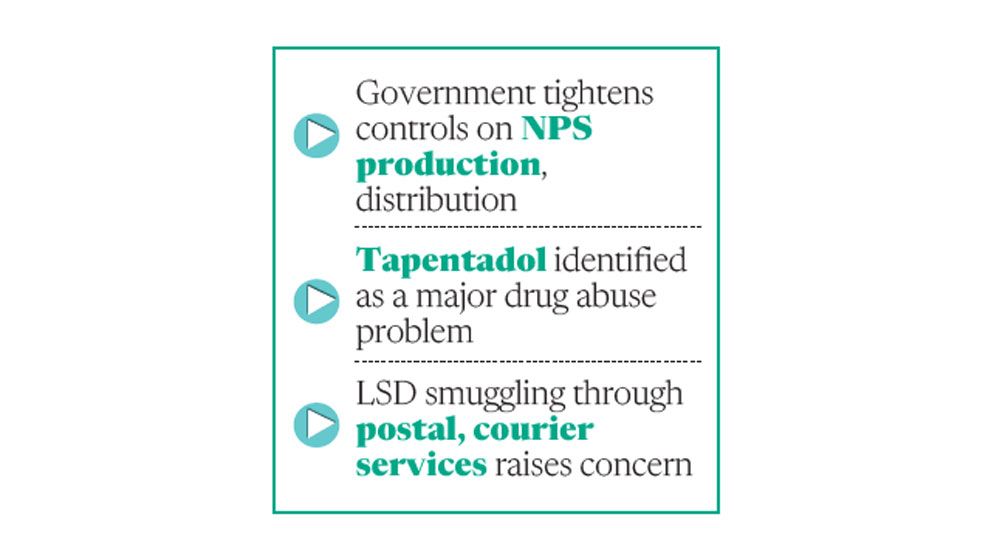
Bangladesh is facing a growing and increasingly complex drug threat from New Psychoactive Substances (NPS), according to the Department of Narcotics Control’s (DNC) annual drug report for 2025, published recently.
Also known as designer drugs, NPS are classified into 15 groups: aminoindanes, benzodiazepines, fentanyl analogues, lysergamides, nitazenes, other substances, phencyclidine-type substances, phenethylamines, phenidates, phenmetrazines, piperazines, plant-based substances, synthetic cannabinoids, synthetic cathinones and tryptamines.
According to the report, these substances encompass a wide range of psychoactive compounds, including novel derivatives and analogues.
NPS are not covered by the two main UN drug conventions of 1961 and 1971.
Quoting the United Nations Office on Drugs and Crime (UNODC), the report says the substances pose a serious public health risk precisely because they fall outside existing legal frameworks.
According to the DNC, NPS are being sold as legal alternatives to banned drugs, making them easier to access and harder to police. Health officials warn that users face serious risks, including acute intoxication, psychosis, seizures and overdose. These dangers are compounded by limited knowledge about the long-term effects of the constantly evolving synthetic compounds.
Isolated incidents have already surfaced. In 2018, authorities seized 5,156kg of khat, a plant-based stimulant, while small quantities of the hallucinogen DOB and synthetic cannabinoids have been confiscated in recent years. The report identifies tapentadol, an opioid painkiller, as one of the most serious drug abuse problems facing the country.
Although intended for pain management, the drug is reportedly being used as a substitute for amphetamine-type stimulants because of its similar effects.
In 2024, Bangladeshi authorities seized 489,364 tapentadol tablets from illegal sources.
In response, the government has tightened controls on domestic production, allowing only three pharmaceutical companies to manufacture the drug, while its distribution is restricted to registered pharmacies and hospitals.
Despite the crackdown, illicit demand persists. Officials say trafficking from neighbouring India, facilitated by Bangladesh’s porous border and continued market demand, remains a significant challenge. The report also details large-scale seizures of other controlled substances during the reporting period. Some 134,468 units of buprenorphine injections were confiscated.
The opioid, which is used to treat drug dependence, is not manufactured in Bangladesh and, according to officials, is trafficked from India.
A substantial quantity of diazepam, a benzodiazepine, was also seized.
Some 56 blotters of LSD were intercepted, with authorities noting that the drug is primarily smuggled through postal and courier services, prompting calls for tighter monitoring of parcel deliveries.
Bangladesh separately imports a range of controlled substances for legitimate medical use under
UN conventions, including eight narcotic drugs such as fentanyl and morphine, and 18 psychotropic substances such as diazepam and alprazolam. These are largely used for pain management, anaesthesia and opioid substitution therapy.
Government response
The DNC report says the government is taking a multi-pronged approach to tackle the threat. Amendments to the Narcotics Control Act have been introduced specifically to target the production and distribution of NPS.
The DNC also launched a National Early Warning Advisory for NPS, holding a workshop in November 2023 that brought together law enforcement agencies, laboratories and private organisations to improve information-sharing.
The government has partnered with non-governmental organisations to conduct campaigns warning citizens about the health risks and legal consequences of using NPS.
Bangladesh is also working with regional and global partners to share intelligence on trafficking routes and emerging substances as part of a wider effort to tackle what officials describe as a fundamentally cross-border problem.