



 For all latest news, follow the Daily Sun's Google News channel.


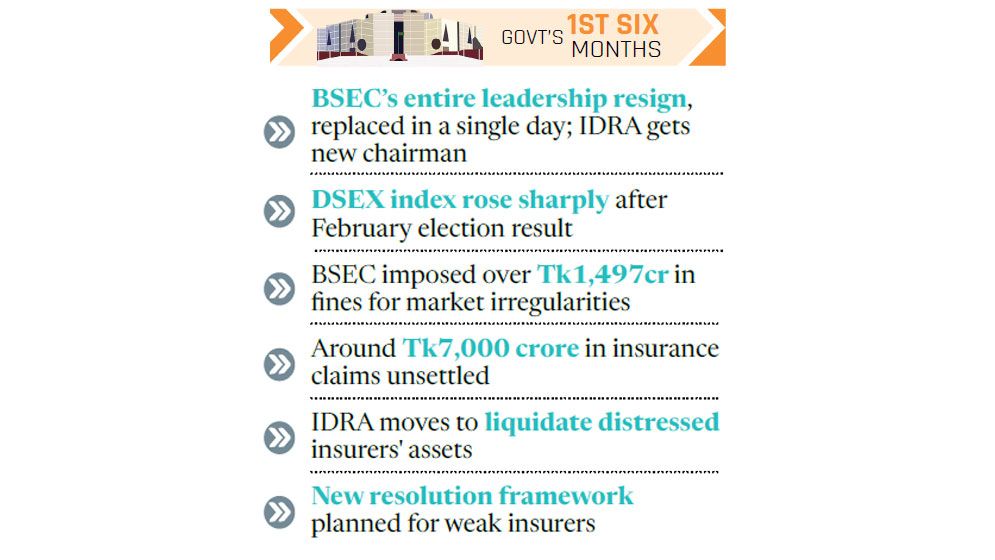
The BNP-led government has overhauled leadership and tightened regulation across the country’s capital market and insurance sector in its first six months in office, replacing the entire securities regulator’s top brass, imposing over Tk1,497 crore in fines for market irregularities, and launching a drive to settle roughly Tk7,000 crore in unpaid insurance claims.
The reforms began almost as soon as the government took office on 17 February 2026.
Investors responded swiftly to the BNP’s electoral victory, with the DSEX index climbing 169 points to 5,569 within the first two hours of trading on 15 February – first trading session after 12 February national election.
Capital market analyst and ICB Chairman Abu Ahmed told the Daily Sun that the driving objec-tive behind the government’s policies over the past six months has been to rebuild trust among cap-ital market and insurance customers alike.
“If policyholders or investors lose confidence in a sector, confidence cannot be restored through laws alone,” he said.
Abu Ahmed argued that those responsible for past market manipulation and banking sector losses must be identified and prosecuted.
“Only then will confidence return among investors,” he said, adding that regulators must go further on insurance.
“IDRA should not only sell the assets of the companies concerned, but also bring to justice the di-rectors whose actions have tarnished the reputation of the entire sector. Only then will discipline return to the sector along with the change in leadership,” he said.
Entire BSEC leadership replaced in a day
The most dramatic shake-up came on June 4, when Bangladesh Securities and Exchange Commis-sion (BSEC) Chairman Khandkar Rashed Maqsood resigned alongside four commissioners – Md Mohsin Chowdhury, Md Ali Akbar, Farzana Lalarukh and Md Saifuddin – leaving the commis-sion’s entire leadership changed within hours.
The government moved swiftly to fill the vacuum, appointing Masud Khan as BSEC chairman for a four-year term, with Nahid Mahtab, Tanvir Habib Rahman and Nafiz Al Tarik joining as com-missioners.
Masud Khan pledged to make the market more transparent, fair, accountable and sustainable, and to cut back on paper-based “analogue” complexities through modernisation of regulatory process-es.
The market responded almost immediately. DSE turnover hit Tk1,351 crore on 4 June – then the highest single-day figure recorded in 2026 – while the DSEX index gained 33.87 points.
By the end of June, the index had crossed 5,700 points for the first time in nearly 22 months, with turnover again exceeding Tk1,300 crore.
Regulatory overhaul under way
The new commission has since pushed a wide-ranging regulatory agenda, including a proposed shift from quarterly to half-yearly financial disclosure for listed companies, which BSEC says would align Bangladesh’s market with international norms while easing compliance burdens.
Parallel reforms are under way covering IPO rules, corporate governance, audit firm listing, whis-tleblower protection, and delisting and direct listing procedures.
BSEC has already introduced the Capital Market Related Information Disclosure and Whistle-blower Protection Rules, 2026, aimed at protecting those who report irregularities and strengthen-ing market transparency, according to stakeholders.
The commission has also stepped up scrutiny of the Dhaka Stock Exchange’s own governance, opening investigations into senior DSE officials over financial management, corporate governance, recruitment and securities trading.
On enforcement, BSEC’s 2026 records show a string of fines, warnings and restrictions against listed companies, brokerages, directors and officials, alongside renewed investigations into histori-cal manipulation cases.
Finance Minister Amir Khasru Mahmud Chowdhury told Parliament that BSEC has levied a com-bined Tk1,497 crore in fines, with some investigation reports referred to the Anti-Corruption Commission.
IDRA turns to distressed insurers’ assets
Leadership change has extended to insurance regulation too, with Mir Nadia Nivin appointed as the new IDRA chairman.
She has prioritised settling long-outstanding claims – one of the sector’s most persistent problems – with around Tk7,000 crore still unpaid across life and general insurance, according to IDRA.
Under her leadership, the authority is moving to liquidate assets, including land, government bonds and bank deposits, held by financially distressed insurers, with proceeds ring-fenced in separate accounts and claims settled under auditor supervision.
IDRA is also planning risk-based supervision, faster digital transformation, new insurance products and stronger customer protection measures.
Beyond claims settlement, the government is pursuing broader legal reform in insurance, including restructuring the boards of weak insurers, appointing administrators where necessary, sharpening director accountability, and curbing excessive single-family ownership of insurance companies, the new chairman said.
IDRA spokesperson Saifunnahar Sumi said an Insurance Resolution framework is being devel-oped to guide how distressed insurers are restructured or wound down.
“The objective is to ensure that when a company becomes extremely weak, it is not kept afloat for an indefinite period,” she said, adding that such firms could instead be restructured, have their as-sets sold, or be resolved in an orderly manner to protect policyholders’ interests.