


 For all latest news, follow the Daily Sun's Google News channel.


Myanmar still playing the old game!
Experts say Naypyidaw’s latest statement another ploy to delay Rohingya repatriation

Nearly nine years after the massive influx of Rohingyas into Bangladesh began, Myanmar appears to be repeating its old playbook — promising repatriation while taking little meaningful action to create conditions for the safe and dignified return of the persecuted minority.
With around 1.2 million Rohingyas still sheltering in Bangladesh, the protracted crisis has become a test of Myanmar’s willingness to resolve a problem it created and the international community’s resolve to hold it accountable.
Myanmar’s military-backed government said on Saturday that more than 3,00,000 Rohingya refugees living in camps in Bangladesh are former “Bengali” residents of western Rakhine State and that it will accept their return once security conditions improve.
Analysts familiar with the activities of the junta and its allied authorities in Naypyidaw said the statement was an old ploy aimed at confusing the international community.
“As a counter to the discussions and criticism at the international level over resolving the Rohingya crisis, they have essentially put forward this narrative,” migration and refugee affairs expert Asif Munier told the Daily Sun.
Munier said the statement was also an attempt to establish internationally that there is no ethnic group called the Rohingya in Myanmar.
Myanmar does not recognise the Rohingya as one of the country’s 135 officially recognised ethnic groups and has consistently referred to them as “Bengalis”.
“This is a kind of pattern we have seen before. There is actually little reason to believe that they genuinely intend to take them back,” he added.
Although the statement makes various claims about the size of the community and whether they are Bengalis or Rohingyas, it makes no mention of the preparations or security arrangements necessary for their repatriation.
Munier, a former national programme officer at the International Organization for Migration (IOM), said the statement could also be an attempt by Myanmar to project a positive image internationally amid the political developments that followed the formation of a new government through an election just days ago.
“Although there are allegations that this was a process aimed at legitimising their military government, they have also tried through this statement to legitimise this democratic facade,” he said.
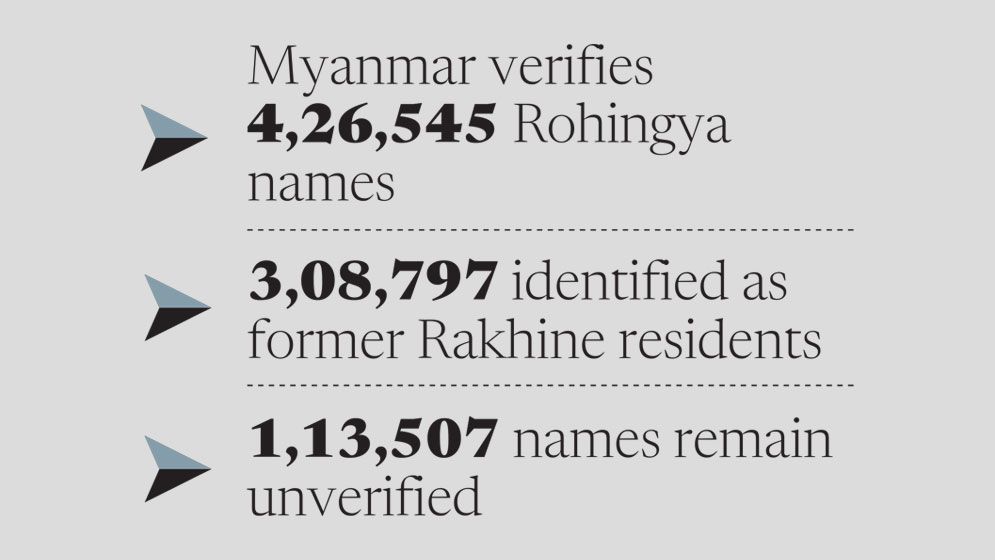
Of the list of 8,28,824 people provided by Bangladesh, Myanmar said it had verified 4,26,545 individuals as of 31 July 2026.
Of those, 3,08,797 were identified as former residents of Rakhine State, while 4,241 were identified as being “involved in terrorist activities”. Myanmar said it could not verify the information of 1,13,507 people.
Myanmar also said it was working with “sincere goodwill” to facilitate the speedy repatriation of those whose identities had been verified once the security situation in Rakhine State becomes more stable.
Former Bangladeshi diplomat to Myanmar and security analyst Major (Retd) Emdadul Islam said Myanmar had once again followed its past pattern of deliberately delaying the repatriation process through various means.
“When they agreed to repatriation in the past, they also came up with a figure like this. They may have declared two members of the same family eligible while rejecting another. For instance, they accepted the father but excluded the mother, or accepted both parents but left out their child in the past. Because of this kind of deliberate manoeuvring, the repatriation process ultimately did not take place,” he said.