


 For all latest news, follow the Daily Sun's Google News channel.


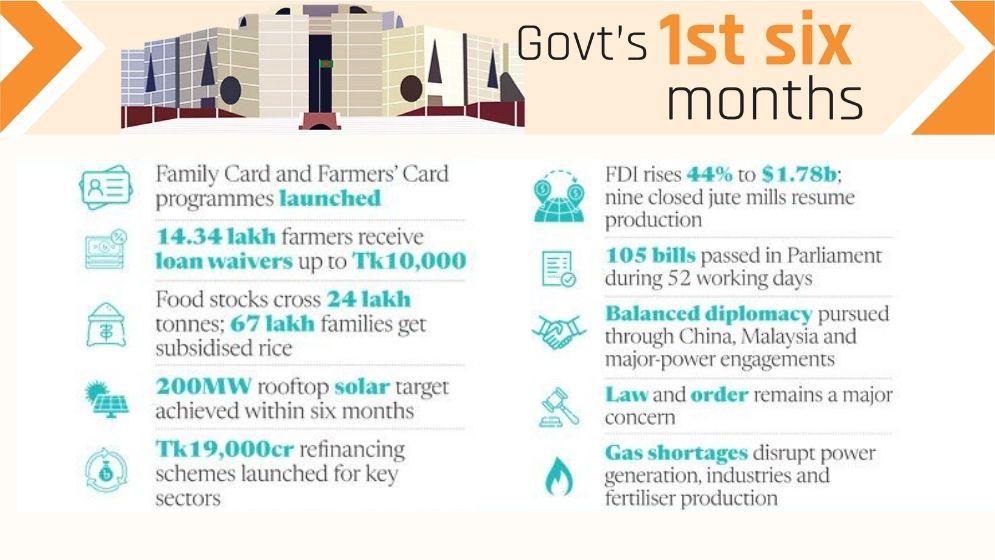
The BNP-led government has completed its first 180 days in office with a mixed record, making progress in social welfare, agriculture and economic management while struggling to meet public expectations on law and order, energy security, corruption control and institutional reforms.
Prime Minister Tarique Rahman-led BNP government assumed office on 17 February following the party’s landslide victory in the 13th national parliamentary election on 12 February, returning it to power after nearly two decades. The government had set its first 180 days as an initial period for delivering on key electoral pledges.
Although six months is too short a period to draw a definitive conclusion about a government’s overall performance, the initial record can provide an indication of its direction.
The government has sought to demonstrate its commitment to improving ordinary people’s lives through a range of programmes, including the pilot Family Card and Farmers’ Card schemes, canal re-excavation, food-security measures and agricultural support.
Agricultural loans of up to Tk10,000, including interest, have been waived for 14.34 lakh farmers. Food-grain stocks have crossed 24 lakh tonnes, while more than 67 lakh vulnerable families are receiving rice at Tk30 per kilogramme. The government has also claimed full achievement of its initial target of adding 200MW of electricity through rooftop solar and net metering.
Youth employment and entrepreneurship have also received attention. Of 10,000 trained youths, 9,450 have received loans totalling Tk94.6 crore, while separate funds worth Tk500 crore have been created for entrepreneurs and start-ups.
Bangladesh Bank has also launched Tk19,000 crore in refinancing schemes covering agriculture, export diversification, green industries and other sectors.
On the diplomatic front, the government has sought to maintain balanced relations with major powers. Prime Minister Tarique Rahman’s visits to Malaysia and China, along with his engagement with the top leaders of the United States, Saudi Arabia, Qatar, the UAE and Türkiye, have been appreciated by many.
The government has also highlighted initiatives in education and healthcare. It launched the ‘One Teacher, One Tab’ programme, established 327 digital classrooms and repaired thousands of old laptops and projectors.
In healthcare, it began recruiting 100,000 healthcare workers, most of them women, while taking steps to recruit 5,000 doctors, establish dialysis facilities and increase the number of seats in upazila-level hospitals to 101.On the economic front, the government says net foreign direct investment rose 44% in 2025 to $1.78 billion. It has also placed 14 closed jute mills under private management, nine of which have resumed production, while pursuing greater trade, investment and labour-market cooperation with several countries.
Parliament has also remained relatively active, passing 105 bills in 52 working days. The government has pointed to accelerated trials in several high-profile rape and murder cases as evidence of efforts to strengthen justice delivery.
Allowances for decorated freedom fighters and families of Bir Sreshthos have been increased, while 13,479 of the 14,368 gazetted July fighters are receiving monthly allowances.
National Professor Mahbub Ullah said building trust among the people was the government’s biggest achievement during its first 180 days.
“The government needed to build trust among people. It required to assure them that there is a government to look after their interests. In this case, it has succeeded to restore confidence after years of autocratic and unelected rule. But now it needs to look beyond this and bring necessary reforms as pledged in the July Charter to give this trust a sustainable shape,” he said.
Political analysts, however, believe the government’s achievements have fallen short of expectations in several areas.
Law and order remains a major concern, with murders, extortion, kidnappings and mob attacks reported despite anti-crime drives.
Partisan appointments to government institutions and universities have also raised questions about the administration’s commitment to depoliticising state institutions.
“Political appointments in the top posts of universities and contract-based appointments in the administration were not good initiatives at all,” Prof Sabbir Ahmed of the Department of Political Science at Dhaka University told the Daily Sun.
Energy security has emerged as perhaps the government’s most immediate challenge. Fuel shortages and price increases in March and April were followed by sharply reduced gas supplies in July and August, affecting electricity generation, industries, fertiliser plants and CNG stations.
Analysts say the government has also been slow in implementing the July Charter and associated reform proposals.
“Many essential reform initiatives, including setting up a separate secretariat for the judiciary, passing an act on Anti-Corruption Commission, bringing reforms in police and administration have been deferred unfortunately,” Prof Sabbir said.
The government is also facing criticism over weak coordination and controversies involving some ministers and state ministers. The Prime Minister’s Office is reviewing the performance of individual ministries, with a cabinet reshuffle reportedly possible based on their results.
“Production in factories has not increased, creating strain on supply chain. Thus employment generation during this period was not that impressive. The foreign ministry hasn’t done anything big other than the Prime Minister’s China and Malaysia visit,” Prof Sabbir added.
He said the government had yet to face any major political challenge.
“Through family card, farmers’ card and other social welfare initiatives, it showed a positive intent,” said Prof Sabbir, who also serves as general secretary of the Bangladesh Political Science Network.
However, he cautioned that the positive intention of one person was not enough, saying a government always needed collective effort to deliver effectively.