



 For all latest news, follow the Daily Sun's Google News channel.


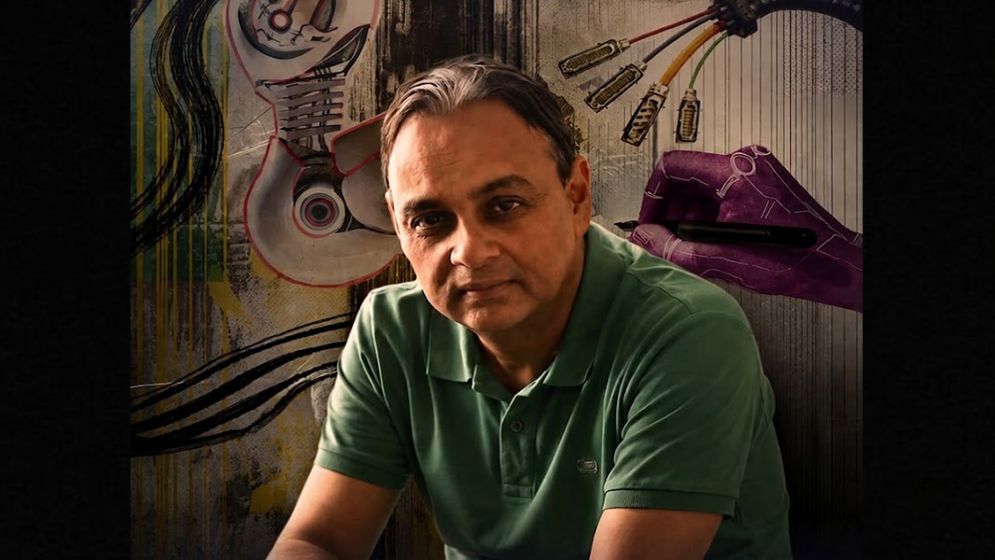
Photo : Courtesy
I marvel at the artists as much as I do at their artworks because the latter are a portal to who they are. Visual art is a silent, and yet, a powerful language that can convey strong feelings, or tell a compelling story. What fascinates me is that it also says a lot about the life and identity of its creator. Recently, I had the opportunity to attend an alternative art fair organised by Powerhouse Arts in Brooklyn, New York.
Powerhouse, a non-profit organisation, invited a number of artists, educators, and curators from around the world to present their works in an art fair called “Conductor”. Its purpose is to bring the artists and educators from around the world and provide them with necessary tools and space to facilitate creative expression, teaching, and sharing. It creates a participatory environment to foster growth. Invited artists not only flaunt their talents, but also schedule small interactive talking sessions to share their personal stories behind their projects with the visitors in an effort to present an immersive experience. “Conductor” was one such fair.
The exhibition was in a large hall in a muti-story building. Stepping out of the elevator, I could see another hall right across from the main one, reserved for different artists’ talking sessions during the event. Through the window I could see the neat arrangements adorned with a stage and rows of chairs. There was one particular artist of special interest whose talk was scheduled for the next day, to my dismay, because that meant I could not attend that. That artist was my main motivator to attend the fair.
Inside the main exhibition hall, all those artists had their stalls in lively colors and formats, all designed to express themselves. It was not just a display of art, but a conscious effort to extract the deeper cultural souls of the places and nations the artists hailed from. That’s what really moved me. But not all artists were in attendance. They had sent their work to be presented and explained by young and knowledgeable volunteers, often aided by literature.
Although there was much to be appreciated, I will pick a few to write home about.
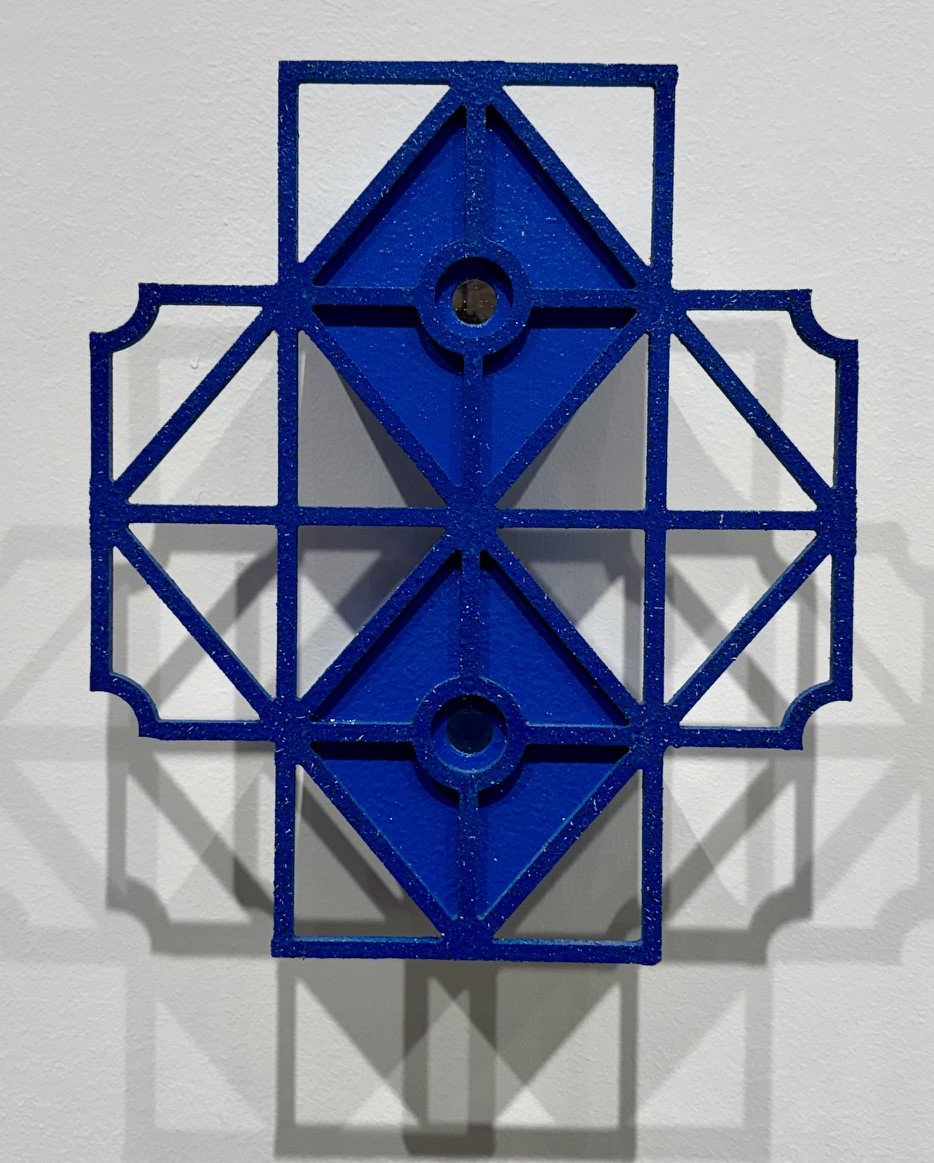
Edra Soto, an artist from Puerto Rico, introduced a series of intricately designed viewfinders hung on the wall for her project called “The Place of Dwelling”. As I became perplexed as to what they might mean, the lady in attendance gestured me to peek into them. Each offered a fascinating insight into the dwellings in her native Puerto Rico. I could see the interior décor adorned with simple furniture, paraphernalia, and family photos. These viewfinders represent post-war Puerto Rican wrought-iron gills, called “Rejas”, through which visitors could now peek for a curious glimpse into the dwellings of working-class families in the historic district of Old San Juan that usually remained shrouded from public view. The Rejas guarding the local homes can be traced back to the African diaspora on the island. The architecture of these dwellings, were patterned after the Yoruba dwellings of the slaves in sub-Saharan Africa brought over to work in plantations on the island, and later influenced by the Spanish colonial design. Through these reimagined Rejas Edra evokes her personal childhood memories, and powerfully amplifies the lives of ordinary citizens. Despite now living abroad, she still remained profoundly attached to her native land.
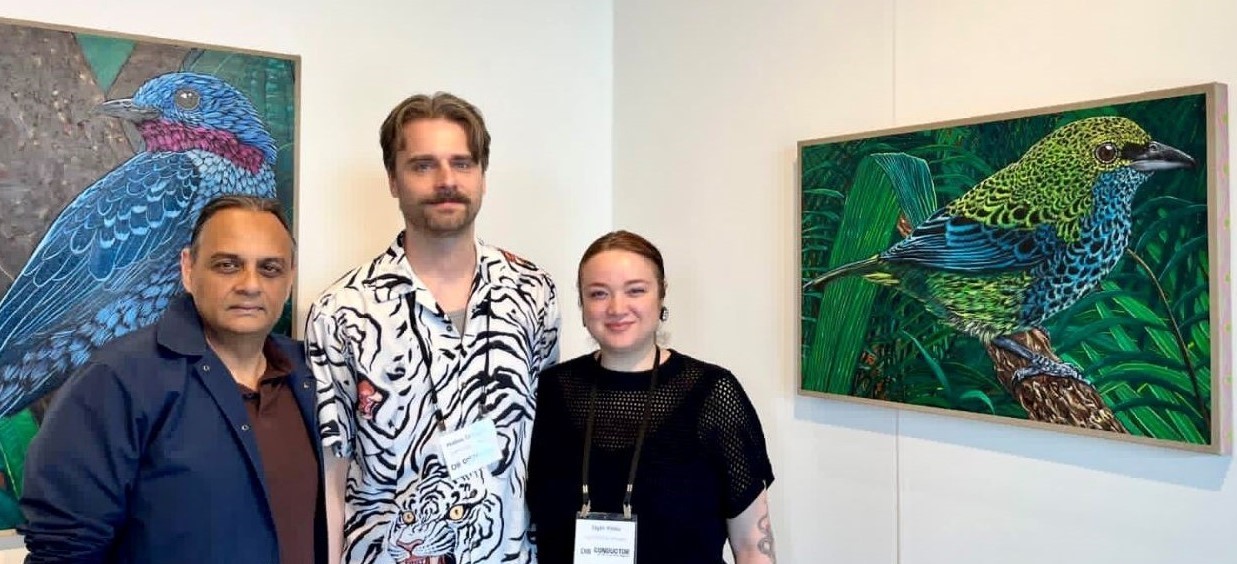
I moved on to the other side of this installation and found an affable Matteo Callegari, the artist for another project, called “Light for The Amazon”. I saw two beautifully-drawn Amazonian birds displayed on the wall and decided to talk to the artist and his wife. The paintings were pigment prints on Moab Entrada archival paper, hand-finished with acrylic paint. Based in New York, they travel regularly to the Peruvian Amazon town of Iquitos, so remote that it is mostly inaccessible by road. They have been running a program in the Amazon area educating the locals about ecology and sustainability. This program aims to preserve knowledge about the medicinal properties of the local plants, and raises awareness about deforestation. They are on a mission to make the Amazon more livable for those very birds that were drawn. I appreciated deeply the fact that there are still selfless people engaged in saving our planet.
But one dream of mine had always remained unfulfilled, living abroad for many years: seeing a Bangladeshi artist on a prestigious global stage. This was the primary reason for my being there. There he was, in his usual professor-like jolly self, in the middle of the main hall. His project “Baithak” occupied the largest space. A glowing Bishwajit Goswami was all smiles on seeing me. I had met him in Dhaka a few years back in his own studio in an artistically transformed space in Hazaribagh.
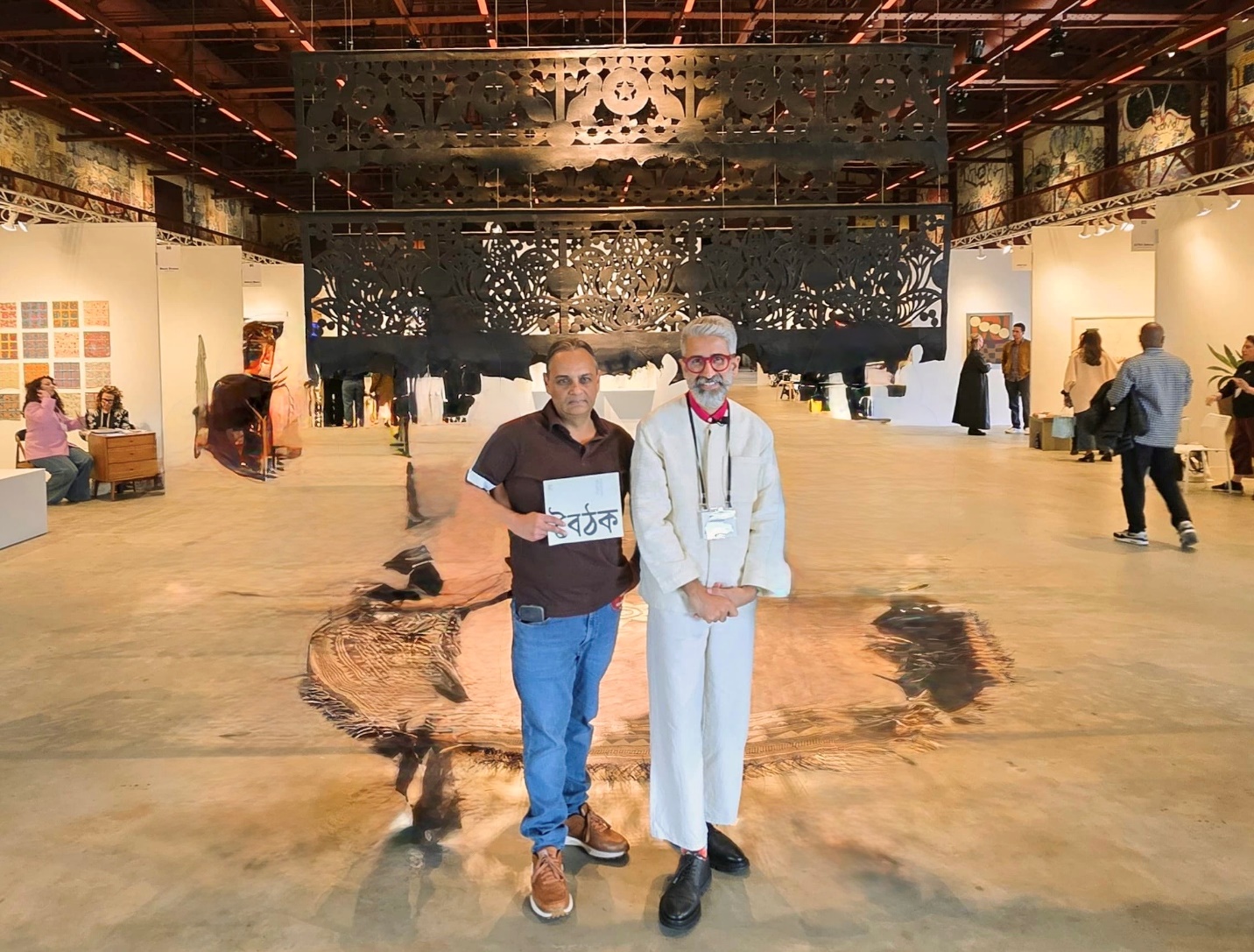
The centerpiece of “Baithak” was a large circular handcrafted straw mat, a “Shitalapati”, the center of which was adorned by a lotus motif, illuminated with a spot light indicating a glowing source of energy. Lotus, blooming at the center embodied the source of positive energy that flowed outward joining other curvilinear patterns, depicting waterways and “Shapla”, another waterborne flower, with a less known “Jhinari”, a small flower, representing a peaceful coexistence of all forms of life in Bangladesh. The main idea is that people derive energy from this central energy source, aligning themselves to become one, connecting to and accommodating one another to form new ideas and relationships with the spirit of acceptance and appreciation. This motif, painstakingly weaved by the artisans in Sylhet, connected to the patterns above, in a smooth continuity of the main theme. To him, continuity is inseparable in the sense it is an attentiveness to relationships among beings, materials, and spaces.
Shitalpati, a cultural identity of Bangladesh, is an invitation to a discourse, the primary theme of the project. It is a dialogue on a level platform for everyone, based on strong bond and unity to resolve differences for the greater good. Traditionally used as a sitting area or a prayer mat on the floor, it takes intense collaboration to weave one, a deeply embedded philosophy evident in all aspects of the design of this project. The Shitalpati is meant to be a platform for discussion, a healthy and productive way of promoting social exchanges, facilitating individual expressions, opinions, and feelings. The first thing that instantly struck me was its circular shape, a powerful embodiment of parity. It would sit everyone face to face in the same way, thereby creating a sense of reimagined camaraderie, giving each participant, engaged in a conversation, equal importance. With the elimination of hierarchy, this effectively brings everyone together in the spirit of social cooperation and harmony.
Over the Shitalpati were sets of truncated scraps of leather, called “Jhalors”. These delineate a fringe, a certain type of a beautifying element that forms a decorative perimeter around cultural events and rituals, or important spaces in the social landscape of Bangladesh. The motif captured in these Jhalors is inspired by the artwork on the back of rickshaws, a very conspicuous mode of transport for the masses. The passenger and the puller embark on a journey together where there’s always a social exchange and a sharing of life’s stories. This important exchange happens in the backdrop of the city, visually and artistically expressed, on the back of rickshaws, adorned by the colorful Jhalors, as if to glorify it further. These ornamental fringes enclose a space of significance, or significant happenings. Similarly, the Jhalors over the Shitalpati create a spatial boundary around a significant gathering, a Baithak. They, however, were painted black to represent the void that we often exist in. Down below, a Shapla, a vibrant symbol of prosperity and productivity, blooms with the idea that a radiant life can be born of that darkness of our state like a phoenix.
Also in the motif, is the beautiful peacock portraying our connection to nature and the animals. A feather-spreading peacock is a symbol of extraordinary beauty. Although this project is related to the traditions of Bangladesh, this concept extends far beyond any country.
Bishwajit, an Assistant Professor at the faculty of fine arts, University of Dhaka, is a highly decorated artist, curator, and a co-founder of Brihatta Art Foundation, in Dhaka. An effective educator, his pedagogy is grounded in lived realities, encouraging greater participation.
He always insists on a harmonious co-existence, predicated on recognition of a few foundational elements. Last time when I visited his environmentally-friendly, and aesthetically pleasant workspace in Dhaka, he pointed to these six main elements that make up our core: Mother, Earth, People, Language, Motherland, and Nature. He explores the impact of these elements in shaping our collective persona. His work underscores collaboration, site-responsiveness, and dialogue with artisans that produce and communities that benefit, both locally and globally. These aspects complete him. These are seemingly invisible, and yet palpable, connections that bring about harmony and balance.
The first element Mother is the source of all energy, not just an abstract symbol, just as the lotus is in the middle of the Shitalpati. He doesn’t exclude the prior state of a transformed space, but rather reactivates and rejuvenates it with a new energy where the old and the new coexist in peace with a reimagined purpose. It is this sense of harmony that emanates from this central lotus motif and radiates and continues outward, joining others in a harmonious continuity. This ideology flows through every physical element that he has presented in his “Baithak” project.
He has exhibited in many other international forums such as “Asia NOW 2024” in Paris, “Paris Internationale 2023”, “London Design Show 2022”, 58th “Venice Art Biennale in 2019”, “The Beijing International Art Biennale” (15, 12), “The Setouchi Triennial Japan 2013”, “The Kunming International Art Biennale” (18, 16, 14) to name a few.
All of the above artists at the fair came not only to show their crafts, but also to share a part of their personal journeys, and how these winding paths have shaped and reshaped their minds. Each point has been a transformation. As I glimpsed into their lives, I came to realise that art is not just a mere visual expression on canvas, it tells a story through a deep connection to something one holds dear.
Each brush stroke, each color, each medium has a purpose. For some, it is the fond memory of their idyllic childhood that influenced their core identity, for some, it is the sense of urgency and sheer love for nature, rushing them to save our earth in a remote region, using art, while for others, it is an attempt to explore our origins, the core elements that shape us to be in a delicate balance with nature. They are all conductors, leading us to a deeper meaning of life through the music of their art.
----------------------------------------------------------------------
The writer is a US-based art enthusiast, essayist and software engineer by profession.
Read More