


 For all latest news, follow the Daily Sun's Google News channel.


From jute to giant: Adamjee EPZ hits $1.18b exports
Once home to a struggling state jute mill, the revamped industrial site now employs 76,000 workers and targets $1.5b in shipments

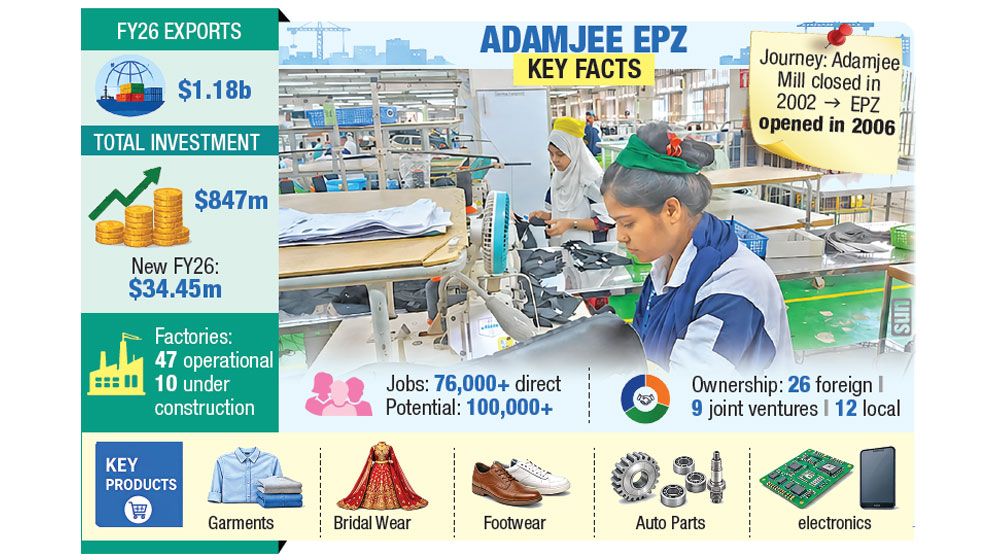
Adamjee Export Processing Zone (EPZ) has cemented its position as a premier manufacturing hub, generating $1.18 billion in exports during the 2025-26 financial year.
Built on the grounds of the former Adamjee Jute Mill, the zone’s growth is increasingly fueled by industrial diversification into high-value and specialised products.
The $1.18 billion figure significantly surpasses the zone’s original full-operational target of $750 million per year.
Speaking to the Daily Sun, Md Abdur Rahman Bhuiyan, executive director of Adamjee EPZ, noted that shipments have now topped the $1 billion threshold for two consecutive years, following a strong FY25.
“The original project proposal estimated maximum annual exports of around $750 million,” Bhuiyan said. “However, with 10 new factories currently under construction, annual exports could realistically cross $1.5 billion once these units go into full production.”
Spanning 292.62 acres, the EPZ hosts 47 fully operational enterprises across 276 industrial plots, alongside the 10 units currently in development.
To date, cumulative actual investment in Adamjee EPZ stands at $847.03 million, with lifetime exports exceeding $11.1 billion.
The zone recorded $34.45 million in investment and created 2,046 new jobs in FY26.
From jute to high-tech manufacturing
The transformation of the historic site is striking. Established in Siddhirganj in 1950, Adamjee Jute Mill began production in December 1951 and eventually grew into one of the world’s largest jute mills.
However, following years of severe financial losses, management challenges, outdated technology, and persistent labour unrest, the government closed the facility on 30 June, 2002.
The land was subsequently handed over to the Bangladesh Export Processing Zones Authority (BEPZA).
Adamjee EPZ was formally inaugurated on 6 March 2006, marking a new chapter for the industrial site. The zone began exports in FY06, when investment stood at just $4 million and exports totalled $0.23 million.
Today, the EPZ employs over 76,000 Bangladeshi workers – more than triple the 20,000 to 25,000 workforce of the original jute mill.
Officials expect total employment to top 100,000 once the 10 factories currently under construction become operational.
The zone’s output has diversified far beyond traditional textiles.
Factories now manufacture high-end garments, bridal gowns, tailored suits, safety footwear, industrial boots, automotive seat covers, and specialised electronics.
Of the 47 active enterprises, 26 are foreign-owned, nine are joint ventures, and 12 are locally owned.
International investors hail from Germany, Japan, China, India, the United States, South Korea, Romania, and Ukraine.
Global brands built in Adamjee
A recent visit by the Daily Sun to four local facilities highlighted the EPZ’s expanding industrial footprint.
Among them, Universal Menswear Ltd – a Romania-Bangladesh joint venture – has invested $45.91 million and employs 8,194 workers (including 8,160 locals and 34 foreign nationals).
Specialising in tailored men’s suits, blazers, and formal trousers, the enterprise generated $97.88 million in exports during FY26
Super Protective Shoes (Pvt) Ltd, a Ukrainian-invested footwear manufacturer, has invested $13.06 million in Bangladesh and employs 987 people, including 979 Bangladeshis and eight foreign workers.
It exported $12.77 million worth of safety shoes, industrial footwear, military boots and specialised footwear in FY26.
Japanese company TS Tech Bangladesh Ltd has invested $4.67 million and employs 512 people, including 508 Bangladeshis and four Japanese workers.
It exported $14.75 million last fiscal year, mainly producing automotive seat-trim covers for Japanese vehicle manufacturers.
The company sources most of its materials from Japan and China, processes the seat covers in Bangladesh and sends them to production facilities in Japan.
Satoru Onishi, managing director of TS Tech Bangladesh, told the Daily Sun that the Bangladesh operation has increasingly focused on productivity improvement and automation.
The company has also introduced measures such as 3D printing for internal production-related work and has gradually expanded its production capacity since beginning operations in January 2017.
Specialised bridal-gown industry
Another distinctive operation is UBF Bridal Ltd, a German-invested company producing premium wedding and evening wear.
The company began operations in April 2022 after investing $3.66 million and currently employs 357 local workers. It exported $5.27 million in FY26.
Its products include wedding and evening dresses, suits, jackets, boleros, veils, petticoats and jewellery.
Md Robiul Hoque Siddiki, chief operating officer of UBF Bridal, said Bangladesh initially lacked workers experienced in producing such specialised garments.
“We had to train the workers and managers ourselves,” he said.
The company started with around 130 workers and has gradually expanded its workforce.
Its management says worker efficiency has risen from around 30% initially to about 60% as employees have gained experience.
UBF sends its products to Germany, where they are distributed to around 37 countries, including markets in Europe, the United States, Brazil and South Africa.
The products retain their “Made in Bangladesh” identity throughout the distribution process.
The company is also seeking to increase local sourcing by developing embroidery and lace production and plans to manufacture footwear in Bangladesh in the future.
Moving towards higher-value exports
The rise of specialised manufacturing is also reflected in the brands and products associated with Adamjee.
Factories in the EPZ produce garments for international brands such as Tommy Hilfiger, Ralph Lauren, Michael Kors and Van Heusen, alongside safety equipment, footwear and automotive components.
The authorities expect further growth as the 10 factories under construction come into operation.
The expansion could take annual exports beyond $1.5 billion and employment above 100,000, strengthening Adamjee’s position as one of Bangladesh’s important export-oriented industrial centres.
The transformation also represents a broader shift in the economic role of the site.
The former Adamjee Jute Mill was once a symbol of Bangladesh’s traditional jute industry and its state-owned industrial era.
Two decades after its closure, the same land has become home to factories producing sophisticated garments, specialised footwear and automotive components for global markets.
The industry has changed, but Adamjee’s role as a major centre of employment and exports has continued – only now with a far more diversified manufacturing base.