


 For all latest news, follow the Daily Sun's Google News channel.


Banks to offer instalments for smartphone purchases
Govt eyes cheaper handsets and wider digital access as 50% of users still rely on 2G phones
Daily Sun Report, Dhaka
Published: 16 Aug 2026, 12:00 AM
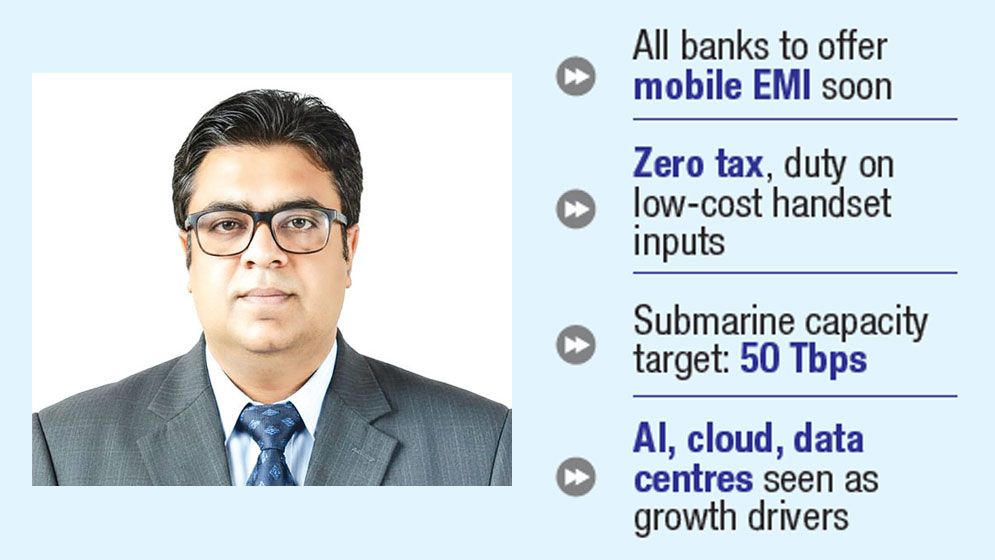
All banks in Bangladesh will soon offer EMI or instalment facilities for mobile phone purchases as the government seeks to make smartphones more affordable and expand digital inclusion, Prime Minister’s Information and Technology Adviser Rehan Asif Asad said.
Discussions have already been held with Bangladesh Bank (BB), paving the way for commercial and state-owned banks to introduce the facilities soon, he said.
Speaking at a roundtable titled “Spectrum for a Connected Bangladesh: Enabling Internet for All”, organised by the Telecom and Technology Reporters’ Network (TRNB) at a city hotel, Rehan also called for concerted efforts to bring down handset prices.
Around 50% of people still use 2G-enabled feature phones, he said, adding that he had held talks with 14 local manufacturers before the budget to explore reducing the price of the cheapest smartphone from Tk10,000 to Tk3,000.
Manufacturers later indicated that a basic Android smartphone could be produced for Tk5,000-6,000, while mobile operators could help through co-branded handsets and voice-data bundles.
Raw materials for low-cost handsets would also receive zero tax and duty, citing a commitment from the National Board of Revenue chairman, Rehan said.
Spectrum renewal
Rehan urged mobile operators not to be overly concerned about the upcoming spectrum renewal, saying only around 20% of the spectrum currently assigned to the four operators would be renewed.
At present, operators hold 406 MHz of spectrum, of which 79.4 MHz is due for renewal in 2026. The renewal process is scheduled to begin in November and continue through 2034.
He said spectrum should be treated as a strategic national resource rather than merely a source of government revenue, given its role in connectivity, digital inclusion, productivity and long-term economic growth.
Rehan called for greater spectrum sharing alongside infrastructure sharing and said the Service and Universal Fund (SoF) could support low-income people’s access to the digital economy and public Wi-Fi.
He also highlighted the growing importance of AI, cloud services, data centres and tokenisation as potential new revenue streams for the telecom industry.
Average data use in Bangladesh has reached around 8.6 GB, compared with more than 20 GB in Southeast Asia, he said, underscoring the need for better network quality and wider access.
Submarine capacity to rise
Bangladesh’s peak submarine capacity requirement currently stands at around 12.1 terabits per second (Tbps) and could rise to about 30 Tbps by 2030, Rehan said.
The government is working to build at least 50 Tbps of capacity and is considering adding another 150%-200% in incremental submarine capacity over the next four years, with multiple redundancies and routes.
The move would help meet rising demand while creating new opportunities for the telecom and IT sectors, he said.
Rehan assured operators that the government would support measures needed for both the industry and consumers, including improved network quality and rational spectrum pricing.