


 For all latest news, follow the Daily Sun's Google News channel.


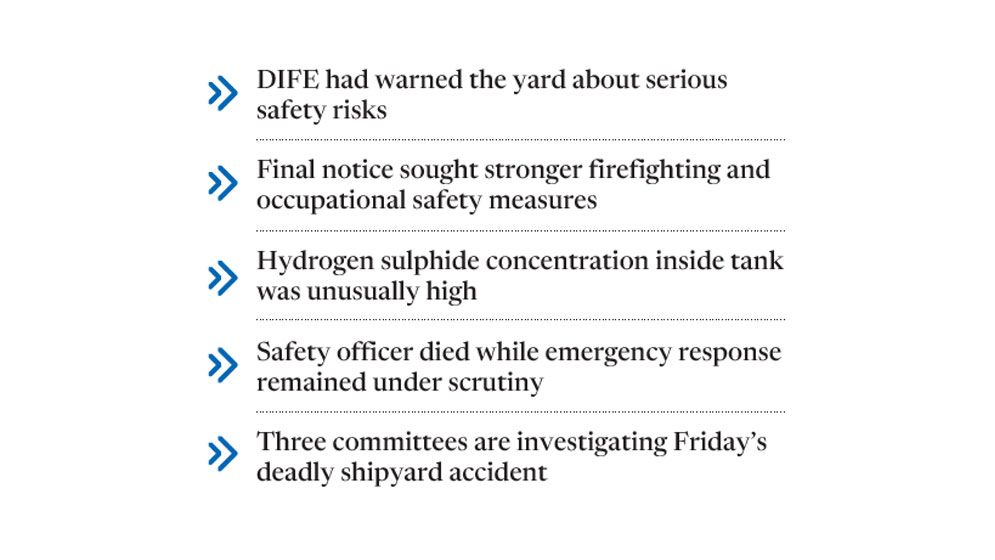
Questions are mounting over the effectiveness of Ferdous Steel Ship Recycling Industries’ “green yard” certification after Friday’s deadly toxic-gas accident, particularly as the yard had previously been warned about serious safety risks and ordered to strengthen its occupational safety measures.
The Sitakunda-based shipbreaking yard received its green-yard certification for meeting international safety and environmental standards.
But the accident has raised concerns over whether the safety systems required under the Hong Kong International Convention for the Safe and Environmentally Sound Recycling of Ships (HKC) were actually functioning on the ground.
The concerns are particularly significant because the Department of Inspection for Factories and Establishments (DIFE) had reportedly issued the yard a notice in February over serious safety risks.
On 8 June this year, it issued a final notice asking the company to strengthen its firefighting arrangements and occupational safety measures.
The accident has therefore brought renewed scrutiny to any gap between certification on paper and safety in practice.
What happened
The accident occurred at around 9am on Friday at Ferdous Steel’s yard in the Station Road area of Bhatiari under Sitakunda upazila, where the LNG carrier MT Rasi had been undergoing dismantling for several months.
Housekeeping and water-draining work was reportedly under way when workers were exposed to toxic gas inside a tank. Several workers fell ill, while others were affected when they rushed in to rescue them.
Among the nine people who died were two brothers from Moulvipara – 55-year-old Mansur, a foreman at the yard, and 50-year-old Nasir, a cutter.
Nasir’s daughter Eva told the Daily Sun that her father had been sleeping at home as Friday was a holiday and initially did not want to go to work. But the yard authorities called him and his elder brother and asked them to attend work.
A worker who witnessed the incident told the Daily Sun on condition of anonymity that Nasir and several others initially began cutting work inside a tank.
“As soon as the cutting started, they were affected by the toxic gas and collapsed. Mansur rushed in to rescue his brother and collapsed too. One after another, those who went in to rescue them were also affected,” he said.
He added that none of the workers had protective masks when the work began.
What the green-yard rules require
The Hong Kong Convention, which came into force on June 26, 2025, aims to ensure safe and environmentally sound ship recycling.
Under the convention, ship-recycling facilities are required to have plans covering worker safety and training, hazardous-material management, emergency response, and monitoring and record-keeping. Each vessel must also have a ship-specific recycling plan and an Inventory of Hazardous Materials (IHM).
Ferdous Steel’s Declaration of Authorization for Ship Recycling (DASR) remains valid until October 29, 2030.
Marine engineer Mahbubur Rahman, technical consultant to the Bangladesh Shipbreakers Association, said the required safety arrangements were supposed to be in place.
“But the level of emergency preparedness was not the same on a weekly holiday,” he told the Daily Sun.
Safety officer also among victims
The death of Mohammad Abdul Alim Sujon, 36, a safety officer at the yard, has further raised questions over the effectiveness of the facility’s safety and emergency-response arrangements.
The HKC requires facilities to maintain emergency preparedness and response measures. Yet witnesses said that after the first workers were affected, others rushed into the area to rescue them without fully understanding the danger.
“After hearing about the accident, workers from nearby rushed to the spot. No one stopped them despite the situation,” said witness Sujon Mia.
The incident reportedly began around 8:30am, but police and firefighters reached the yard around 11am, witnesses said.
Relatives of the victims also alleged that Emran, a nephew of the owner responsible for overseeing the yard, left the premises by sea after the situation deteriorated, while the gate remained closed.
Kamal Hossain, a resident of nearby Moulvipara, alleged that the yard authorities did not arrange immediate medical treatment for the affected workers.
“The gate remained closed until around 10am,” he said.
Hospital records show that the first patient reached Chattogram Medical College Hospital around noon – roughly three hours after the incident began.
Mystery over source of hydrogen sulphide
The Directorate of Explosives detected an unusually high concentration of hydrogen sulphide inside a tank of the vessel, according to government officials.
Industries Secretary Abdun Naser Khan, who inspected the yard on Saturday morning, said the level of hydrogen sulphide detected inside the vessel was higher than normal.
“We are examining what happened before and after the accident, and whether there was any negligence or failure of duty,” he said.
Experts said hydrogen sulphide would not normally be expected in a clean water or seawater tank of an LNG carrier. One possible explanation, they said, was that sediment or waste had been dumped in the tank before the vessel arrived in Bangladesh.
That, however, remains to be established by the investigation.
Mahbubur Rahman said the vessel had been undergoing dismantling for about a year and had been certified as gas-free before work began.
“If the original shipowner did not inform the yard that such a hazardous substance was present in the water tank, it may not have been possible for the yard authorities to know about it,” he said.
“Under the HKC, responsibility is shared. The seller is required to hand over the vessel as a ‘clean ship’ after removing hazardous waste. The investigation will determine whose negligence led to the accident,” he added.
Is certification enough?
The accident has reignited concerns among workers’ representatives over the effectiveness of green-yard certification, particularly in ensuring occupational safety.
Shipbreaking Yard Workers and Employees Federation General Secretary KM Shafiullah said many recent serious accidents had occurred at yards holding green certification.
“Green certification may satisfy the owners, but are the organisations issuing these certificates actually looking at occupational safety?” he asked.
Ferdous Steel Manager (Administration) Md Obaidullah, however, said the vessel had been certified as gas-free by a recognised entity.
“A recognised entity certified that the vessel was gas-free. The accident was extremely unfortunate. No matter how carefully we operate, accidents can happen,” he told the Daily Sun.
Three probes launched
The Industries Ministry, Chattogram district administration and Bangladesh Ship Recycling Board have formed separate committees to investigate the accident.
The ministry formed an 11-member committee, while the district administration and the board formed nine-member and five-member committees respectively.
The investigations are expected to establish how the toxic gas accumulated inside the tank, whether required safety procedures were followed and whether there was any negligence or failure of duty.