


 For all latest news, follow the Daily Sun's Google News channel.


FROM SAND TO SILICON
Can Bangladesh Build a High-Tech Future?
GSB study identifies 300 billion tonnes of quartz-rich sand, mapping a 25-year roadmap into the global tech supply chain

What if the sand beneath Bangladesh’s rivers could become a building block of the global digital economy?
For decades, the country’s vast riverbeds have been viewed mainly as sources of construction material and a challenge of sedimentation.
A new study, however, suggests that these deposits could hold a much more valuable proposition: the raw material for a high-tech industrial ecosystem.

A review by the Geological Survey of Bangladesh (GSB), a national government agency, estimates that the country’s major river systems contain more than 300 billion tonnes of sand resources, much of which is rich in quartz.
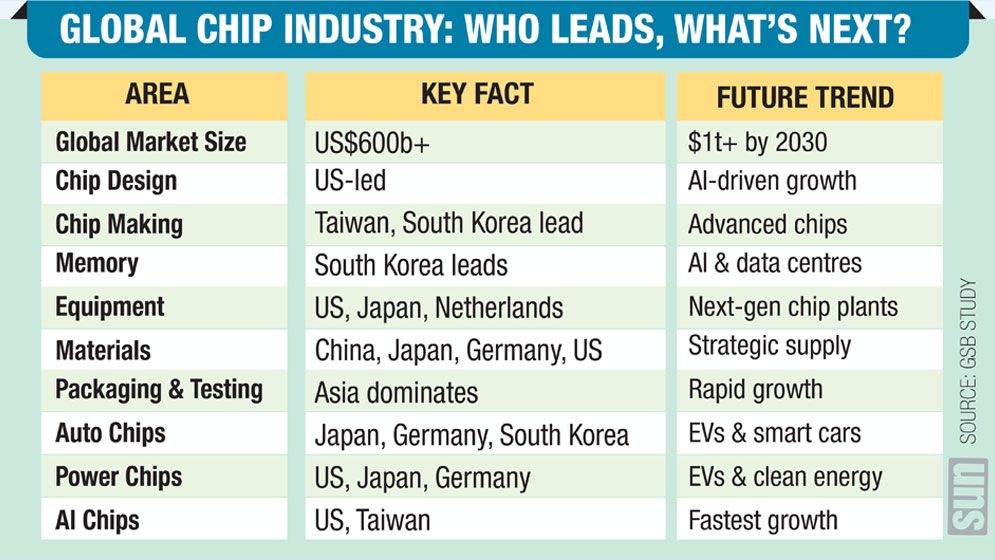
The finding comes as the global semiconductor industry races towards US$1 trillion in annual sales, driven by artificial intelligence, data centres, advanced telecommunications, electric vehicles and the clean-energy transition.
Authored by Dr Md Sohel Rana, deputy director (Geology) at GSB, the study proposes a long-term strategy to explore converting Bangladesh’s quartz-rich river sediments into high-value materials for specialty glass, solar technology, optical fibre, and semiconductors.
But the study also draws a clear line between potential and proof.
Bangladesh has an enormous quartz-rich resource, but it has not yet established that its river sand can meet the extreme purity standards required for semiconductor manufacturing.
A geological gift from the Himalayas
Bangladesh’s potential begins thousands of kilometres upstream. For millions of years, weathering and erosion have broken down rocks across the Himalayan region.
The Ganges-Brahmaputra-Meghna river system transports this material southwards, depositing huge quantities of sediment across Bangladesh.
The country effectively sits at the end of a giant natural mineral conveyor belt.
According to GSB data cited in the review, the major river basins contain more than 300 billion tonnes of estimated sand resources, while around 1-1.5 billion tonnes of fresh sediment may be naturally replenished each year during the monsoon.
Sand deposits in riverbeds can reach 5-30 metres in depth. Quartz accounts for nearly 89% of the light mineral fraction, while heavy minerals make up around 8%-15% by weight.
The Brahmaputra-Jamuna system has the highest reported heavy-mineral concentration at around 10%-15%, followed by the Padma at 8%-13% and the Teesta at 7%-12%.
Much of this resource is currently used for concrete, brickmaking, road construction and landfilling.
The study argues that Bangladesh may be capturing only a fraction of the potential economic value of this vast geological resource.
The purity gap
The biggest hurdle is not the availability of sand. It is purity.
Research on Brahmaputra River sand indicates that physical separation techniques – such as reverse flotation, electrostatic separation, and magnetic treatment – can boost silica purity to roughly 99.5% silicon dioxide.
At this level, the material becomes suitable for high-value applications, including glass and ceramic manufacturing.
Semiconductor manufacturing, however, operates at an entirely different level of precision.
Producing electronic-grade silicon requires extreme purity and tight control over trace impurities like iron, titanium, sodium, lithium, boron, and aluminum.
The transition from raw quartz to semiconductors involves multiple stages of high-temperature processing and chemical purification before ultra-pure polysilicon is converted into single-crystal silicon, wafers and, ultimately, integrated circuits.
In simple terms, 99.5% purity is impressive for industrial silica, but it is nowhere near enough for semiconductor-grade material.
The GSB review acknowledges that Bangladesh currently lacks the detailed scientific evidence needed to establish whether its river sands can eventually meet those requirements.
High-precision trace-element analysis, crystallographic studies and pilot-scale chemical purification are still required.
The study therefore presents semiconductor-grade quartz as a research opportunity, not an established resource.
Beyond the chip factory
The bigger opportunity for Bangladesh may lie in industries that require high-purity silica but involve lower capital and technology barriers than advanced chip fabrication.
High-purity silica is used in solar photovoltaic technology, specialty glass, optical fibre and telecommunications.
Demand for these materials is expected to rise as the global economy becomes increasingly digital and electrified.
Bangladesh could also target less capital-intensive parts of the semiconductor value chain, including:
* Integrated-circuit design
* Electronic-system development
* Semiconductor intellectual property
* Outsourced semiconductor assembly and testing
* Advanced packaging
* Specialty glass and optical materials
These industries could generate higher-value exports and make use of Bangladesh’s growing pool of engineers and technology graduates.
The strategy, therefore, is not to leap directly into advanced chip fabrication, but to build capabilities step by step.
A 25-year journey: From river sand to silicon
GSB roadmap charts Bangladesh’s path from quartz-rich sediments to high-value materials and semiconductors
The GSB review lays out an ambitious 25-year roadmap, from 2026 to 2050, built around a bold proposition: Bangladesh’s quartz-rich river sediments could become the foundation for a high-value materials industry and, ultimately, a domestic semiconductor ecosystem.
The roadmap begins in 2026-2030 with a nationwide effort to map, sample, and analyse river sands to identify deposits with the highest potential for high-purity applications.
A specialised Sand Processing and Research Center would support laboratory research, pilot projects, and the development of purification technologies.
The next phase (2031-2035) focuses on pilot-scale commercialisation, targeting more than 1,000 tonnes of high-purity silica annually for markets like specialty glass, laboratory glassware, and optical-fibre materials.
During this phase, Bangladesh could also build capabilities in IC design, semiconductor assembly, and testing – linking its mineral resources directly to the electronics industry.
From 2036-2040, the target would be to raise high-purity silica production beyond 5,000 tonnes a year while exploring pilot-scale semiconductor manufacturing based on mature technologies.
The 2041-2045 phase could then advance towards commercial production of mature-node semiconductor devices, supported by capabilities in advanced packaging, testing and chiplet integration.
By 2046-2050, the vision is for Bangladesh to emerge as a global supplier of high-purity quartz, silica and silicon-based materials, backed by a wider electronics and semiconductor ecosystem.
Reaching that point would require sustained investment in research, infrastructure, skills, technology transfer and industrial capacity.
Priorities to unlock the potential
The roadmap calls for a coordinated national effort, starting with systematic exploration to identify and protect the country’s most promising quartz deposits using advanced mineralogical and geochemical analysis.
To support this, Bangladesh will need a dedicated research and processing center capable of developing and testing scalable purification technologies.
Building a skilled workforce would be equally critical, with universities and technical institutions developing expertise in semiconductor materials, mineral processing, electronics and chip design.
Rather than immediately competing with the world’s most capital-intensive chip fabs, Bangladesh could focus first on more realistic opportunities such as IC design, specialty glass, optical fibre and semiconductor assembly and testing.
A long-term national framework would also be needed to align investment, research, skills development, technology transfer and public-private partnerships, while ensuring environmental safeguards.
Big opportunity, bigger challenges
The ambition faces significant hurdles, including high capital costs, advanced technology requirements, intellectual-property constraints, energy needs and skills shortages.
Environmental risks are equally substantial. Uncontrolled sand mining could accelerate riverbank erosion, damage aquatic ecosystems, and disrupt natural river dynamics.
The study offers far more than a semiconductor vision: it invites Bangladesh to rethink the value of its quartz-rich river sediments and explore whether a resource long viewed as simple construction material could serve as the foundation for a high-value industrial chain.
If the science proves viable, the technology can be developed and extraction managed sustainably, the country could embark on a remarkable journey from Himalayan sediment to high-value materials, and potentially from river sand to silicon.
The rivers have supplied the raw material. Now science, industry and policy must turn it into value.

