


 For all latest news, follow the Daily Sun's Google News channel.


Weak demand hits industrial raw material imports
Capital machinery imports fall 10.68% as businesses defer new investment amid headwinds

Weak domestic demand, high inflation, elevated borrowing costs, energy supply uncertainty, and low business confidence continue to drag down industrial activity.
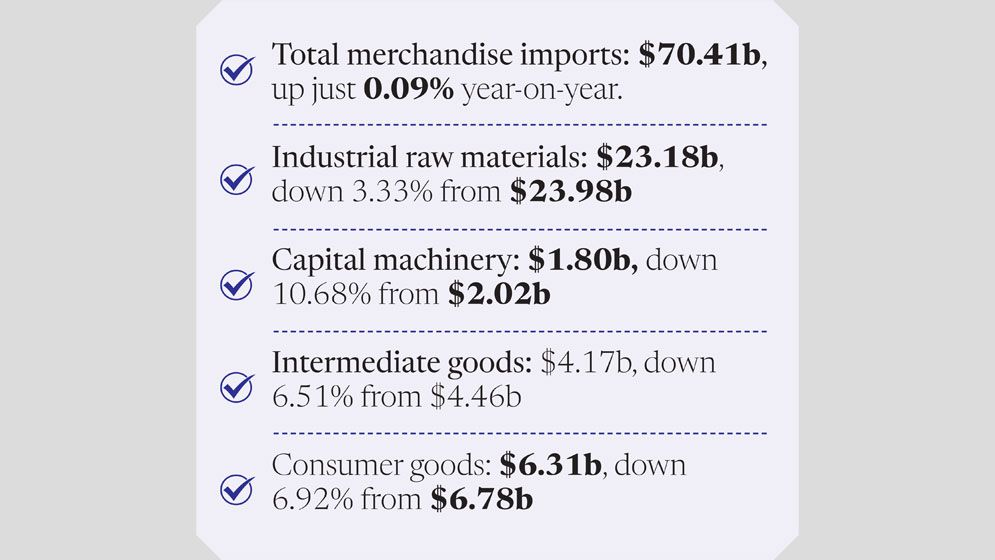
Reflecting this slump, imports of capital machinery – a key gauge of new investment and factory expansion – fell sharply by 10.68% to US$1.80 billion in FY26, down from $2.02 billion the previous fiscal year.
Imports of industrial raw materials also contracted by 3.33% over the same period.
Bangladesh spent $23.18 billion on raw material imports in FY26 compared to $23.98 billion a year earlier, according to central bank data.
Imports of intermediate goods declined by 6.51%, with expenditure falling to $4.17 billion in FY26 from $4.46 billion a year earlier.
The decline in production-oriented imports comes despite almost no change in the country’s overall import bill.
Total merchandise imports stood at $70.41 billion in FY26, compared with $70.34 billion in FY25, registering a marginal 0.09% increase.
The figures suggest that while imports as a whole have remained broadly stable, demand for goods directly linked to industrial production and fresh investment has weakened.
Meanwhile, consumer goods imports dropped 6.92% to $6.31 billion from $6.78 billion, providing another indication of subdued domestic demand.
Businesspeople say the decline in industrial raw material imports is primarily a reflection of weaker market demand.
Persistent inflation has eroded consumers’ purchasing power, reducing demand for products ranging from consumer goods to construction materials.
As orders have weakened, manufacturers have little incentive to increase production. Many factories are operating below capacity, while some have partially or completely suspended production.
As a result, entrepreneurs are importing only the amount of raw materials necessary to keep their existing operations running rather than bringing in additional stocks to increase production.
Businesspeople say they are also reluctant to build inventories because of uncertainty over future demand.
Shams Mahmud, president of the Bangladesh-Thai Chamber of Commerce and Industry (BTCCI), told the Daily Sun that the sharp drop in capital machinery imports reflects a broader slump in fresh industrial investment.
“Entrepreneurs are increasingly delaying new projects and expansion plans as they remain uncertain about future demand, operating costs, and the overall business environment,” Mahmud said. “Although pressure on foreign exchange reserves has eased compared to previous years, uncertainty persists across several sectors.”
He noted that many investors are taking a “wait-and-see” approach rather than committing capital to new factories.
Construction and consumer goods processing are among the hardest hit by weak demand, forcing many businesses to curb production and focus on survival.
Energy security remains another major hurdle. Business leaders say potential investors hesitate to build new facilities – even in designated economic zones – without guaranteed, uninterrupted gas and power supplies.
Banks focus on loan recovery
The slowdown in industrial activity is also being reinforced by cautious bank lending.
Bankers say most banks are now placing greater emphasis on recovering existing loans rather than aggressively expanding new lending.
The high burden of defaulted loans and financial weaknesses in several banks have made lenders more cautious about approving large loans, particularly for new investment projects.
Syed Mahbubur Rahman, managing director of Mutual Trust Bank, said the country is weathering a period of broad economic strain.
“Declining export demand, reduced purchasing power, the gas crisis, and overall uncertainty have discouraged entrepreneurs from making new investments,” Rahman said, adding that high inflation has also dampened demand for bank loans.
“Because of uncertainty in the business environment, entrepreneurs are adopting a wait-and-see strategy instead of committing large capital,” he added. “This is directly affecting industrial production, raw material imports, and job creation.”
Bangladesh Bank officials, however, believe that the current low credit growth should not be viewed entirely negatively.
They said high private-sector credit growth in the past was partly driven by loans concentrated among influential borrowers.
A significant portion of such loans subsequently became defaulted, while cases involving money laundering also emerged.
Against this backdrop, the current cautious approach to lending has a positive side, they said.
Bangladesh Bank has meanwhile taken steps to support economic activity by reducing its policy rate.
The central bank recently cut the repo rate to 9.5% from 10%, marking its first policy-rate reduction in nearly years.
The rate cut is expected to lower banks’ cost of borrowing from the central bank and, eventually, put some downward pressure on lending rates.
Read More