


 For all latest news, follow the Daily Sun's Google News channel.


Unico bets on quality care to keep patients home
Daily Sun Report, Dhaka
Published: 11 Aug 2026, 12:00 AM
For many Bangladeshis, seeking medical treatment abroad is not simply a matter of choice. It is often a question of trust - whether the diagnosis will be accurate, the treatment reliable and the overall standard of care comparable with overseas facilities.
Unico Hospital is seeking to challenge that mindset by building a healthcare model around patient-centred care, advanced technology and international experience, with the aim of making more high-quality medical services available in Bangladesh.
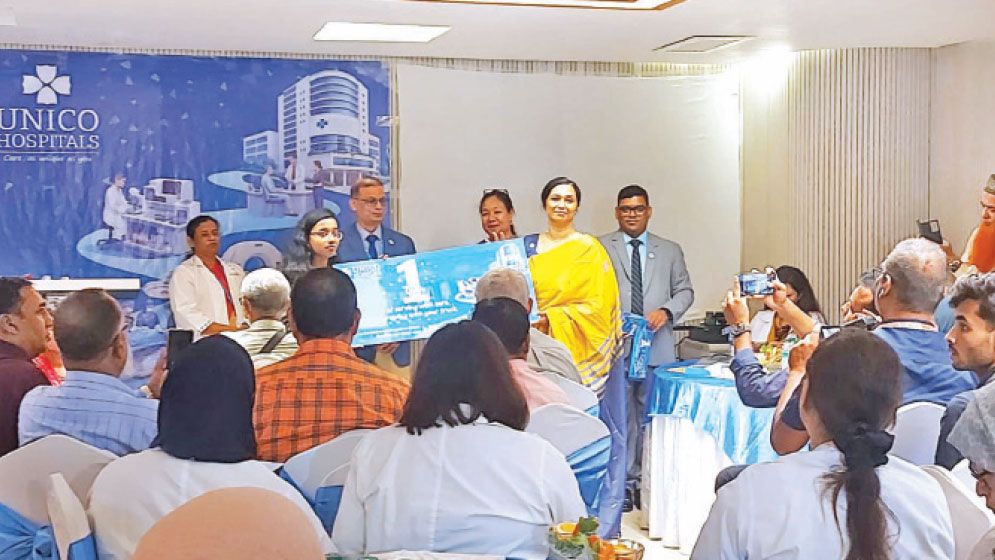
The hospital, which recently marked its first anniversary, says it treated more than 12,000 new patients during its first year, averaging close to 1,000 new patients a month, according to CEO Ardra Kurien.
For a new institution, the numbers are notable. But Unico’s larger ambition goes beyond patient volume: it wants to build confidence that patients can receive reliable care at home when the required services are available locally.
Building trust, not just infrastructure
Unico Managing Director Tazul Islam Dhali said the founders entered healthcare after identifying a gap between Bangladesh’s medical talent and the way that expertise is organised and delivered.
Bangladesh has highly qualified doctors, nurses and technical professionals, he said, but bringing them together as an integrated team remains a challenge.
Unico describes itself as a “human service platform”, where every member of staff, from doctors and nurses to support personnel, contributes to the patient’s overall experience.
Kurien said doctors are encouraged to spend adequate time listening to patients and understanding their individual circumstances. Unico says doctors are not encouraged to spend less than 15 minutes in an outpatient consultation and receive no financial incentive for prescribing medicines, laboratory tests or radiology investigations.
The stated objective is to place clinical judgement and patient welfare ahead of commercial considerations.
Technology designed around the patient
The hospital is also investing in digital infrastructure.
Kurien said Unico operates a single hospital information system covering electronic medical records, human resources, supply chain, finance, medicines and administration.
Patients can access approved laboratory, ECG, echocardiography and radiology reports through a digital patient portal, alongside outpatient summaries.
The system is intended to give patients greater control over their medical information and improve continuity of care. Unico is also developing telemedicine capabilities and has integrated diagnostic systems with its electronic medical-record platform.
Bringing advanced care closer to home
Unico’s strategy also focuses on services that could reduce the need for overseas treatment.
Kurien said the hospital is seeking to develop advanced minimally invasive cardiothoracic procedures, including newer approaches to valve replacement, alongside high-end interventional cardiology services.
Its antenatal programme provides structured support to expectant mothers and their families throughout pregnancy.
The hospital is also exploring genetic testing and analysis, particularly for preventive healthcare and cancer treatment. Discussions are under way with a group that could support DNA extraction and genetic analysis capabilities in Bangladesh.
Unico does not claim that every specialised service can already be delivered locally. Kurien cited proton therapy as one example of treatment that remains unavailable in Bangladesh.
The objective is therefore not to eliminate overseas treatment altogether, but to reduce unnecessary medical travel by expanding dependable services at home.
When patients choose Bangladesh
The strongest evidence comes from patients themselves.
At the anniversary event, Farah, who had planned to travel to India for surgery, said she reconsidered after learning about Unico through a friend and speaking with its doctors. With two young children, travelling abroad would have created additional difficulties, so she chose to undergo treatment in Bangladesh.
Her decision reflects a broader reality: patients may travel abroad not because Bangladesh lacks medical expertise, but because they want confidence in the entire healthcare system.
That confidence depends on more than doctors and equipment. It encompasses diagnosis, nursing, communication, transparency, technology and the overall treatment journey.
Other patient stories reinforce the point.
Mehzabin Shahidi, who received antenatal care at Unico, said she initially felt apprehensive about choosing a relatively new hospital. She later decided to deliver there after being impressed by the service and support she received during pregnancy.
Rittika, who travelled from Narsingdi with her daughter after seeking treatment at several hospitals in Dhaka, also described a positive experience and said her daughter’s condition improved after treatment.
For a young hospital, such experiences can become a powerful source of credibility through word of mouth.
International experience, local ambition
Although Kurien is Indian, she stressed that Unico is fundamentally a Bangladeshi healthcare institution, with most of its doctors and staff being Bangladeshi.
The hospital is drawing on international experience. Dhali said the management has sought technical assistance and collaboration, including expertise from Kerala, India, where healthcare institutions have developed substantial experience in organised care delivery.
The emphasis is not simply on acquiring sophisticated equipment. A modern machine, Dhali argued, is useful only when supported by trained professionals, technical expertise and effective systems.
That is why Unico places particular emphasis on diagnosis. Accurate diagnosis, the management says, is the foundation of appropriate treatment.
A bigger challenge for Bangladesh
Unico’s first year raises a question that extends beyond one hospital: Can Bangladesh turn medical trust into a domestic advantage?
The answer will depend on sustained clinical quality, transparent practices, skilled professionals, advanced diagnostics, patient rights and affordability.
Unico says it has also introduced programmes for senior citizens and assistance mechanisms for financially vulnerable patients, reflecting its broader claim that healthcare should be treated as a human service rather than simply a commercial transaction.
The hospital’s journey is still at an early stage. Twelve thousand new patients in a year do not, by themselves, prove that Bangladesh’s medical-travel trend is reversing.
But they suggest that patients are willing to give local institutions a chance when they encounter credible doctors, modern systems and a positive experience of care.
The real test for Unico - and Bangladesh’s wider private healthcare sector - will be whether that trust can be sustained through clinical outcomes and consistent standards.
Read More