


 For all latest news, follow the Daily Sun's Google News channel.


6 to 170 – Bangladesh builds campuses, not rankings
India, Pakistan pull ahead in research output

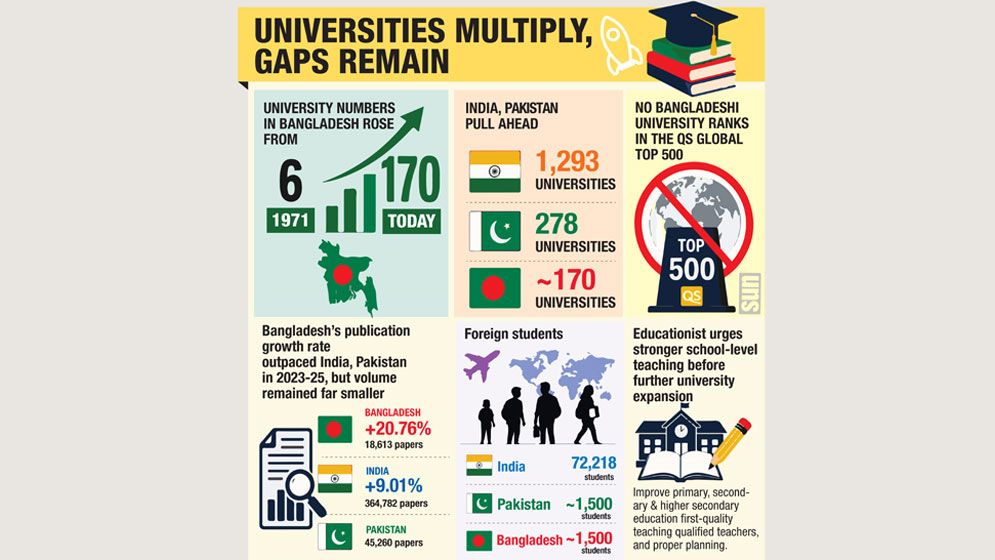
Bangladesh’s university count has grown nearly thirty-fold since independence, from six institutions in 1971 to around 170 today, but the country continues to trail India and, on several measures, even Pakistan in research output, global rankings and international student numbers – a gap that sits uneasily alongside the government’s ambition to build a “global education hub”.
The government’s stated goal comes as data shows that while Bangladesh has focused primarily on expanding access through new universities, India has become South Asia’s research powerhouse and Pakistan has made steady gains in research output and international visibility over the past two decades.
When British India was partitioned in 1947, East Bengal, later East Pakistan, was left with a single university: Dhaka University, founded in 1921. Expansion was slow over the following two decades, with Rajshahi University established in 1953, Bangladesh Agricultural University in 1961, the institution now known as BUET in 1962, Chittagong University in 1966 and Jahangirnagar University in 1970.
After independence, higher education was declared a pillar of national reconstruction, and the University Grants Commission (UGC) was set up in 1973.
Bangladesh had six public universities at that point, and only two more were added before 1990.
Growth accelerated in the 1990s, when the Private University Act of 1992 opened the sector to private investment.
According to the UGC’s latest report, Bangladesh now has 110 private universities, though seven have yet to begin academic activities and four are flagged as red-listed.
By comparison, India’s University Grants Commission puts the country’s total at 1,293 universities, comprising 57 central universities, 521 state universities, 157 deemed-to-be universities and 558 private universities.
Pakistan has 278 universities and higher education institutions, according to the Pakistan Scientific and Technological Information Centre (PASTIC), of which 163 are publicly funded and 115 privately managed, spread across 77 cities.
India dominates rankings; Bangladesh misses top 500
Bangladesh’s expansion has not translated into global standing.
The QS World University Rankings 2027 include 52 Indian universities and 18 Pakistani universities, against just 13 from Bangladesh.
Only three Bangladeshi universities feature in the global top 1,000, and none reaches the top 500.
Research output rising, but from a low base India also leads South Asia comfortably in scientific publications, producing 364,782 in 2025, up from 318,691 in 2023 – growth of 9.01%.
Pakistan ranked second, publishing 45,260 papers.
Bangladesh’s output rose from 15,028 in 2023 to 18,613 in 2025, a growth rate of 20.76% – faster than either neighbour, though its overall volume remains far smaller.
Foreign student numbers
India also draws far more international students than its neighbours, hosting 72,218 from nearly 200 countries. Pakistan hosts around 1,500 foreign students, while Bangladesh has approximately 633.
Improve schools first, says educationist
Mohammad Mojibur Rahman, professor at Dhaka University’s Institute of Education and Research, told Daily Sun that Bangladesh needed to strengthen education at lower levels before expanding higher education further.
“We are not providing the quality of teaching expected at the primary, secondary and higher secondary levels. We do not have enough qualified teachers, while teachers are poorly paid and face various other challenges,” he said.
“In many other countries, education is compulsory and free up to Grade 12. We need to focus on improving education at the lower levels before putting greater emphasis on higher education,” he added.
Mojibur Rahman said Bangladesh also needed proper planning based on population and educational needs.
“Simply establishing universities and constructing buildings will not be enough. We need proper planning in every aspect. A comprehensive plan should be developed through the formation of an education commission,” he said.
He added that turning Bangladesh into a global education hub would also require creating conditions to draw Bangladeshi academics working abroad back home.
“We need to improve law and order and raise the standard of living. India, Pakistan, Nepal and Malaysia are all recognising the contributions of teachers and improving their salary structures,” he said.
“If we can formulate a comprehensive master plan covering all these issues, Bangladesh can establish a stronger position in the global education landscape,” Mojibur Rahman said.