






 For all latest news, follow the Daily Sun's Google News channel.


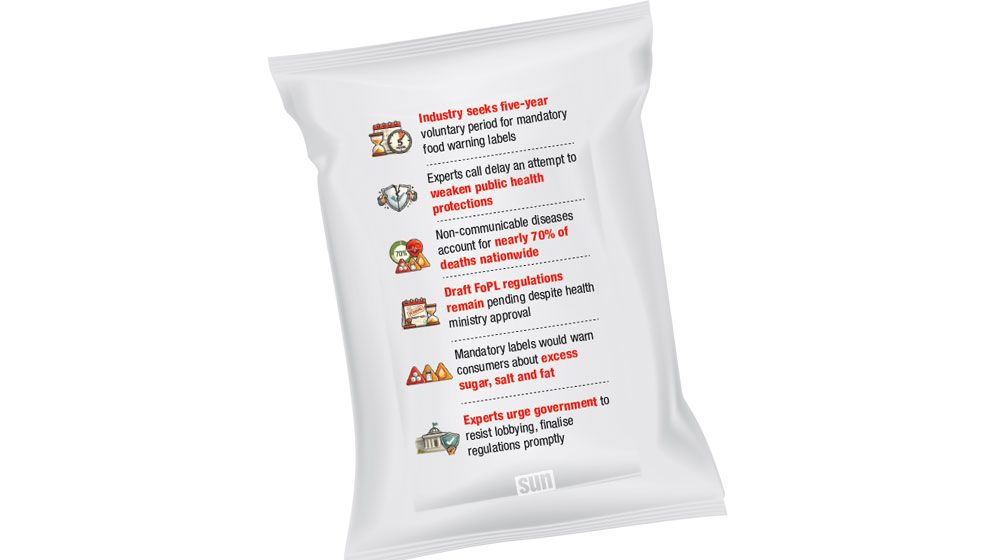
As Bangladesh moves closer to introducing mandatory front-of-pack warning labels on packaged foods high in sugar, salt and saturated fat, public health experts have accused the food industry of trying to derail the reform by lobbying for a five-year voluntary implementation period.
Nutrition experts, lawyers and public health advocates say the proposal would significantly weaken the draft “Food Safety (Labelling of Packaged Food) Regulations, 2026”, arguing that it prioritises commercial interests over public health at a time when non-communicable diseases (NCDs) account for around 70% of all deaths in the country.
They have urged the government to resist corporate pressure and swiftly finalise a science-based, mandatory Front-of-Pack Labelling (FoPL) framework.
Food manufacturers, along with several domestic and international industry bodies, including the International Council of Beverages Associations (ICBA), are pushing for changes that critics say would dilute the proposed regulations.
Their key demand is that the warning label system remain voluntary for at least five years to allow the industry to adapt.
Public health advocates dismissed the demand as unjustified.
“It is nothing but an attempt to weaken the upcoming Front-of-Pack Labelling regulations,” said Kamrunnisa Munna, senior policy analyst at the Center for Law and Policy Affairs (CLPA).
She described the proposal as “technically unreasonable, strategically delayed and directly contrary to the interests of public health”.
Admitting that lobbying is taking place, BFSA member Professor Dr Mohammad Shoeb said the draft regulations had already been forwarded to the relevant ministry.
“They (manufacturers) have some activities. We sent the draft regulations to the food ministry on 30 June. The commerce ministry will probably hold another meeting on this. Then the regulations will be finalised,” he told the Daily Sun on Wednesday.
Although Bangladesh first initiated FoPL reforms through proposed amendments to the Food Safety Regulations, 2017, progress has repeatedly stalled.
A draft titled “Food Safety (Labelling of Packaged Food) Regulations, 2023” was prepared but never implemented. The issue was revisited in early 2025, when the Bangladesh Food Safety Authority (BFSA) was tasked with revising the regulations, but no visible changes followed.
In early 2026, the BFSA prepared the latest draft regulations, while the proposed FoPL design received approval from the health ministry. However, the draft remains pending, with officials yet to complete the approval process.
Dr Ahmed Khairul Abrar, assistant scientist at the National Heart Foundation, urged the authorities not to bow to pressure from manufacturers.
“The authorities concerned should not succumb to the pressure and lobbying that is going on to weaken the proposed regulations. The government should take a strong stand in this regard,” he said.
Barrister Nishat Mahmood of the Bangladesh Supreme Court also opposed any grace period.
“Policymakers must reject calls for a five-year voluntary period. Mandatory warning labels are essential to protect public health. FoPL will empower consumers to make informed food choices, reduce the consumption of unhealthy products and help ensure every citizen’s fundamental right to information,” she said.
Experts say many consumers regularly buy packaged foods without understanding their nutritional content or associated health risks.
Excessive consumption of foods high in sugar, salt and unhealthy fats increases the risk of obesity, hypertension, diabetes, heart disease and other NCDs.
They warn that children and adolescents are particularly vulnerable because of their high consumption of processed foods.
Advocate Syed Mahbubul Alam, a public health and environmental policy expert, said prominent warning labels would help young consumers make healthier choices.
“Globally, the FoPL system is recognised as an effective tool to help consumers quickly identify healthier food options. Bangladesh should make its implementation mandatory by enacting the drafted regulation as soon as possible,” he said.
Under the draft regulations, packaged food labels must be clear, visible, securely attached and written in Bangla. Labels must not contain misleading or false information, while multi-unit packages must display at least one visible label.
The draft also requires manufacturers to clearly identify the nature of food products, processing methods and imported food descriptions. Additives such as artificial flavouring, natural flavouring and colouring must be declared.
Manufacturers would also be required to disclose ingredients, their proportions, animal sources, compound ingredients and allergens. Misleading claims such as “pure” or “purity” would be prohibited, while allergens must be prominently highlighted.
The proposed rules further require nutrition information, including energy, protein, fat, carbohydrates, sugars, sodium and salt, to be displayed on packaging. Separate labelling requirements have also been prescribed for non-retail food packages.
Industry representatives argue that redesigning packaging and adjusting supply chains would require about five years.
However, critics say that claim is contradicted by the industry’s own business practices.
Food and beverage companies routinely redesign and roll out new packaging within weeks for Pahela Baishakh, Eid, Durga Puja, Victory Day, major sporting events, promotional campaigns and limited-edition products.
“Where rapid change is routine for commercial gain, requesting a five-year delay in printing a simple health warning label is a tactic for delay,” Kamrunnisa Munna said.
Experts warn that if Bangladesh adopts a voluntary system for five years, most unhealthy packaged foods would remain without warning labels, denying consumers vital health information and defeating the very purpose of the proposed regulations.