


 For all latest news, follow the Daily Sun's Google News channel.


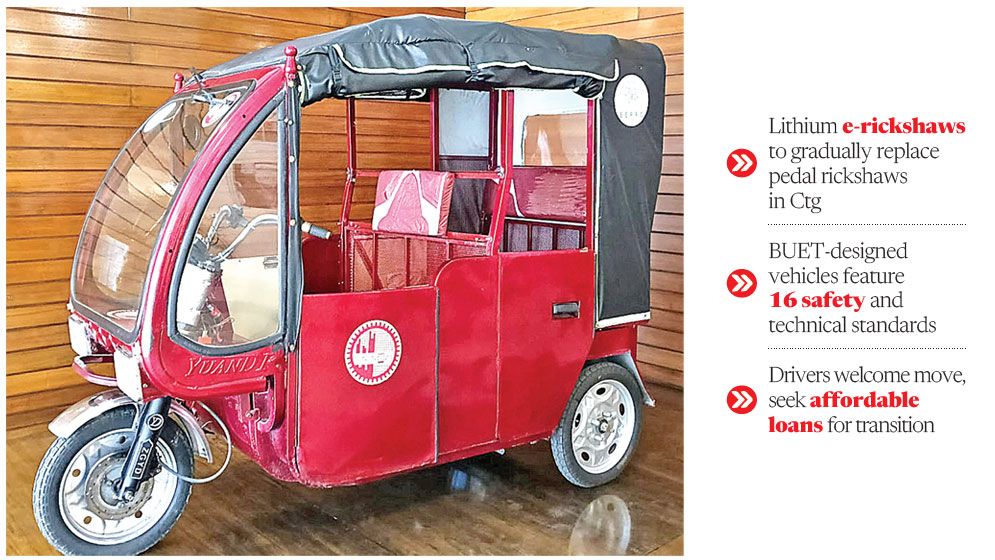
Chattogram is set to overhaul its urban transport system by gradually replacing traditional pedal rickshaws with lithium battery-powered e-rickshaws under a new initiative aimed at improving road safety, reducing traffic congestion and modernising public transport.
The programme, launched by the Chattogram City Corporation (CCC), is also expected to ease the physical burden on rickshaw pullers while introducing a cleaner, safer and more organised mode of transport.
According to CCC officials, around 70,000 registered and unregistered rickshaws currently operate across the port city.
Under the proposed policy, owners will receive one licence for a lithium-powered e-rickshaw after surrendering the licences of two registered pedal rickshaws. City authorities believe the measure will gradually reduce the number of vehicles on the roads, improve traffic management and create a more efficient transport network.
BUET-designed model focuses on safety
The new e-rickshaw, designed by the Bangladesh University of Engineering and Technology (BUET), incorporates 16 standard safety and technical features to enhance passenger and driver safety, durability and environmental sustainability.
A pilot project using the BUET-designed vehicle was launched in Aftabnagar, Dhaka, on 4 January this year.
The e-rickshaws will use environmentally friendly lithium batteries instead of conventional lead-acid batteries and will have a maximum speed of 30km/h.
They will also be fitted with geo-fencing technology to prevent them from operating outside designated areas or entering highways.
Why lithium batteries?
Lithium-powered three-wheelers are gaining popularity worldwide because of their lower carbon emissions, greater efficiency and lower long-term operating costs.
According to market research firm Mordor Intelligence, lithium-ion batteries typically last for more than 5,000 charge-discharge cycles, compared with only 400 to 500 cycles for conventional lead-acid batteries. Their lighter weight also enables vehicles to travel longer distances on a single charge.
Some garage owners in Chattogram have already begun switching to lithium batteries.
Mohammad Solaiman, who owns a garage in Chandgaon, said lead-acid batteries generally need replacing every eight to 12 months and require regular maintenance, including topping up water.
“In contrast, lithium batteries last three to five years and can be fully charged within one to three hours,” he said.
Ismail Hossain, owner of Battery Cell Centre in Colonel Hat, said that although lithium batteries involve higher initial costs, they are more economical in the long run.
“Drivers do not have to replace them every year. They also require no regular water refilling or acid leakage checks. Faster charging and lower weight allow drivers to operate longer hours while consuming less electricity,” he said.
Strict licensing policy
CCC officials said new licences would be issued only to owners of legally registered pedal rickshaws that have regularly renewed their annual licences.
Under the scheme, one lithium e-rickshaw licence will be issued in exchange for the licences of two registered pedal rickshaws. Unregistered or unauthorised vehicles will not be eligible.
Mayor Dr Shahadat Hossain said the initiative was intended to modernise the city’s entire rickshaw system rather than simply replace existing vehicles.
“We will gradually replace pedal rickshaws with lithium-powered e-rickshaws. This will reduce drivers’ physical hardship, improve passenger services and help protect the environment,” he said.
He added that updating the database of registered rickshaws would also make traffic management more effective.
Drivers seek financial assistance
Rickshaw drivers and owners have welcomed the initiative but urged the government to introduce affordable financing to help them switch to the new vehicles.
Rimon Hossain, a 38-year-old rickshaw puller from Jamal Khan, said riding through steep roads and busy commercial areas every day was physically demanding.
“An e-rickshaw will reduce our hardship. We will be able to complete more trips in less time, which is likely to increase our daily income,” he said.
Abdul Kader Majumder, president of the Chattogram Metropolitan Rickshaw Drivers and Owners Unity Council, described the initiative as a positive step but stressed that the licensing process must remain transparent and free from corruption.
He also called for easy loan or instalment facilities, saying the cost of lithium batteries remained beyond the reach of many drivers and small-scale owners.
Urban planners believe that if successfully implemented, Chattogram’s transition to lithium-powered e-rickshaws could become a model for sustainable urban transport across Bangladesh.