


 For all latest news, follow the Daily Sun's Google News channel.


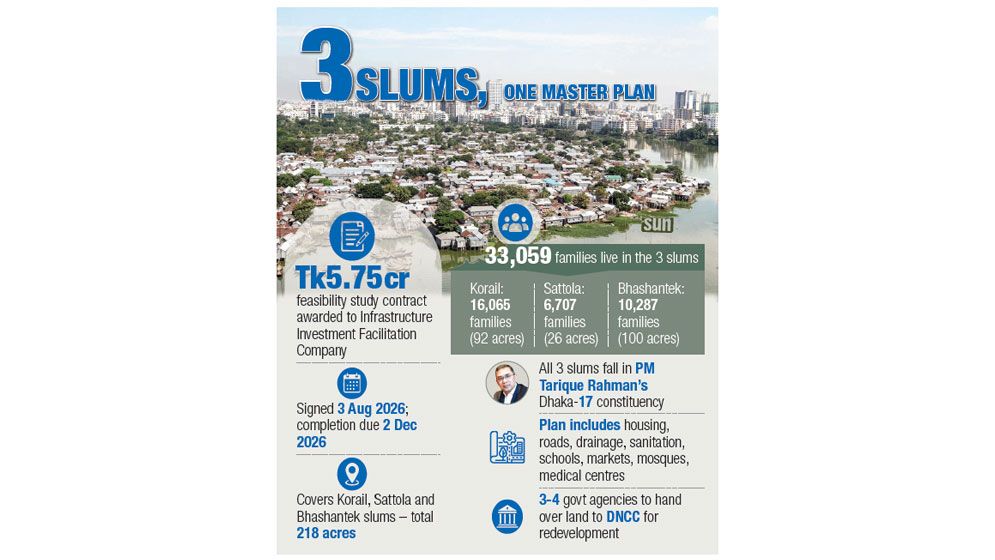
More than 33,000 families packed into three of Dhaka’s largest slums could soon swap tin shacks for high-rise flats, as the Dhaka North City Corporation (DNCC) launches a feasibility study and master plan to transform Korail, Sattola and Bhashantek slums – a project rooted in a political promise from ruling party BNP to lift slum dwellers out of squalid, hazard-prone conditions.
The DNCC awarded a Tk5.75 crore contract to Infrastructure Investment Facilitation Company through single-source selection on 30 July.
The agreement was signed on 3 August and is due for completion by 2 December, with DNCC Superintending Engineer Faruque Hassan Md Al Masud signing off on the deal.
The initiative aims to secure high-rise housing and community facilities for slum residents while tackling recurring hazards such as fire and waterlogging.
A study by Dustha Sashtya Kendra found 33,059 families living across the three slums, with 25,328 of them settled there for more than five years. Korail houses 16,065 families, Sattola 6,707, and Bhashantek 10,287.
Notably, all three slums fall within the Dhaka-17 constituency, represented by Prime Minister and local MP Tarique Rahman, who pledged during his election campaign to improve living conditions in the area.
Together, the settlements sprawl across roughly 218 acres – among the largest clusters targeted under any slum improvement drive to date.
Korail, straddling Gulshan, Banani and Mohakhali, covers 92 acres; Sattola, in Mohakhali, spans 26 acres; and Bhashantek, spread across Bhasantek Bazar, Dhamalcoat and Tekpara, occupies 100 acres.
DNCC documents describe conditions in the slums as dire: poor housing, narrow access roads, inadequate drainage, limited sanitation and insufficient waste management, with no planned community infrastructure to speak of.
The study is expected to map out infrastructure gaps, housing demand, service shortfalls and land-use constraints, alongside temporary relocation requirements, environmental risks and the socio-economic needs of residents – laying the groundwork for a practical, sustainable improvement plan.
Under the contract, the appointed consultant must draw up an upgrading plan geared towards improving residents’ living conditions, environmental health and climate resilience, proposing durable housing, all-weather internal roads, drainage, sanitation, safe water supply, solid waste management and community facilities.
The brief also calls for proposals on residential apartments, water and sanitation systems, stormwater drainage, waste collection, pedestrian walkways, roads, street and security lighting, and public parks and green spaces – along with crime and violence prevention measures, including community centres.
Planned in-situ developments include residential apartments for existing slum dwellers, shopping malls and bazaars, restaurants, mosques and other religious facilities, medical centres, colleges, schools, kindergartens, playgrounds, property management centres and waste collection points.
The consultant has also been tasked with analysing the socio-economic profile of each slum – family size, income levels, economic activity, existing living conditions, length of residency and the authenticity of dwellers’ claims – as well as policy, legal and regulatory matters, land ownership, the in-situ redevelopment process, relocation and compensation issues, planning codes, construction standards and institutional arrangements.
Speaking to the Daily Sun on Thursday, DNCC Urban Planner Remon Ahmed Asif said, “The living conditions of the slums are not suitable for a healthy life.
Under the project, conditions will be improved and proper sanitation and their facilities will be ensured. Under the contract, we will get a proposal on how we can upgrade the living conditions of the densely populated area with all civic facilities.”
He added, “We have to go for a high-rise building to save space for other common facilities like a mosque, market, community centres and others. The consultant will also suggest an ownership or rental model and detail the development costs. We can follow the example of slum development in Mumbai.”
Asif said three to four government agencies currently own the land in question and would hand it over to the DNCC for redevelopment.
The proposed redevelopment has raised hopes among many residents, who say decades of overcrowding, poor services and recurring fires have made life increasingly difficult.
Shadat Hossain, a resident of Korail’s Bow Bazar area originally from Begumganj in Noakhali, welcomed the government’s initiative, saying he hoped it would bring lasting improvements to the settlement.
“I live here with six members of my family. Among the many problems, the most disturbing is the regular fire incidents. The roads are so narrow that fire engines cannot enter to extinguish the flames. The government should set up a fire station here and ensure a proper water supply,” he said.
A rickshaw puller by profession, Shadat said he pays Tk5,000 a month for two tiny tin-roofed rooms with concrete floors, with gas and water charges included in the rent. “I have an ailing father and three siblings. If the government gives us a flat, even with a small payment scheme, we will be grateful,” he added.
Mst Aklema, who has lived in Bhangadeyal slum for the past 17 years, said residents there had yet to receive any information about the government’s redevelopment plan.
She lives with her husband and son in a one-room rented house, paying Tk3,000 a month, excluding gas, water and electricity bills.
“If the government builds apartment buildings for us with proper facilities, it will certainly benefit us. We are poor and cannot afford expensive flats in good buildings,” she said.