


 For all latest news, follow the Daily Sun's Google News channel.


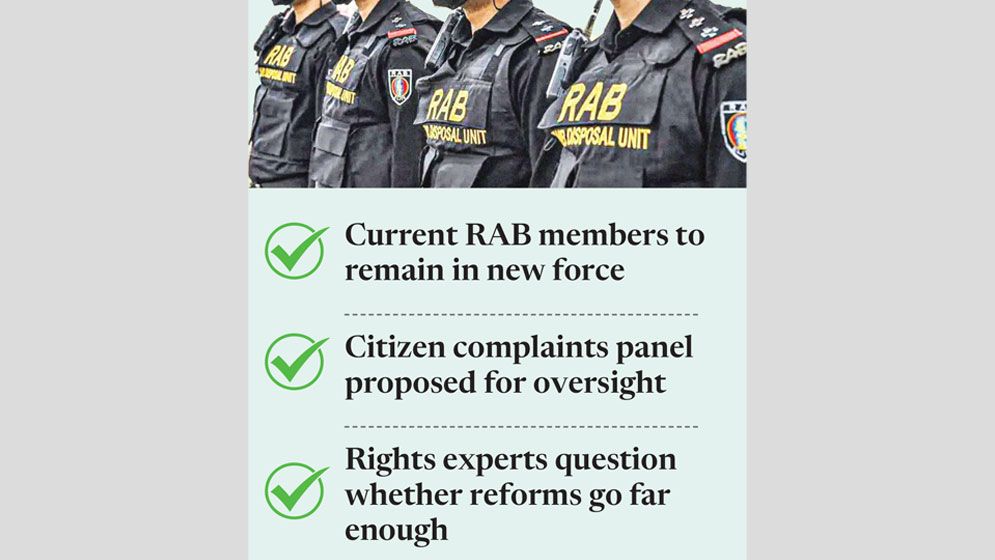
The government has moved to replace the Rapid Action Battalion (RAB) with a new force named the Special Response Battalion (SRB), but the proposed law retains the existing structure, personnel and operational powers, with the notable addition of a committee to investigate public complaints against its members.
The Ministry of Home Affairs on Tuesday published the draft “Special Response Battalion Act, 2026” on its website, inviting opinions from the public. Feedback has been sought via [email protected].
Under the proposed law, the SRB will be established by repealing the provisions of the “Armed Police Battalions (Amendment) Act, 2003”, under which RAB was formed. However, all current RAB personnel will automatically become members of the new force.
The SRB will operate as a specialised unit under Bangladesh Police, headed by an additional inspector general serving as director general (DG). Police and armed forces personnel will continue to be deputed to the battalion for two-year terms.
If necessary, the DG may recommend through the inspector general of police (IGP) that deputed personnel be returned to their parent organisations. The ranks, appointments and service conditions of SRB members will be determined under the new law.
According to the draft, the SRB will have its own flag, insignia and uniform. Its headquarters will be in Dhaka, while units may be established elsewhere in the country with prior government approval.
The proposed law assigns the force a wide range of responsibilities, including protecting internal security, gathering intelligence, recovering illegal firearms, ammunition, explosives and narcotics, combating organised crime and human trafficking, and taking action against crimes such as violence against women and children, rape, abduction, murder, land grabbing and enforced disappearances.
The SRB will also assist other law enforcement and security agencies, file cases and conduct investigations as directed by the courts, the government or the IGP, and perform any additional duties assigned by the government.
Subject to the Code of Criminal Procedure and other applicable laws, the force will have the authority to enter premises, conduct searches, seize property and make arrests. Those arrested, along with seized property, must be handed over to the nearest police station without delay.
The battalion will have its own lock-ups, interrogation rooms and “malkhanas” (property storage facilities), while seized property will be disposed of in accordance with court orders or government rules.
The draft law also provides for departmental action against SRB members accused of crimes or negligence. The force may detain its own members for up to 15 days during investigations and arrest those who attempt to flee after committing an offence.
A key new provision is the formation of a complaints committee to examine allegations lodged by citizens against SRB personnel.
The committee will be headed by the additional director general of the SRB and include a representative from the Ministry of Home Affairs, a Police Headquarters officer of at least assistant inspector general (AIG) rank, a government-nominated individual with at least 10 years’ experience in human rights, law or the administration of justice, and the SRB director (Legal and Media), who will serve as member secretary.
The committee may investigate complaints itself or assign an investigating officer to do so and recommend disciplinary action if allegations are proven.
The draft law also requires all deputed members to undergo training after joining the force.
Reacting to the proposal, Nur Khan Liton, former member of the Commission of Inquiry on Enforced Disappearances and former executive director and secretary of Ain o Salish Kendra, said the draft introduced little change apart from the complaints committee and a new uniform.
“The members of the Armed Forces will be in the SRB as they are in the RAB. Keeping the military personnel, the SRB cannot get rid of the defamation the RAB did. The SRB should be constituted with only the trained members of police,” he told the Daily Sun.
Questioning the effectiveness of the proposed oversight mechanism, he said: “It will have human rights activist who will be appointed by IGP or SRB DG. So, question raises what the committee can do for the people.”
Crime analyst Dr Tawohidul Haque, an associate professor at the University of Dhaka, also argued that changing the force’s name and uniform alone would not restore public confidence.
“The RAB should be made accountable and transparent as the force was used for political purpose in the past,” he said.
“The image will not restore only changing the name. Internal departmental inquiry against the SRB force members will not bring good result. It will need multiple stakeholders to look into their offences.”