


 For all latest news, follow the Daily Sun's Google News channel.


SECOND ANNIVERSARY OF JULY UPRISING
Nationalism, July and Bangladesh of the Future: Continuity of State-thought

Nationalism is one of the most powerful political ideas in the modern state system. The birth of a state, its legitimacy, the political loyalty of its people, and national identity – nationalism sits at the centre of all of it. The political scientist Benedict Anderson explained the nation as an “imagined political community”, in which the members regard themselves as part of a single community on the basis of a shared identity even though they never personally know one another. Ernest Gellner tied this to the structural transformation of modern society, while Anthony D Smith placed his emphasis on history, tradition and cultural memory. The unfolding of Bangladesh’s national identity does not stand outside this global reality either, though our  own road was far bloodier and more complicated.
After the mass uprising of 2024, an old question has come to the fore once again: what is the identity of the state? Are we merely a nation defined by language, or are we the citizens of an independent state? The history of the world teaches us that a state does not automatically mature into a nation simply by being born on a map. A map can be drawn in a single day, but national identity, the trust of citizens and loyalty towards the state are built up across generation after generation of experience and through a political and social contract.
Bangladesh’s national identity first took shape through our Language Movement, the struggle for autonomy, the Great Liberation War and the founding of an independent state. From the Language Movement of 1952 to the Liberation War of 1971, Bengali nationalism was the principal cultural and political catalyst, the force that united a nation in an anti-colonial struggle. Yet immediately after independence, a fundamental question arose: on what foundation would the identity of this war-ravaged state rest? Building an inclusive civic identity for every religion, community and ethnic group living within a sovereign territory became the newborn state’s central challenge.
The year 1975 is a decisive turning point in Bangladesh’s political history, and historians and analysts remain divided over it to this day: some see it as a political realignment, others as the outward expression of a deep crisis. In the period that followed, “Bangladeshi Nationalism” emerged under the leadership of President Ziaur Rahman as a coherent philosophy of the state, one that brought territory, sovereignty, the constitution and citizenship to the centre of identity. These years saw the reintroduction of a multiparty political system and an emphasis on economic development, agriculture and a diversified diplomacy, although political debate over this period, too, continues.
For narrow political ends, Bengali and Bangladeshi nationalism are often presented as mutually opposed. However, a deeper reading of history shows a different picture: Bengali nationalism gave us the cultural and historical foundation of independence, while Bangladeshi nationalism gave us the civic and sovereign framework for running the state. In the Bangladesh of the future, it is only reasonable to see these two legacies not as rivals but as complements.
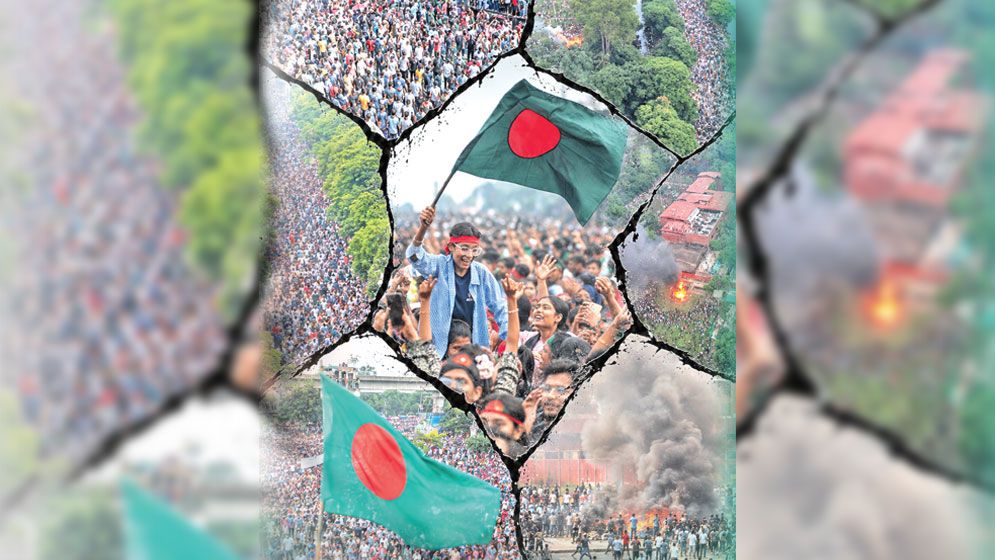
On 16 July 2024, the pellet fire directed at Abu Sayeed in Rangpur did not merely condense a mass movement into a single demand; it set off an unprecedented political awakening among the young generation. The country’s average age is only a little over 26, and nearly two-thirds of its people are under 35; against that reality, the awakening on the streets proves that the civic demands of this digital generation cannot be met with the old ideological divisions. The greatest lesson of July is not simply a change of government; it is a change in what citizens expect of the state.
There are various readings of the background, the causes and the significance of this uprising, which began as a movement to reform the quota system; some have seen it as a movement for democratic rights, some as a demand for reform of the state, and others as the political awakening of a new generation. One thing, however, is clear: the broad participation of students and of many social groups proved that the young generation wants more than a change of power; it wants accountable institutions, justice and equality of opportunity.
The “July National Charter” was drawn up at the initiative of the interim government formed in the continuity of the July uprising. In the national referendum held on 12 February 2026, this charter and the associated proposals for constitutional reform received a majority of the votes. One group of analysts regards this as a historic opportunity to correct a flawed political and constitutional framework; others hold that more cautious analysis is needed as to whether a reform process driven by the political emotion of the moment has been tested enough to secure long-term stability. This year, on the second anniversary of the July uprising, the observance of July Martyrs’ Day across the country showed that the post-1975 question of Bangladeshi nationalism and the post-2024 question of reforming the state have become part of the same continuum.
Rebuilding national identity is not a new phenomenon. After Otto von Bismarck took office in 1871, he strengthened the loyalty of the German nation not only through military force, but also by introducing the world’s first social security system. Singapore, which began its journey after separating from Malaysia in 1965, was built by Lee Kuan Yew based on zero-tolerance corruption and merit-based governance. Turkey’s Mustafa Kemal Ataturk also built a modern republic based on civil rights after the fall of the Ottoman Empire. The evolution of Bangladesh’s state ideology is also in line with this global experience.
The debate over nationalism is no longer confined to the political stage today; its reflection can be seen in the economy as well. Bangladesh is now an emerging economy of roughly 450 billion dollars. A poverty rate that stood above 80 per cent at the time of independence has fallen dramatically to around five per cent. The vast exports of the ready-made garment sector, the earnings of expatriates and the successes of agriculture are proof of economic capability. And yet a low score on the human capital index, a poor position on the corruption perceptions index and the very large number of young people who are outside both education and employment remind us of a hard truth: economic growth and institutional good governance are not the same thing.

In the words of the political scientist Samuel Huntington, the durability of a state depends not on political participation alone but on the institutional capacity to keep that participation well organised. And in Max Weber’s terms, a state becomes stable over the long run only when its people place their trust in its institutions, its laws and its processes of decision-making. If a state cannot give equal rights and security to every one of its citizens Chakma, Santal, Bengali, Hindu, Muslim or expatriate then nationalism becomes nothing more than an empty political slogan.
Bangladesh’s position in the geopolitics centred on the Bay of Bengal is significant. Amid the tug-of-war for power between India, China and the United States, the new form of Bangladesh’s nationalism ought to be “strategic autonomy,” maintaining a balance centred on the national interest rather than depending on any single great power. Although the primary aim of an independent state’s foreign policy is to protect the national interest, that does not mean remaining isolated; it means strengthening one’s own position through balanced relationships.
If nationalism in post-July Bangladesh is to be given the shape of a modern, state-centred philosophy, it will have to stand on five pillars. Firstly, territorial sovereignty and civic pluralism: rising above religious, linguistic or ethnic identity to guarantee equal constitutional rights. Secondly, historical inheritance and democratic consciousness: bringing together the democratic spirit of 1952, 1971 and 2024 to build a shared national narrative of pride. Thirdly, institutional good governance and a merit-based system: building a state that rests on institutions in place of a politics that rests on individuals. Fourthly, an inclusive economy and human capital: carrying the benefits of growth through to people at the margins. Fifthly, strategic autonomy and foreign policy: conducting dignified relations abroad with the national interest placed first of all.
Critics may say that a fresh debate over nationalism could create division rather than unity. That is a reasonable concern. But the real question is not whether nationalism will remain; it is how inclusive and how citizen-friendly it will be. Division is created when nationalism is turned into an instrument of partisanship; but when it guarantees good governance, the rule of law and equal opportunity, it builds a bridge to unity.
What Bangladesh needs now is a new social contract, and it can rest on three things: strong institutions, in which the law matters more than any individual or group; inclusive development, in which every citizen has access to the opportunities of development; and national unity, in which everyone gives the highest priority to the shared interest even where political opinions differ. The July Charter and the constitutional reform process may be seen as an institutional attempt to rebuild that social contract, though its real success will be proved only through long-term implementation.
In the end, the true identity of a state is determined by the quality of life of its people. A flag, a territory, and a political philosophy become meaningful only when they bring hope, security and dignity into the lives of ordinary people. History proves that the people of this country have found a new path out of crisis again and again. 1952 taught us our language, 1971 gave us independence, and 2024 reminded us that the real strength of a state comes not from the barrel of a gun but from the belief of its citizens. The history of Bangladesh to come will be written on the strength of its capacity to keep that belief.
_______________________________________________
The writer is the Defence Advisor to the Prime Minister and a former Brigadier General