



 For all latest news, follow the Daily Sun's Google News channel.


Two years after the July uprising, judicial accountability for the atrocities committed during the student-led movement remains incomplete.
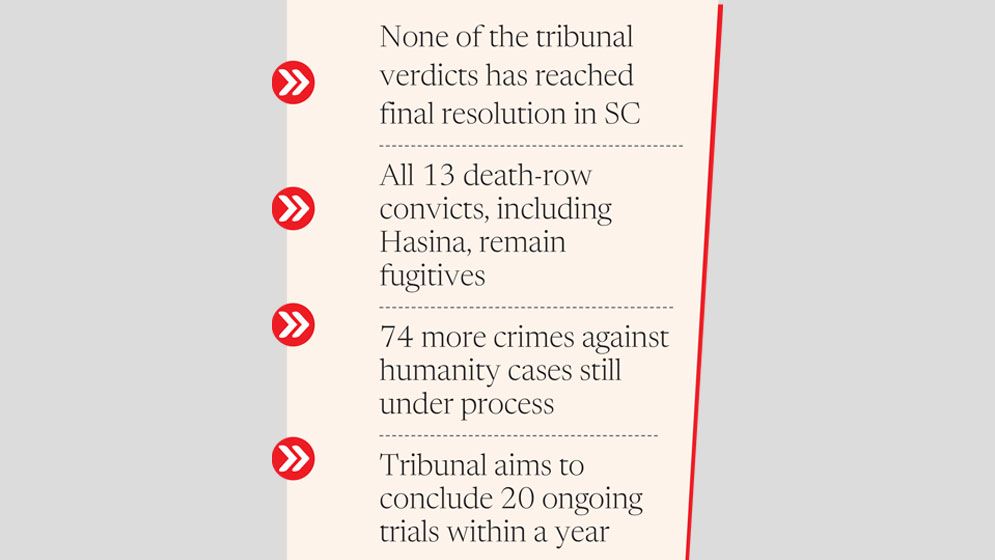
While the International Crimes Tribunal (ICT) has convicted 60 people in six cases, no proceedings in the regular courts have reached a conclusion, none of the tribunal verdicts has become final, and all 13 death-row convicts remain at large.
The anniversary of 5 August marks two years since the violent uprising that toppled the Sheikh Hasina-led Awami League government following widespread bloodshed and allegations of crimes against humanity.
According to tribunal records, investigators have documented information on 509 incidents linked to the uprising across the country. More than 80 crimes against humanity cases have so far been filed with the ICT. The two tribunals – ICT-1 and ICT-2 – have delivered verdicts in six cases, convicting a total of 60 individuals. Of them, 13 were sentenced to death, while the others received life imprisonment or varying prison terms.
Despite those convictions, none of the death sentences has been carried out, as all 13 condemned individuals, including ousted fascist prime minister Sheikh Hasina and former home minister Asaduzzaman Khan Kamal, remain outside the authorities’ reach.
Moreover, none of the ICT verdicts has attained finality, with appeals pending before the Appellate Division of the Supreme Court. No appeal hearing has yet taken place, meaning the judicial process remains incomplete.
ICT Chief Prosecutor Md Aminul Islam said on Tuesday that the prosecution was working to conclude 20 cases currently under trial within the next year while maintaining international standards of justice.
He also said preparations were under way for the appeal hearings before the Supreme Court.
According to tribunal data, 74 other cases remain under active proceedings. Of these, 23 have reached the evidence and witness testimony stage, while 51 are still under investigation.
Hundreds accused, many still absconding
The ICT cases collectively involve 465 accused. Among them, 175 are in custody, 280 remain fugitives, one has died and another has been acquitted.
The latest person shown arrested in a July uprising case is Major (retd) Md Mozaffar Hossain, a convicted fugitive in the 1981 assassination case of President Ziaur Rahman. He was produced before the tribunal on 23 July and shown arrested in a crimes against humanity case linked to the uprising.
Former Awami League minister Abdul Latif Siddique was also arrested on 29 July in connection with an ICT case, although that relates to the 2013 Shapla Chattar crackdown rather than the July uprising.
High-profile verdicts
The first verdict delivered by the reconstituted tribunal sentenced Sheikh Hasina and former home minister Asaduzzaman Khan Kamal to death after finding them guilty of crimes against humanity linked to the deadly crackdown on protesters during the uprising.
Other cases decided by the tribunal include the killing of Abu Sayed, regarded as the first martyr of the uprising; the killing and burning of six youths in Ashulia; the Chankharpool massacre in Dhaka; and the Rampura case involving the fatal shooting of a youth hanging from the cornice of an under-construction building, along with the killing of two others.
In the most recent verdict, delivered on 30 June, Jatiya Samajtantrik Dal (JSD) President and former minister Hasanul Haq Inu was sentenced to 10 years’ imprisonment, becoming the first senior political leader in custody to be convicted over the 2024 atrocities.
Victims seek complete justice
Human rights advocates say the convictions represent progress but argue that justice will remain incomplete until appeals are concluded and the convicted fugitives are brought back to face punishment.
Advocate Muzahedul Islam Shahin of the Supreme Court said verdicts alone offered little solace to victims’ families if those sentenced to death remained beyond the reach of the law.
“Justice delivered on paper offers little comfort to the victims’ families when those condemned to death remain at large. Ensuring accountability requires proactive diplomatic pressure alongside domestic law enforcement action,” he told the Daily Sun.
He noted that, under the law, the judicial process cannot be regarded as complete until the Supreme Court disposes of the appeals and delivers final judgments.
Meanwhile, tribunal officials said several other high-profile cases are approaching completion.
The trial of Awami League General Secretary Obaidul Quader, along with senior leaders of the Juba League and Bangladesh Chhatra League, is in its final stages.
The prosecution began its closing arguments on Tuesday, with verdicts in the case expected in the coming weeks.