


 For all latest news, follow the Daily Sun's Google News channel.


A hospital built to treat the sick children of southern Dhaka is instead turning many of them away after dark – not for want of beds, wards or equipment, but for want of the staff to run them.
Dhaka Mahanagar Shishu Hospital, a 100-bed facility on Gaurasundar Roy Lane in Lalbagh under the Dhaka South City Corporation (DSCC), has all the trappings of a well-equipped children’s hospital: a digital pathology laboratory, X-ray facilities, physiotherapy services, operating theatres, an Expanded Programme on Immunisation (EPI) centre and dedicated wards for diarrhoea and dengue. What it lacks is doctors. A recent visit to the four-storey building, set on nearly a bigha of land, found the infrastructure well maintained but badly underused.
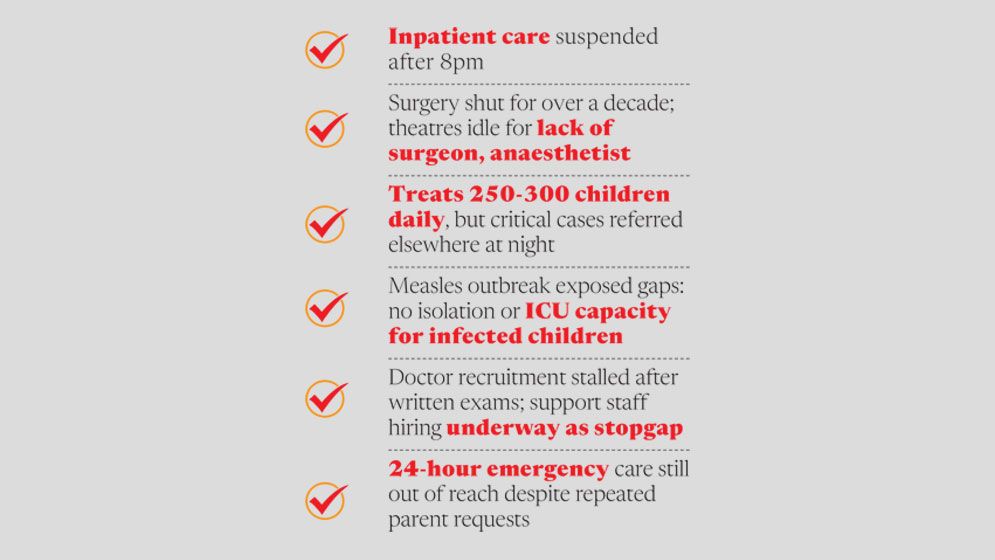
The surgery department has sat idle for more than a decade. Round-the-clock inpatient care was suspended in mid-2023. After 8pm, the hospital cannot admit anyone.
Acting Director and Consultant Pathologist Dr Hamida Khatun, who joined the hospital in 2014 following a promotion, said the facility now runs on a skeleton crew of just six doctors.
It offers emergency care, general medicine, and its diarrhoea and dengue wards, alongside pathology, X-ray and physiotherapy services – but has no blood bank of its own, and its operating theatres stand unused for lack of a surgeon and anaesthetist.
“Previously, when we had adequate manpower, we could run the hospital properly. But over the years, as the number of doctors and staff kept declining, the situation has become increasingly difficult,” she told the Daily Sun.
The shortfall has consequences that go well beyond administrative inconvenience.
When measles swept the country recently, the hospital could offer only outpatient care and initial clinical management for infected children before referring serious cases elsewhere – because treating measles properly demands isolation facilities, intensive care and staff the hospital simply does not have, Dr Hamida explained.
Even so, the hospital remains a lifeline for low- and middle-income families in the area, treating 250-300 children daily between 8am and 1pm for outpatients, and up to 8pm for emergencies.
Pneumonia, dengue, diarrhoea, typhoid, respiratory infections and seasonal viral illnesses account for most cases, and many patients receive medicines free of charge.
But once evening emergency hours end, families are left with few options.
Patients needing further treatment must go home and return the next day; the critically ill are sent on to Bangladesh Shishu Hospital and Institute, Sir Salimullah Medical College (Mitford) Hospital, or other government facilities.
For parents, the gap is felt keenly.
Mukta Mandal, who lives in the Khaje Dewan Lane area of Lalbagh, said the hospital offers good treatment and free medicines, but that the absence of round-the-clock inpatient care pushes families towards other facilities whenever an emergency strikes.
Rokeya Khanam, from the Lalbagh Kella area, said her son was once treated here for just Tk10 – yet each time his condition worsened, she had to rush him elsewhere.
DSCC’s Chief Health Officer and hospital superintendent Dr Jahane Ferdous Binte Rahman did not dispute the picture.
“We do not have enough doctors and manpower. We are unable to provide the level of service we want to offer patients,” she told the Daily Sun.
She said a recruitment drive for doctors had already reached the written examination stage before stalling – the viva voce round never took place, she said, “due to the political situation at the time,” leaving the process unfinished.
“The written tests were held, but the viva could not take place. Those candidates cannot simply be excluded now. The issue is under consideration, and we have already requested recruitment of doctors because we urgently need them.”
In the meantime, DSCC has begun hiring for support roles – computer operators, nurses, cleaners and investigation assistants – as a stopgap.
“Step by step we are trying to fill vacant positions. The issue of recruiting doctors is more complicated because of the earlier recruitment process that remained unfinished,” she added.
The staffing gap has also stalled DSCC’s ambition to run 24-hour emergency services at its hospitals, including Dhaka Mahanagar Shishu Hospital, where emergency care currently runs only in morning and evening shifts.
“We want to keep emergency services open 24 hours. But we do not have sufficient manpower. If we could appoint enough doctors and specialists for three shifts – morning, evening and night – it would greatly improve services and would also give us professional satisfaction,” Dr Ferdous said.
She acknowledged that extra staff could have made a real difference during the measles outbreak, but stressed the hospital continues to serve large numbers of children despite the constraints – many of whose families, she said, have repeatedly asked for night-time emergency treatment to be introduced.
Read More