


 For all latest news, follow the Daily Sun's Google News channel.


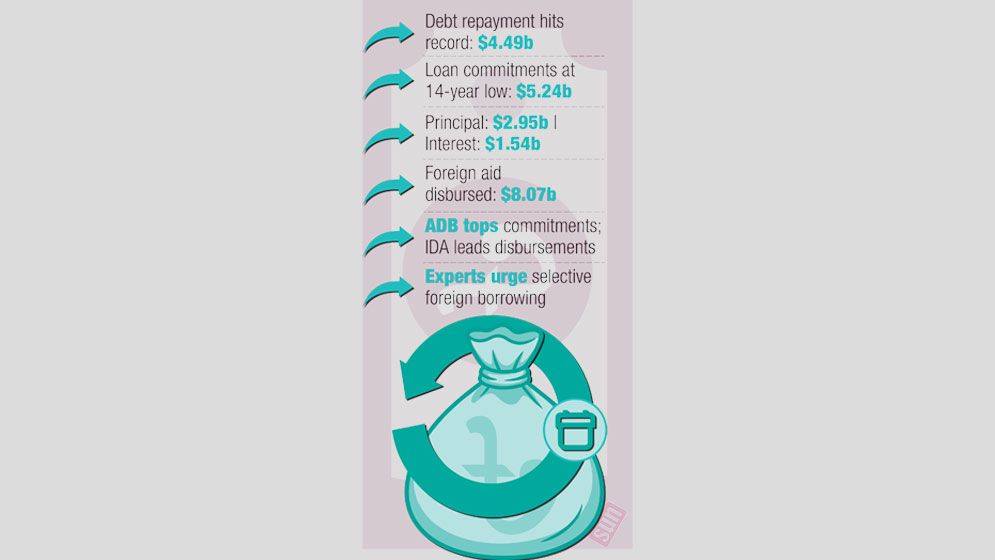
Bangladesh’s foreign debt servicing hit a record high in the fiscal 2025-26, with repayments nearly matching fresh external loan commitments as the country grapples with rising obligations from mega projects and a sharp decline in new development financing.
According to provisional data from the Economic Relations Division (ERD), Bangladesh repaid a record US$4.49 billion in principal and interest during FY26, up from $4.09 billion in the previous fiscal year.
The increase reflects a growing repayment burden as grace periods for several foreign-funded infrastructure projects expire.
Meanwhile, fresh foreign loan commitments fell sharply to $5.24 billion, the lowest level in 14 years.
The last time Bangladesh secured a lower amount was in FY12, when commitments stood at $4.76 billion. The latest figure is also close to the $5.26 billion recorded in FY15.
The data indicate Bangladesh is entering a new phase in which external borrowing is slowing while debt repayments continue to climb, putting greater pressure on foreign exchange reserves and public finances.
Debt burden continues to rise
ERD data show that of the $4.49 billion repaid in FY26, $2.95 billion was principal and $1.54 billion was interest. In local currency, the repayments amounted to about Tk54,957 crore.
The debt-servicing burden has risen steadily in recent years as repayment grace periods for many externally financed transport, energy and infrastructure projects have ended.
Dr Mustafa K Mujeri, former chief economist of Bangladesh Bank and executive director of the Institute for Inclusive Finance and Development (InM), said the combination of rising debt repayments and declining foreign loan commitments highlights the need for a more cautious approach to external borrowing.
“Bangladesh must ensure that every dollar borrowed is invested in projects capable of generating economic returns, export earnings or foreign exchange savings. Future external borrowing should be guided by project quality rather than the volume of borrowing,” he told the Daily Sun.
He also stressed the need to strengthen project appraisal, improve implementation efficiency and prevent cost overruns to maximise the benefits of external financing. “As debt repayments continue to rise, maintaining fiscal discipline, expanding domestic revenue and boosting exports will be critical to ensuring long-term debt sustainability,” he added.
Commitments fall despite strong disbursement
Despite weaker new loan commitments, foreign assistance disbursements remained robust.
According to the ERD, Bangladesh received $8.07 billion in foreign assistance during FY26, including $7.52 billion in project loans and $553.95 million in grants.
By comparison, new commitments totalled $5.24 billion, comprising $5.01 billion in loans and $233.78 million in grants.
The gap between commitments and disbursements reflects continued implementation of previously approved projects, even as development partners committed less new financing.
Among development partners, the Asian Development Bank (ADB) provided the largest new loan commitment at $2.69 billion, followed by the International Development Association (IDA) with $820 million, Japan with $314 million, China with $280 million and the Asian Infrastructure Investment Bank (AIIB) with $250 million.
Bangladesh received no new commitments from India or Russia during the fiscal year.
In terms of disbursements, the IDA ranked first with $2.07 billion, followed by the ADB ($1.91 billion), Russia ($1.05 billion), Japan ($795 million), AIIB ($693 million), China ($533 million) and India ($279 million).
Read More