


 For all latest news, follow the Daily Sun's Google News channel.


Dhaka presses Benazir’s return despite Dubai bail
Daily Sun Report, Dhaka
Published: 03 Aug 2026, 12:00 AM
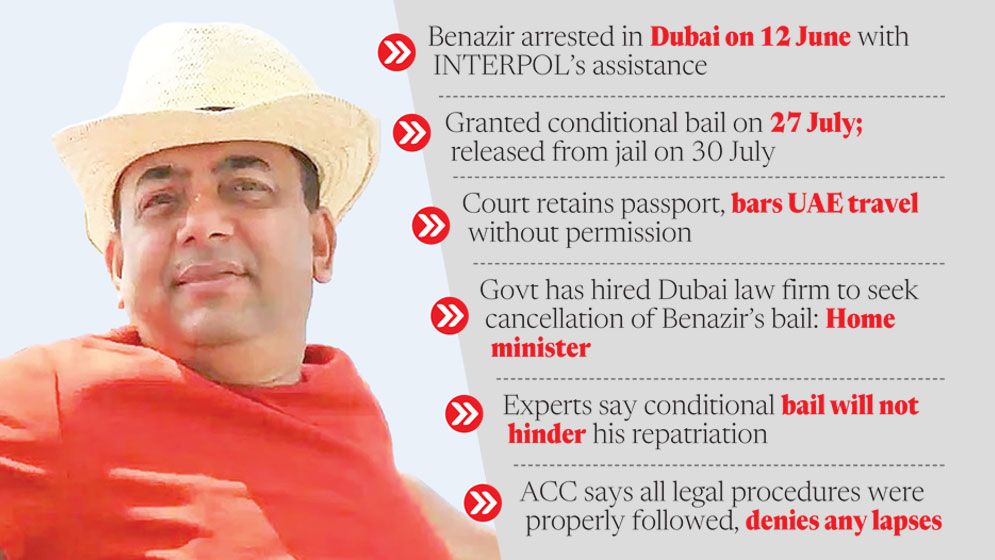
The government has moved to challenge the conditional bail granted to former inspector general of police (IGP) Benazir Ahmed by a Dubai court, insisting that his release will not derail efforts to bring him back to Bangladesh to face corruption charges.
Home Minister Salahuddin Ahmed said on Sunday that the government has already engaged a law firm in the United Arab Emirates (UAE) to seek cancellation of the bail, while the Ministry of Home Affairs continues the process of securing his return.
Benazir, who was arrested in Dubai on 12 June with the assistance of INTERPOL in connection with cases filed by Bangladesh’s Anti-Corruption Commission (ACC), was granted bail by a Dubai court on 27 July and released from prison on 30 July after completing the required legal formalities.
His release has raised questions over whether the extradition process could now face legal complications.
Responding to those concerns, the home minister said the government remained determined to pursue the case.
“We have already hired a law firm solely for this matter. The firm has been instructed to pursue the cancellation of the bail,” Salahuddin told reporters after an event at the Bangladesh Police Academy in Sardah, Rajshahi.
He expressed hope that the bail would be revoked, paving the way for Benazir’s return to Bangladesh.
Prime Minister’s Foreign Affairs Adviser Humayun Kabir also said the government had begun the formal process of bringing the former police chief back from the UAE.
“The home ministry has started the necessary process and discussions are ongoing,” he told reporters at the foreign ministry.
Echoing Humayun, State Minister for Foreign Affairs Shama Obaed Islam said the government is maintaining close communication with the United Arab Emirates (UAE) authorities and expressed optimism that Benazir would be brought back to Bangladesh soon.
“Communication between the two sides is underway and the required documents have been exchanged. They (the UAE) wanted some specific information, which was provided accordingly,” she said.
Shama said the UAE authorities are proceeding in line with their domestic laws, while Bangladesh will take the next steps through due legal process.
Legal and diplomatic experts, however, believe the bail itself is unlikely to prevent Benazir’s eventual extradition.
Former diplomat M Humayun Kabir told the Daily Sun that the conditional release should not become an obstacle, noting that an Interpol Red Notice had already been issued against the former IGP.
Former additional inspector general of police Dr M Akbar Ali acknowledged that the development could create some legal complexities but said the government’s continued efforts could still ensure Benazir’s return.
Following his release, Benazir confirmed that he had been granted bail in accordance with the court’s order and said he was in good physical condition.
Speaking to journalists in the UAE, he declined to comment on the next stage of the legal proceedings.
According to multiple sources in Dubai, the court imposed several conditions on his release, including surrendering his passport to the court and obtaining judicial permission before leaving the UAE.
The court granted the conditional bail after hearing arguments from both sides on the extradition documents submitted by the Bangladesh government and other related legal issues.
Meanwhile, the ACC said it had fulfilled all of its legal obligations in pursuing the former police chief and had not yet received any official notification regarding his release.
“We came to know about it through media reports, just as you did,” ACC Director General (Special Investigation) Mir Md Zainul Abedin Shebly told reporters at the commission’s headquarters in Dhaka.
“Whatever legal steps are necessary in this regard will certainly be taken by the relevant authorities,” he added.
Asked whether Benazir’s release indicated any shortcomings on the ACC’s part, Shebly firmly rejected the suggestion.
“There was no lapse on the ACC’s part. We took all actions required under the law,” he said.
He explained that under the Mutual Legal Assistance (MLA) framework, the Ministry of Home Affairs acts as Bangladesh’s central authority for international legal cooperation. The ACC sends its requests to the ministry, which then forwards them through the Ministry of Foreign Affairs to the relevant foreign government.
“Whatever documents and requests we were required to send, we had done so. Legal matters are handled jointly by all the relevant authorities,” he said.
Asked what might have prompted the Dubai court to grant bail, Shebly declined to speculate.
“It would not be appropriate to comment on the issue without having complete information,” he said.
The ACC has filed multiple cases against Benazir on charges of amassing illegal wealth and laundering money. As part of those investigations, Bangladesh initiated international legal measures that ultimately led to his arrest in Dubai.
Benazir served as Bangladesh’s inspector general of police from 15 April 2020 to 30 September 2022. Earlier, he served as commissioner of the Dhaka Metropolitan Police and director general of the Rapid Action Battalion (RAB).
In December 2021, the United States imposed sanctions on several current and former RAB officials over alleged human rights violations, with Benazir among those named.
The ACC launched an inquiry into his alleged accumulation of illicit assets in 2024. Around that time, Benazir left Bangladesh. Multiple corruption cases were subsequently filed against him, and courts later issued arrest warrants.