


 For all latest news, follow the Daily Sun's Google News channel.


Drugs replace cash as Myanmar border smugglers embrace ‘narco-currency’
Daily Sun Report, Dhaka
Published: 03 Aug 2026, 12:00 AM
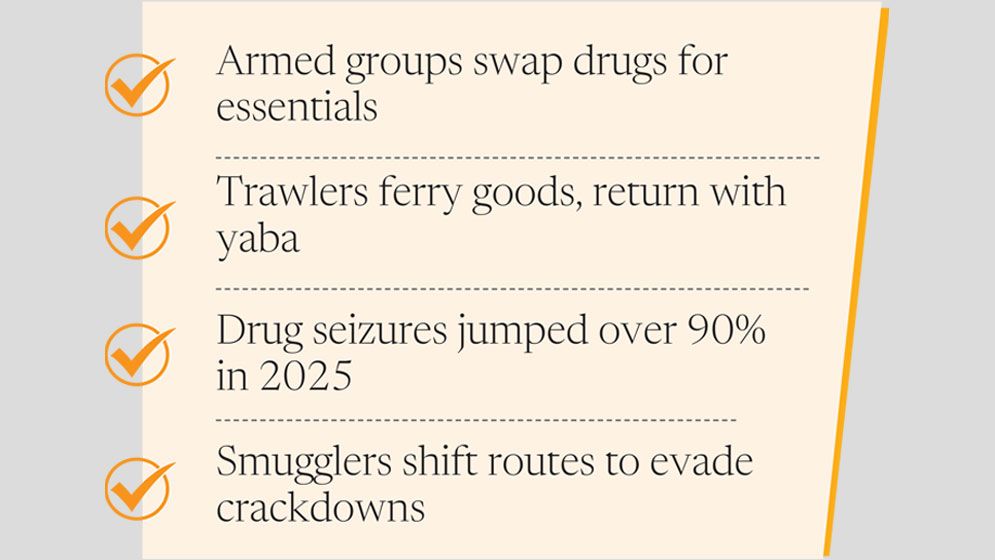
Armed groups in Myanmar’s conflict-ridden Rakhine State are increasingly paying for Bangladeshi food and essential supplies with yaba and crystal meth, creating a growing “narco-currency” system that is fuelling drug trafficking across the border, according to Bangladesh law enforcement and intelligence sources.
Officials from the Bangladesh Coast Guard (BCG) and the Department of Narcotics Control (DNC) said syndicates are smuggling yaba and “ice” into Bangladesh in exchange for rice, lentils, cement, fuel and other essentials transported across the Bay of Bengal.
Despite repeated crackdowns and arrests by the Coast Guard, authorities admit the illicit trade remains difficult to contain.
Sources said cross-border smuggling has evolved beyond conventional cash transactions. While part of the payment is still made through hundi, a significant portion is now settled with narcotics.
According to officials, the Arakan Army and other armed groups controlling large swathes of Rakhine are using drugs to pay for goods sourced from Bangladesh.
The trade is carried out mainly by fishing trawlers operating across the Bay of Bengal. Food and other essentials are shipped from Bangladesh, while drug consignments are loaded on the return journey.
A source familiar with the network said around 50% of the payment is transferred through hundi before goods leave Bangladesh. Another 25% is paid after the trawler departs a Myanmar jetty, while the remaining 25% is settled with yaba or crystal meth during handovers at sea.
The smuggling network has expanded as Rakhine grapples with severe shortages of rice, lentils, cement, ginger and other essentials amid the ongoing conflict.
According to investigators, one of the principal drug routes begins at Ayyik Sitt Jetty in Rakhine, about 80-100 kilometres by sea from Teknaf, where narcotics are loaded before being shipped across the Bay of Bengal.
Another route starts in Yangon and passes through Minbya, Ann, Sittwe, Rathedaung and Maungdaw before reaching areas bordering Bangladesh.
A source, speaking on condition of anonymity, said Myanmar-based smugglers use satellite phones to coordinate with Bangladeshi counterparts before transferring drug consignments at sea. The shipments are then brought into Bangladesh through various points along the Naf River.
The DNC Annual Drug Report 2025 said law enforcement agencies seized more than 43.5 million yaba tablets and quantities of crystal meth in 2025, a 90.58% increase from the previous year.
Officials attributed the surge to the Arakan Army’s territorial gains in Rakhine. Since fighting intensified in November 2023, the armed group has taken control of around 80% of the state, while restrictions imposed by Myanmar’s military have triggered acute shortages of food and fuel.
A senior police officer monitoring the Myanmar border said the Arakan Army is increasingly exchanging narcotics for essential goods from Bangladesh to sustain supplies in conflict-affected areas.
A fisherman who previously worked on a trawler operating between Chattogram and Myanmar alleged that a vessel owned by Khalil Majhi of Monpura in Bhola regularly transported rice, lentils, cooking oil and cement to Rakhine before returning with yaba.
Requesting anonymity, the fisherman claimed Khalil had been involved in the trade for about a year. Each round trip took around five days, with the head boatman receiving Tk300,000 and other crew members earning Tk30,000-Tk40,000.
He said the outward cargo was concealed beneath fishing gear, while yaba tablets were hidden inside fish and secret compartments on the return journey.
Khalil Majhi denied the allegations, saying he had rented out the trawler and reclaimed it after learning of the alleged smuggling activities.
DNC officials estimated that 80-90% of drugs entering Bangladesh are consumed domestically, while the remainder is trafficked overseas through airports and courier services.
They said enhanced scanners and CCTV surveillance at Dhaka and Chattogram airports have significantly reduced trafficking through air routes, while tighter monitoring has also disrupted attempts to send drugs to Oman, Saudi Arabia, Dubai, Europe, the United States and Australia through courier networks.
Border Guard Bangladesh (BGB) officials said traffickers routinely shift routes in response to tougher enforcement.
Lt Col Md Zahirul Islam, commanding officer of BGB-64 Battalion, said stronger surveillance merely displaced the networks.
“When pressure increases in one area, they move to another route,” he said.
The Bangladesh Navy has also stepped up operations, seizing large consignments of cement, lentils, ginger, diesel and other goods believed to have been destined for Rakhine.
Officials said the repeated seizures reflected soaring demand for Bangladeshi products in Myanmar’s conflict-hit border region. A bag of cement costing around Tk500 in Bangladesh can reportedly fetch nearly 100,000 Myanmar kyat in Rakhine, providing a powerful incentive for smugglers.
Officials also warned that using narcotics as a form of payment is no longer confined to the Myanmar frontier. Similar barter systems have emerged along the India border, where smugglers exchange phensedyl, cannabis and heroin for gold, hilsa and other goods.
Syeda Zannat Ara, Additional DIG (Operations) at the DNC headquarters, said the Narcotics Control Act 2026 had given the agency greater powers to intercept drugs along the borders.
“However, the law has not yet been implemented in practice and its enforcement will begin soon,” she said.
Coast Guard media officer Lt Commander Sabbir Alam Suzan told the Daily Sun that the Bangladesh Coast Guard is maintaining strict surveillance along the Bangladesh-Myanmar maritime border to prevent illegal entry, smuggling, human trafficking, drug trafficking and other cross-border crimes.
He said regular patrols are being conducted across sea and river routes, with intelligence surveillance strengthened to check the smuggling of goods from Myanmar and drug infiltration into Bangladesh. Advanced technology is also being used to keep suspicious vessels under constant monitoring, he added.
Special focus has been given to sensitive coastal and river areas, including the River Naf, where patrol activities continue, Lt Commander Sabbir said, adding that the Coast Guard will maintain the highest level of alertness and professionalism to check smuggling and drug trafficking.
Read More