


 For all latest news, follow the Daily Sun's Google News channel.


In the early 1950s, cinema halls across erstwhile East Pakistan primarily screened films imported from Kolkata, Mumbai and Lahore. To establish the film-making infrastructures, a meeting was held in 1953, arranged by Abdus Sadek, the then director of East Bengal Bureau of Statistics. In the meeting, Fazle Dossani, a West Pakistani film distributor, claimed the local climate was not suitable for film production. Young Bengali director Abdul Jabbar Khan challenged him and started planning to make a feature film.
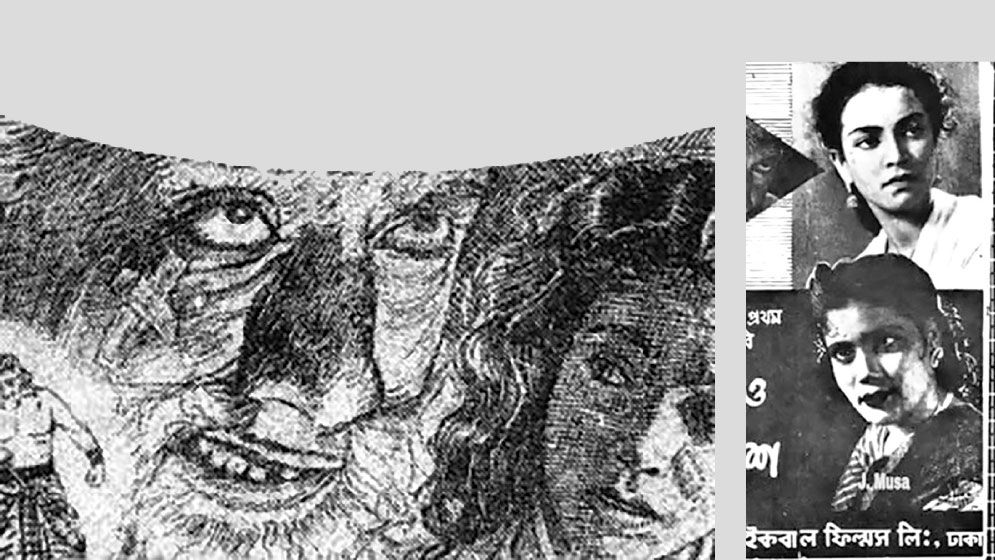
The result was “Mukh O Mukhosh”--the first full-length Bengali-language film produced in East Pakistan, marking the birth of what would eventually become Bangladesh’s film industry.
Even though the film production started in December 1953, it was 6 August 1954 when the inaugural ceremony (muhurat) took place at Hotel Shahbagh (now defunct) in Dhaka. It was inaugurated by the then Governor of East Bengal Iskander Mirza.
The production, directed by Abdul Jabbar Khan, was released on this day in 1956. Thus, this is one of the most special days in the history of Bangladeshi cinema. This year the Bangladeshi cinema turns 70.
The premiere show of “Mukh O Mukhosh” was held at Rupmahal Cinema Hall in Dhaka. The release ceremony was inaugurated by the then Governor of East Pakistan A K Fazlul Huq. The film slowly made its way to other theatres in Dhaka, Chattogram, Khulna, and Narayanganj after its release.
Although earlier productions such as “Sukumari” (1928), a short film, and “The Last Kiss” (1931), a silent feature produced by the Dhaka Nawab family, had been made in the region, “Mukh O Mukhosh” was the first full-length Bengali feature film with synchronised sound.
Born in 1916 in Louhajang, Munshiganj, Abdul Jabbar Khan developed a passion for theatre at an early age. During his school days, he performed in plays like “Behula”, “Vishwamangal”, “Satirtha”, “Samajpati”, “Matir Ghar”, and “Sohrab Rustam”. After completing study at Ahsanullah Engineering School, he moved to Dhaka in 1949 and founded the “Kamalapur Dramatic Association”, staging acclaimed productions including “Tipu Sultan” and “Alivardi Khan”. He also wrote several plays, including “Dakaat”, which later became the basis for “Mukh O Mukhosh”.
Despite having little filmmaking experience, Abdul Jabbar Khan accepted the challenge. He travelled to Kolkata with assistant director QM Zaman, where screenwriter Moni Bose adapted “Dakaatt” into a screenplay. Following the advice of photographer Murari Mohan, Jabbar purchased an old film camera, while an ordinary Philips tape recorder was used for sound recording.
QM Zaman handled cinematography, while Shyam Babu worked as makeup artiste. Music was composed by Samar Das, with songs performed by legendary singers Abdul Alim and Mahbuba Hasnat. The cast of the film includes, Aminul Haque, Inam Ahmed, Ali Mansoor, Zahrat Ara, Abdul Jabbar Khan, Kazi Khaliq, Purnima Sengupta, Piyari Begum, Saifuddin Ahmed, Golam Mostafa, Abul Khair, and Sona Mia.
Moinul Islam worked on the sound design, and the poster was created by Subhash Dutta, who later became a notable director.
Producing the film was financially risky. Cultural patron Kalim Uddin Dudu Miah (father of actor Alamgir) financed nearly half of the production budget of around 82,000 rupees, while Abdul Jabbar and four friends covered the remainder.
The shooting of the film began in Kaliganj (a village across the Buriganga river) in December 1953. Later, the Filming took place across Siddheswari, Tejgaon, Rajarbagh, Kamalapur, Lalmatia, Jinjira and Tongi. It took more than two years to finish the production. In the absence of any local film production studios, the negatives of the film had to be taken to Lahore for development.
More than a cinematic achievement, “Mukh O Mukhosh” became a symbol of Bengali identity, creativity and self-confidence. The film inspired generations of filmmakers and established cinema as a powerful medium for cultural expression and resistance, laying the foundation for the flourishing Bangladeshi film industry that followed.
The cast of the film
Inam Ahmed, Aminul Haque, Zahrat Ara, Abdul Jabbar Khan, Kazi Khaliq, Purnima Sengupta, Piyari Begum, Saifuddin Ahmed, Abul Khair, Sona Mia, Bilkis Bari, Ali Mansoor, Rafiq, Nurul Anam Khan and Golam Mostafa.