




 For all latest news, follow the Daily Sun's Google News channel.


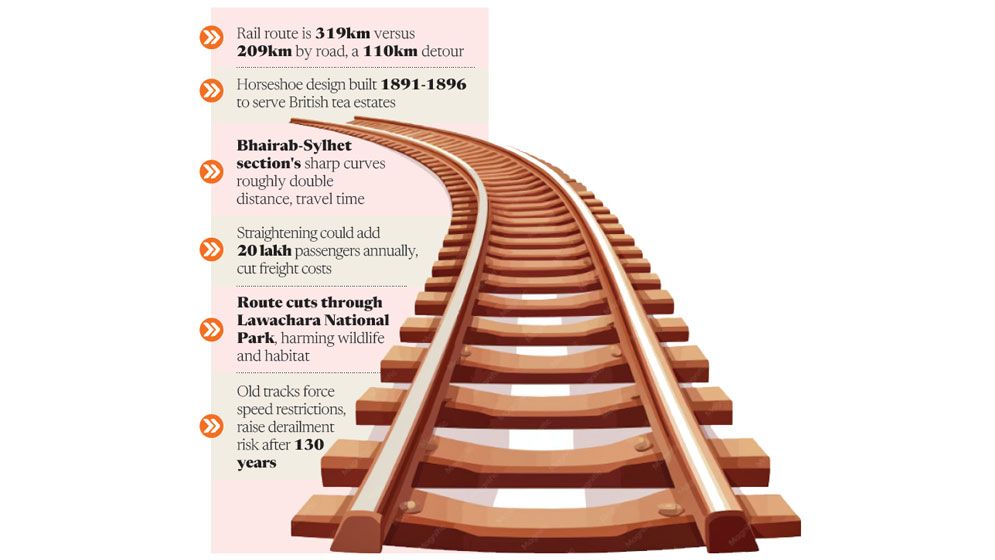
Nearly eight decades after Partition erased the borders it was built to serve, the Dhaka-Sylhet railway continues to snake through a colonial-era detour that adds 110 kilometres and roughly four extra hours to every journey – even as the highway it runs alongside crumbles from years of neglect.
The road distance between the two cities is around 209 kilometres. By rail, it stretches to 319 kilometres, thanks to a horseshoe-shaped alignment that dates back to the late 19th century.
The route was never designed to connect Dhaka and Sylhet directly. It was built to serve British tea estates, river ports and logistics corridors linking what is now Bangladesh to Assam and Tripura in India.
"Rather than establishing direct inter-city tracks, the Dhaka-Sylhet rail network was designed connecting some areas near Assam and Tripura, creating a massive horseshoe-shaped path," said Md Ehsan-e-Elahi, a retired secretary and former senior official of Bangladesh Railway.
The worst of it lies in the Bhairab-Sylhet section, where sharp curves and long detours push the track through Brahmanbaria, Habiganj and Moulvibazar rather than following a direct line – roughly doubling both distance and travel time.
Straightening this stretch, experts say, would lift passenger capacity by 20 lakh commuters a year and cut freight costs for industries moving stone, tea and agricultural produce. It would also slash the current eight-hour slog between the two cities to around four.
But the arch-shaped route carries an ecological cost too. It cuts directly through the environmentally sensitive Lawachara National Park in Moulvibazar, fragmenting habitat and killing wildlife along the way.
"It is possible to straighten the Dhaka-Sylhet railway line by avoiding the protected forest areas. New alignment will safeguard fragile ecosystems while enabling trains to maintain higher speed limits safely. The government should
take step in this regard," said Sharif Jamali, member secretary of environmental platform Dhoritri Rokhhay Amra (DHORA), who is from the Sylhet region.
Beyond the environmental toll, the century-old design itself has become a safety liability. Ageing tracks and outdated structural planning have forced frequent speed restrictions and heightened the risk of derailment.
Azizul Islam, chief coordinator of the Eight-Point Demand Implementation Council of the Dhaka-Sylhet rail line, said the route has seen no meaningful development since it was first built 130 years ago. Repair budgets are allocated periodically, he said, but nothing has matched the scale of work carried out during the British period, and he called for the line to be properly developed.
Md Afzal Hossain, director general of Bangladesh Railway, backed the case for change, saying straightening the section is necessary for modernising the country's wider rail network, and that BR's own internal logic supports it.
The line was built between 1891 and 1896 as part of the Assam-Bengal Railway, engineered to haul tea from Assam's Barak Valley to Chattogram port for export, with tracks curved tightly around Tripura's western border near Cumilla.
In 1915, Kulaura in Moulvibazar was added as a junction to bypass the Surma and Kushiara rivers, stretching the loop even further through the eastern borderlands.
The alignment made sense before 1947. Once the international border was redrawn, the logic behind it vanished – though the track, and the delays it causes, remain.
___________________________________
The reporter can be reached at: [email protected]