



 For all latest news, follow the Daily Sun's Google News channel.


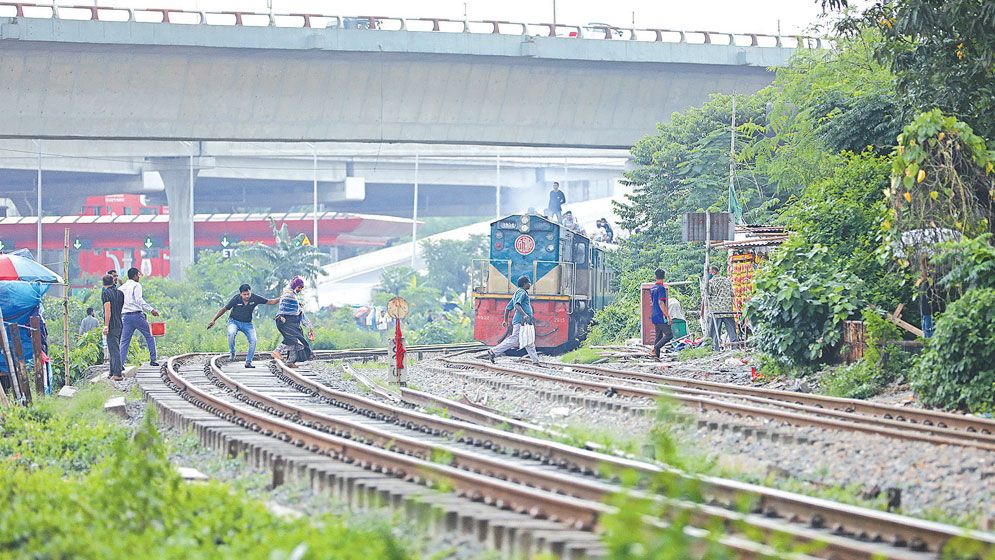
Pedestrians risk their lives crossing the railway tracks at Kuril in Dhaka on Friday. Photo: Kamrul Islam Ratan

For Ridita Ahsan Raisa, crossing the railway tracks at Kuril Bishwa Road has become an unavoidable part of everyday life.
Six days a week, the North South University student travels by bus from Mirpur to Kuril, walks across the railway tracks between Airport Road and Pragati Sarani, and then takes a rickshaw to complete her journey to campus.
She is one of hundreds of pedestrians who use the busy crossing every day. Residents of Badda, Bashundhara Residential Area, Kalachandpur, Rampura, Khilkhet, Nikunja and nearby neighbourhoods rely on it as a shortcut between Airport Road and Pragati Sarani.
Schoolchildren, college and university students, office-goers and long-distance travellers all use the crossing despite the obvious risks.
“Crossing the railway tracks is really risky. A footbridge here would be very helpful for us,” Ridita told the Daily Sun.
Kuril is one of the capital’s busiest transport hubs, where buses from different parts of the country stop throughout the day. Many passengers, often carrying heavy luggage or travelling with young children, have little option but to cross the railway tracks on foot.
Among them was Saleha Khatun, who had just arrived from Mymensingh with her husband, two children and an infant. Carrying two heavy suitcases, the family carefully negotiated the uneven crossing.
“We’re heading home now,” she said. “Crossing the railway tracks with heavy luggage and children is a real struggle. My husband and I are getting older. One wrong step could lead to a serious accident.”
Despite the heavy pedestrian movement, the crossing has no footbridge, pedestrian safety facilities or warning gates. Passenger and freight trains pass through the area at high speed, leaving little margin for error.
The crossing itself presents another challenge. Loose ballast stones, scattered bricks and uneven ground make it difficult to walk, particularly for elderly people, children and those carrying luggage. Although only two of the four railway tracks are operational, hawkers have occupied parts of the unused lines with makeshift stalls. After sunset, the area becomes even more hazardous due to poor lighting, with illumination coming mainly from roadside shops.
For many commuters, the lack of basic infrastructure raises questions about the city’s planning.
“At Mohammadpur Ring Road, there are two footbridges that hardly anyone uses,” said Musa Khondokar. “That road isn’t nearly as busy as Kuril, yet there are two footbridges there and none here. Why has no one thought about building one at this crossing?”
Another regular commuter, Sayeed Al Mesbah, said pedestrians often fail to notice approaching trains until the last moment.
“One evening, around 7pm, I almost didn’t notice a train approaching,” he said. “Airport Road is on one side and Pragati Sarani on the other. Both roads remain busy throughout the day, with large crowds constantly crossing the railway tracks.”
Commuters say the danger is worsened by the alignment of the railway line. The tracks curve near the crossing, while overgrown trees and shrubs restrict visibility, making it difficult to spot approaching trains until they are dangerously close.
Railway Police statistics show that around 93 people were killed in train accidents in the area last year. Officials could not immediately provide this year’s casualty figures.
Dhaka District Railway Police Superintendent Nikulin Chakma believes a pedestrian footbridge could significantly reduce accidents.
“The government should take the initiative to build a footbridge for pedestrians. Since so many people, including school students, cross the tracks every day, I believe it would greatly improve safety,” he told the Daily Sun.
Professor Dr Adil Mohammed Khan of the Department of Urban and Regional Planning at Jahangirnagar University also stressed the need for immediate action.
“A footbridge over the railway would make crossing much safer for pedestrians. No one should lose their life simply because they have to cross dangerous railway tracks when such accidents can be prevented through proper infrastructure,” he said.