


 For all latest news, follow the Daily Sun's Google News channel.


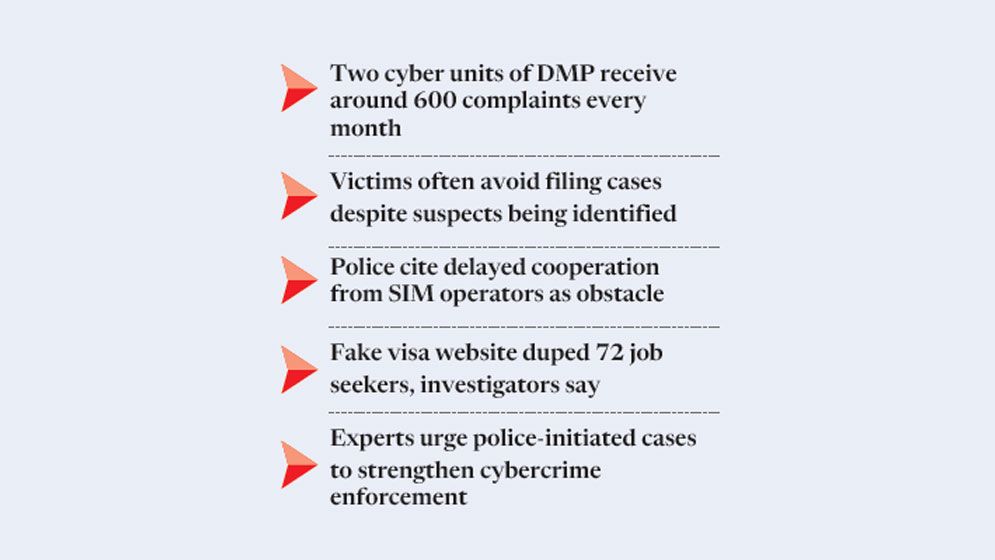
Two specialised cyber units of the Dhaka Metropolitan Police (DMP) receive around 600 complaints every month, underscoring the growing scale of cybercrime in the capital.
However, police say their efforts to prosecute offenders are often frustrated because many victims refuse to file formal cases even after suspects have been identified.
The complaints are handled by the DB Cyber and Special Crime (North) and DB Cyber and Special Crime (South) units, which investigate a wide range of cyber offences across the city.
Khaleda Begum, deputy commissioner of DB Cyber and Special Crime (North), told the Daily Sun that her unit alone receives around 300 complaints every month. Victims either approach the unit directly after submitting complaints to police stations or have their complaints referred by the stations.
She said many complainants are unwilling to pursue formal legal action even after investigators trace the perpetrators, making it difficult to bring offenders to justice.
“Besides, when we seek help from stakeholders, including SIM operators, we do not get it in time,” she said.
According to Khaleda, cyber fraudsters frequently use SIM cards registered with fake National Identity (NID) cards.
“We have recently recovered several hundred such SIM cards from different operators,” she said, stressing the need for prompt cooperation from all stakeholders to curb cybercrime.
She said her unit is currently investigating around 2,200 complaints and 250 cases.
Asked whether police could initiate non-GR proceedings based on verified complaints, she said victims are generally reluctant to pursue that route as well.
Sources at the DB Cyber and Special Crime (South) unit said it also receives around 300 complaints every month and is investigating about 1,500 complaints and 200 cases.
One recent case involved Saydeul Haque, a resident of Nalitabari in Sherpur, who filed a case with Pallabi Police Station on 22 July after falling victim to a sophisticated online visa scam.
He said he was lured through a Facebook account advertising jobs in Australia and was persuaded to transfer money via mobile banking for visa processing and other expenses.
He later received what appeared to be a valid visa and was directed to verify it through a website designed to resemble Australia's official visa-checking portal. Convinced the visa was genuine, he made further payments.
“I paid Tk480,000 in several instalments. But I eventually discovered the visa was fake, and then filed the case,” he said.
Walilul Islam, additional deputy commissioner of the DB Cyber and Special Crime (North) Division, said police arrested two suspects – Maruful Islam, 21, and Hasinur, 28 – in Kishoreganj and Nilphamari on 22 July.
During preliminary interrogation, the suspects admitted to producing forged work permits and visa approval letters and creating a fake website mimicking Australia's official visa verification system.
They also confessed to defrauding 72 people by promising jobs in Australia and Canada, taking between Tk400,000 and Tk500,000 from each victim, he said.
Dr Tawohidul Haque, crime analyst and associate professor at Dhaka University, said social stigma discourages many victims from filing formal cases. He suggested police should be allowed to initiate cases once complaints are verified and use mobile courts to establish the offences.
“If the criminals face punishment, cyber-related crime may fall,” he said.