


 For all latest news, follow the Daily Sun's Google News channel.


Banks turn to short-term FDRs amid deposit battle
Lenders offer up to 12% interest as savers seek safety

When 62-year-old Abdul Karim received his retirement benefits earlier this year, he faced a dilemma familiar to many Bangladeshi families: where should he keep the savings of a lifetime?
The stock market remained volatile. Gold prices had climbed to record highs. Buying an apartment was beyond his means, while mutual funds and corporate bonds seemed unfamiliar and uncertain.
His choice was simple – a bank fixed deposit.
“I wanted peace of mind,” Karim said. “The return may not be the highest, but I know my money is safe and I know exactly how much I’ll receive when the deposit matures.”
Karim’s decision reflects a growing trend across Bangladesh. As uncertainty clouds many investment options, households are increasingly returning to banks, attracted by higher interest rates, capital protection and predictable returns.
The latest battleground is the market for short-term Fixed Deposit Receipts (FDRs).
Banks are aggressively competing for deposits with maturities of less than one year, offering interest rates of up to 12% to attract fresh funds and strengthen liquidity.
The strategy enables lenders to raise deposits while retaining the flexibility to adjust funding costs as interest rates change.
Several banks now offer double-digit returns on short-term FDRs, making them among the country’s most attractive low-risk savings products.
Short-term deposits take centre stage
Unlike in previous years, when banks encouraged customers to lock in their money for longer periods, many lenders are now offering higher returns on shorter-term deposits.
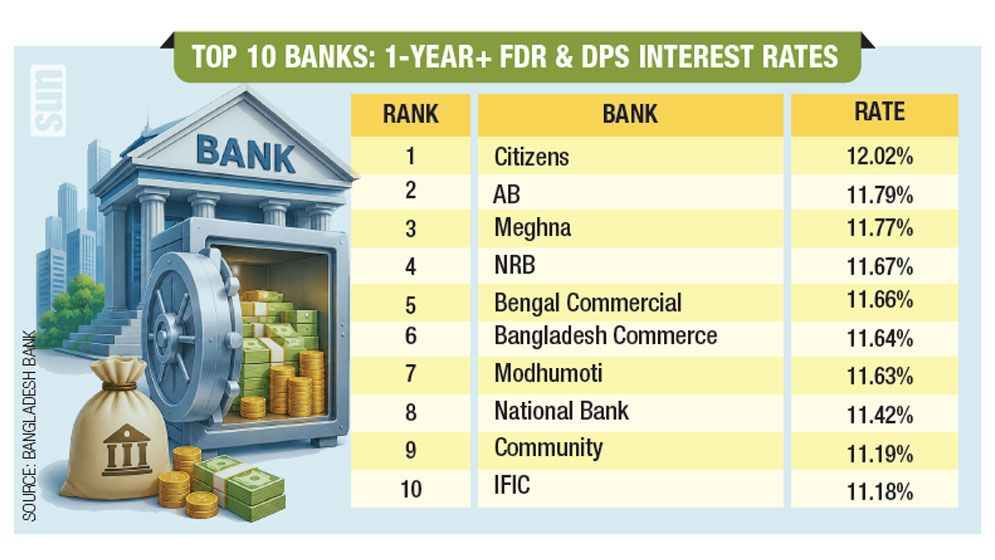
AB Bank currently offers up to 12.01% on selected FDRs with maturities of less than one year, among the highest rates in the market.
Meghna Bank offers 10.96%, while Standard Islami Bank, NRB Bank, Bengal Commercial Bank and several other lenders are also providing competitive returns on short-term deposits.
The aggressive pricing reflects intense competition among banks to strengthen their funding base as liquidity remains a priority.
For savers, the appeal extends beyond higher returns.
Short-term FDRs allow customers to reassess their financial plans within months instead of locking away funds for years, while still offering security and guaranteed income.
Safety regains its appeal
Higher interest rates tell only part of the story.
Many households are once again prioritising safety over potentially higher but uncertain returns as alternative investment avenues continue to lose appeal.
The stock market remains subdued amid weak investor confidence and low trading activity.
Although National Savings Certificates (NSCs) recorded net sales of Tk2,260 crore in April – the highest monthly figure during the first 10 months of the fiscal 2025-26 – tighter eligibility rules have restricted access for many investors.
Gold remains a traditional safe-haven asset, but record-high prices have discouraged fresh investment.
The property market is recovering only gradually as high construction costs and elevated borrowing costs weigh on demand.
Meanwhile, the corporate bond and mutual fund markets remain relatively underdeveloped, limiting heir appeal among retail investors.
Against this backdrop, bank deposits have once again emerged as one of the safest and most dependable destinations for household savings.
Deposits continue to rise
Bangladesh Bank data show total deposits in the banking sector reached Tk21.58 lakh crore at the end of March 2026, an increase of Tk2.34 lakh crore, or 12.19%, from a year earlier.
Individual customers account for around 56% of total deposits, underscoring the critical role household savings continue to play in financing the banking system.
A stronger deposit base enables banks to expand lending to businesses, exporters, manufacturers, farmers and small and medium-sized enterprises, supporting investment, employment and overall economic growth.
Confidence remains selective
The renewed interest in bank deposits comes despite concerns surrounding the newly formed Sammilito Islami Bank, created under the Bank Resolution Ordinance through the merger of EXIM Bank, First Security Islami Bank, Global Islami Bank, Union Bank and Social Islami Bank.
Under the resolution framework, Bangladesh Bank initially allowed deposit withdrawals in phases while assuring customers that all deposits would be repaid within two years.
Some depositors, however, have reported delays in accessing their money.
Financial analysts say the issue is confined to a small number of institutions and should not undermine confidence in the broader banking sector.
They advise customers to choose financially sound banks with strong governance, adequate liquidity, quality customer service and reliable digital banking rather than focusing solely on the highest advertised interest rates. Many also recommend spreading savings across multiple banks to reduce risk.
More than an investment
For millions of Bangladeshis, bank deposits serve purposes that extend well beyond earning interest.
Parents build education funds through Deposit Pension Schemes (DPS).
Salaried employees create emergency savings. Retirees rely on interest income to supplement their pensions. Entrepreneurs temporarily park surplus cash before reinvesting in their businesses.
Unlike shares or property, fixed deposits offer certainty. Savers know exactly how much they will receive when their deposits mature, making financial planning easier during periods of economic uncertainty.
As Bangladesh’s financial landscape evolves and new investment products emerge, the intense competition among banks for short-term deposits underscores an enduring reality: when uncertainty rises, safety, stability and predictable returns become increasingly valuable.
For a growing number of Bangladeshis, that confidence is once again being placed in the banking system.