


 For all latest news, follow the Daily Sun's Google News channel.


On 21 July, police detained a madrasah teacher in Kushtia's Kumarkhali upazila after a 10-year-old student accused him of repeatedly sexually assaulting him over a period of 10 to 12 days.
According to the victim, the abuse began on 12 July at “Taloa Hafezia Madrasah and Lillah Boarding” after senior students had left for their examinations.
The child alleged that the teacher assaulted him repeatedly over the following days and warned him not to tell anyone, saying he was "just dreaming."
The incident also sparked allegations that members of the madrasah committee and local political leaders tried to settle the matter through local arbitration before police intervened. Police later detained the accused teacher and took the victim into protective custody.
Kumarkhali Police Station Officer-in-Charge (OC) Jamal Uddin told the Daily Sun that the preliminary investigation found evidence supporting the allegations, and the accused has been sent to court as legal proceedings continue.
The Kushtia case is not an isolated incident. Similar allegations have been reported from districts including Lalmonirhat, Chattogram, Madaripur, Moulvibazar, Lakshmipur, Feni, Faridpur, Manikganj and Dhaka, pointing to a wider pattern of sexual violence against boys across Bangladesh.
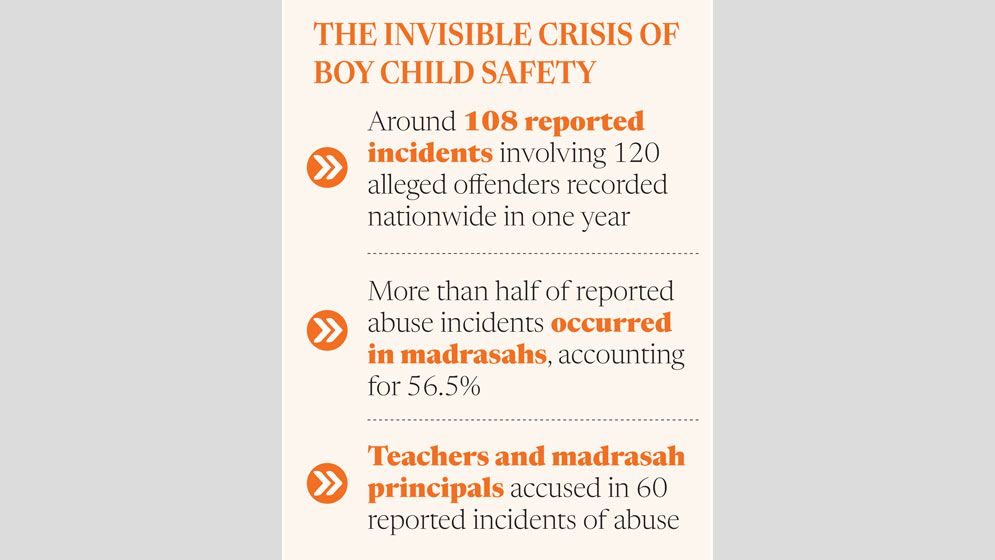
A Daily Sun analysis of reported incidents from 15 July 2025 to 15 July 2026 found around 108 reported incidents of sexual violence against boys across Bangladesh, involving a total of 120 alleged offenders.
The figure is based on cases filed at various police stations across the country and information gathered through the Daily Sun's own monitoring.
As Bangladesh does not have a central database to track such cases, the figures in this report are based on reported incidents reviewed by the Daily Sun.
The numbers show the broader pattern of the issue.
The data shows that among the victims, 24 (22.2%) were aged four to six, 48 (44.4%) were seven to nine, and 36 (33.3%) were 10 to 13 years old.
Danger lurks in places where children are expected to be safe
Most of the reported incidents occurred in places where children were expected to be safe, including madrasahs, schools and places of worship. In several cases, the accused were teachers or people known to the victims.
Some incidents also involved allegations of attempts to settle the incidents locally instead of taking legal action. Madrasahs accounted for 61 cases (56.5%) of the estimated incidents, making them the most common location where the abuse took place.
Open fields or jute fields accounted for 23 cases (21.3%), while homes or private tuition settings and construction sites each accounted for 12 cases (11.1%). Teachers or madrasah principals were accused in 60 cases, or half of the estimated total, making them the largest group of alleged offenders. Senior madrasah students accounted for 12 cases (10%), while neighbours and other adults in the community each accounted for 24 cases (20%).
Rape was the most commonly reported form of abuse, accounting for 72 cases (66.7%) of all cases. Repeated rape of the same child was reported in 24 cases (22.2%), while the remaining 12 cases (11.1%) involved attempted rape.
Lack of gender sensitivity, social inequality, misconceptions about sexuality
Crime analyst and Associate Professor at the University of Dhaka’s Institute of Social Welfare and Research, Dr Tawohidul Haque said sexual violence against children often occurs in places where they are expected to be safe, due to a lack of gender sensitivity, social inequality and misconceptions about sexuality.
He said even when the victim and offender are of the same gender, children can become vulnerable due to their social status, economic condition or lack of ability to resist.
“If a victim can be controlled because of his social position or other factors, the risk of such crimes increases,” Dr Tawohidul said.
He said some offenders may have been victims of abuse themselves during childhood. Their past experiences and environment may influence their later behaviour.
Dr Tawohidul said residential settings in Qawmi madrasahs, where students and teachers spend long periods together, may create opportunities for such crimes. However, he stressed that an offender should be treated as a criminal regardless of their profession or identity.
On repeated abuse and local arbitrations, he said poverty, social pressure and fear of losing educational support often stop families from taking legal action. Many families fear that reporting abuse could force the child to leave the madrasah, increasing their financial burden. Social stigma also discourages them from reporting such crimes.
“Reported cases are less than 1% of the actual
incidents. Many families ask victims to remain silent or try to settle the matter
through local arbitration instead of taking legal action,” he said.
An analysis of data related to police and legal
action shows that arrests or detentions were made in 96 cases (88.9%), while no
arrest was made in the remaining 12 cases (11.1%).
Cases were filed in 72 incidents, accounting for
66.7% of the total. So far, the accused in 36 cases (33.3%) have been produced
before the court and sent to jail, while legal proceedings continue.
Supreme Court lawyer Ishrat Hasan said crimes such
as sexual abuse of children are serious offences against the state and cannot
be settled through local arbitration or compromise.
She said such cases should be tried in criminal
courts, as local settlements can block justice, destroy evidence and protect
offenders.
She added that the state must ensure proper
investigation, victim protection and punishment, especially in child abuse
cases.
On the legal protection for boys, Ishrat said the
2025 amendment to the Women and Children Repression Prevention Act, 2000
expanded the definition of rape by including forced anal or oral penetration,
allowing such offences against boys to be tried as rape. She said the amendment
addressed an important legal gap.
She added that under Section 9 of the law, rape
carries a punishment of death or life imprisonment, while separate punishments
exist for attempted rape.
However, she said the law still needs further reform to clearly define all forms of sexual abuse against both boys and girls, ensure mandatory reporting, child-friendly trials and proper rehabilitation.