


 For all latest news, follow the Daily Sun's Google News channel.


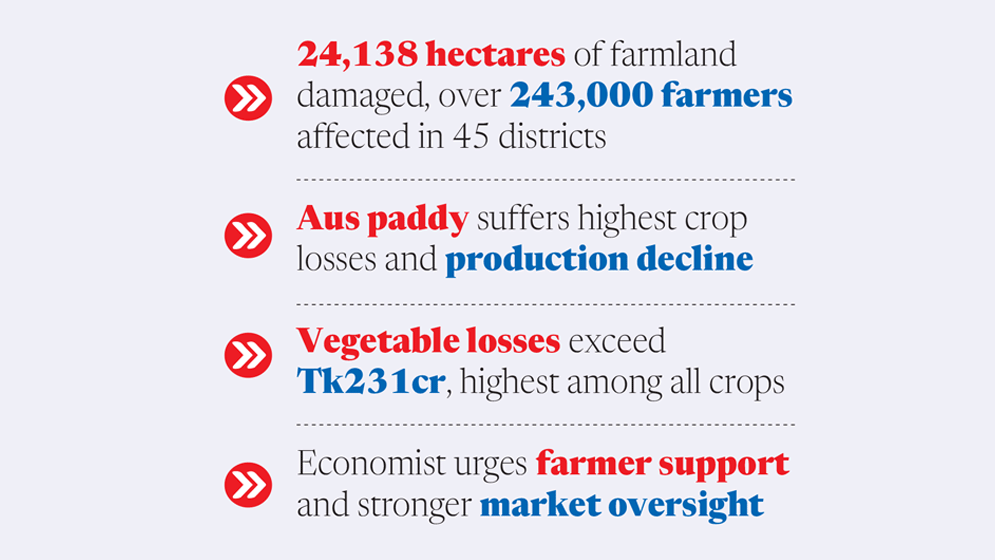
Flash floods and prolonged heavy rainfall triggered by upstream hill runoff damaged agricultural produce worth an estimated Tk477.97 crore across the country between 6 and 19 July, affecting 243,660 farmers in 45 districts, according to the final assessment by the Department of Agricultural Extension (DAE).
The floods damaged 24,138.65 hectares of cropland and destroyed an estimated 133,972 tonnes of crops.
Aus paddy suffered the largest area of damage, with 12,783.70 hectares affected, leading to production losses of 36,266 tonnes and financial losses of Tk171.59 crore.
Vegetables sustained the heaviest financial blow. Floodwaters inundated 8,836.13 hectares of vegetable fields, destroying 87,967 tonnes of produce and causing losses estimated at Tk231.96 crore.
The floods also damaged 1,746.13 hectares of transplanted Aman seedbeds, reducing production by 949 tonnes and causing losses of Tk16.96 crore.
Another 50 hectares of broadcast Aman fields were affected, with production losses of 56 tonnes valued at Tk45 lakh.
Other crops were also hit. Floods damaged 115.24 hectares of chilli, 124.86 hectares of ginger, 100.92 hectares of turmeric, 143.75 hectares of orchards and 130.75 hectares of betel leaf cultivation. Estimated financial losses stood at Tk4.79 crore for chilli, Tk22.87 crore for ginger, Tk9.47 crore for turmeric, Tk7.37 crore for orchards and Tk8.22 crore for betel leaf. Agricultural economist Dr Jahangir Alam Khan told the Daily Sun that, besides crop damage, the loss of working days for agricultural labourers should also be considered, as many were unable to work during the flooding.
He said the losses were relatively small compared with the country’s overall agricultural output and were unlikely to threaten food security or trigger significant food inflation.
“There will not be any major shortage in market supply due to the flood-related agricultural losses,” he said.
However, he warned that even a slight supply shortfall could encourage unscrupulous traders to manipulate markets and raise prices unnecessarily.
Dr Jahangir urged the government to maintain effective market oversight and prepare a list of affected farmers to ensure they receive timely support.
He said adequate assistance would help farmers recover quickly and ensure successful cultivation of the upcoming winter crops.