


 For all latest news, follow the Daily Sun's Google News channel.


‘Ma, I’m coming home’
Survivors recount how Mirpur became one of the July uprising’s bloodiest battlegrounds
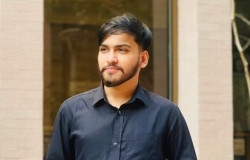
Shafiq Uddin Ahmed Ahnaf’s final phone call to his mother lasted only moments.
“Ma, I’m coming home. Don’t worry.”
Those were the last words the first-year BAF Shaheen College student spoke to his mother at 4:48pm on 4 August 2024.
His mother, Zartaj Parveen, had repeatedly pleaded with him not to leave home that day. But Ahnaf insisted on joining the movement, assuring her he would return before the curfew. He never did. Within minutes of that final phone call, he was shot dead.
Ahnaf’s death came to symbolise the bloodshed that engulfed Mirpur during the July mass uprising, when streets, rooftops, alleyways and even family homes became scenes of violence as protesters confronted the then government’s crackdown.
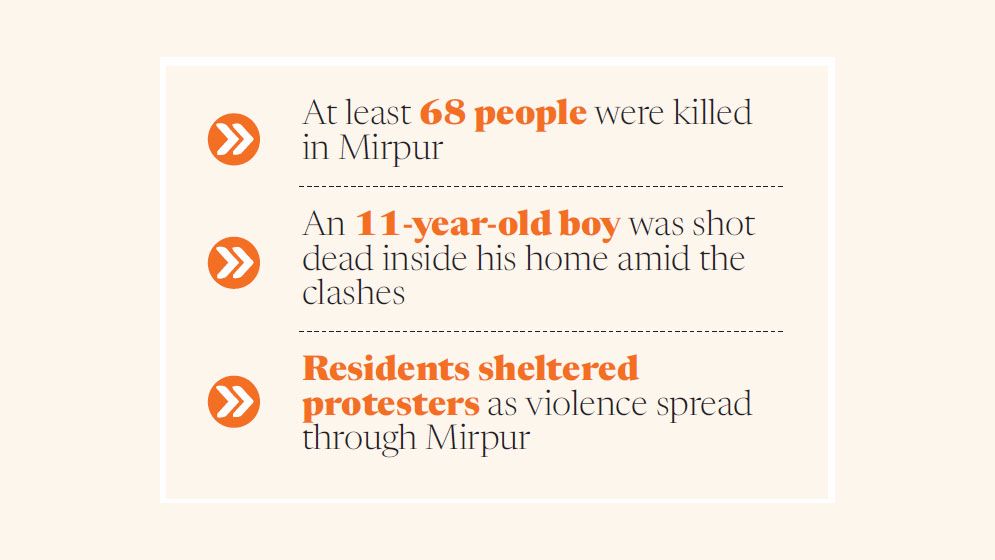
According to the July Revolutionary Alliance, at least 68 people were killed in Mirpur alone. The organisation initially documented 72 deaths, including unidentified victims.
“Our statistics show around 68 people were killed in Mirpur. Initially, we counted 72, including unidentified victims,” said the organisation’s president, Saleh Rayhan.
A child killed inside his own home
The violence spared no one. On 19 July, 11-year-old Safkat Samir was playing inside his family’s apartment at the Housing Staff Quarter in Kafrul while fierce clashes raged outside.
As tear gas spread into the house, Samir walked towards a window to close it. Moments later, a bullet pierced the room.
“It happened within seconds,” recalled his uncle, Imon.
“I ducked after hearing a loud sound. My sister screamed. I saw concrete fragments scattered across the room after the bullet hit the wall. Then I saw Samir collapse from the table onto the floor, covered in blood.”
For Samir’s father, Sakibur Rahman, the house remains a painful reminder of his son.
“The room still has his drawings of the national flag and the first Bengali letters he learnt to write,” he said.
“There is nothing more horrifying for a father than seeing parts of his child’s brain come out through his eyes. I had only seen such scenes in films. I never imagined I would experience something like this.”
The family later buried Samir without a post-mortem examination.
How Mirpur turned into a battleground
The confrontation in Mirpur had begun days earlier.
After public universities were shut down on 16 July, students from Bangladesh University of Business and Technology (BUBT), Commerce College and other institutions gathered around Mirpur-10, turning the area into one of the uprising’s strongest centres of resistance.
“We divided ourselves into six or seven groups strategically,” said student coordinator Priyot Rahman.
“Police opened live fire. Shots were fired from rooftops. BGB personnel were also deployed and they fired.”
By 19 July, Mirpur-10 had become the epicentre of the confrontation. Witnesses said law enforcement personnel opened live fire as the then ruling party activists and members of affiliated organisations confronted protesters. According to protesters, security forces and armed political activists jointly attempted to regain control after demonstrators seized the Mirpur-10 intersection.
Unable to stop the advancing crowds, law enforcement personnel allegedly fired from rooftops while armed activists joined the assault. The roads soon turned into scenes of bloodshed.
Streets of resistance
As clashes intensified, Mirpur’s narrow lanes became lifelines for protesters forced off the main roads.
Residents opened their gates, sheltered demonstrators and helped treat the injured.
“When police couldn’t control us, helicopters dropped sound grenades and hot water,” recalled protester Dhrubo Chandra. “People living nearby opened their homes for us.”
Women also played a visible role throughout the movement.
“There were schoolgirls, homemakers and working women,” said participant Monnujan Khan. “Everyone contributed in whatever way they could.”
The final push
Despite raids and arrests, protests spread across Mirpur-11, Mirpur-13, Kazipara and Shewrapara. As the movement entered its final phase, demonstrators returned to the streets on 4 August with the one-point demand for Sheikh Hasina’s resignation.
“We knew we would come out on 4 August,” said protester Shahriar Tuhin. “They had occupied Mirpur-10 since the previous night.”
College student Al Shams was among those shot that day.
“We kept throwing bricks and they started retreating,” he recalled. “Then they opened fire again. I was among the last people standing. The first bullet hit my leg.”
Despite mounting casualties, protesters continued to resist.
On 5 August, thousands marched from Mirpur-10 along Begum Rokeya Sarani towards Ganabhaban as part of the “Long March to Dhaka” programme. Witnesses said firing continued even as crowds advanced.
By then, however, the political tide had already turned. For many families in Mirpur, the memories of those days remain etched not only in history but also in the empty chairs, silent rooms and final phone calls that never brought their loved ones home.