


 For all latest news, follow the Daily Sun's Google News channel.


Dhaka’s road medians losing green cover to dev push
City’s overall green cover slips below 8% as shrinking afforestation budgets, weak execution deepen fears of worsening heatwaves

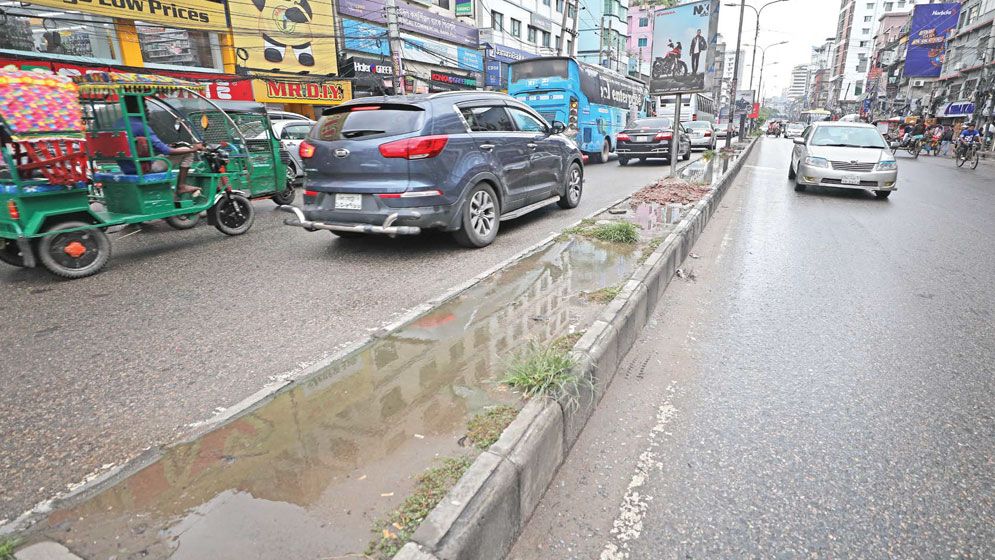
A tree-less road median in the capital's Malibagh illustrates the growing loss of roadside greenery as development projects reshape the capital. The photo was taken on Thursday. - KAMRUL ISLAM RATAN
Dhaka’s road medians, once a defining feature of the capital’s urban green belt, are vanishing at an alarming pace under the weight of road expansion and major infrastructure projects, even as inadequate funding and poor implementation of afforestation schemes leave the city’s shrinking green cover further exposed.
The large trees, shrubs and flowering plants that once softened the capital’s road medians did more than beautify the cityscape – they cut dust, lowered temperatures, absorbed carbon dioxide and improved air quality. But the spread of metro rail lines, flyovers and elevated expressways has steadily eaten into median space.
In many stretches, medians have vanished entirely; in others, what remains is too narrow to support healthy tree growth.
The fallout is stark: Dhaka’s green cover has now dropped below 8% of the city’s total area, while water bodies cover less than 5%, sharpening the urban heat island effect, worsening air pollution and pushing temperatures higher.
The Bangladesh Institute of Planners (BIP) says a liveable city should devote at least 30%-35% of its area to green spaces and water bodies combined. Dhaka’s green and blue spaces together make up less than 10%. In many wards, concrete now covers over 90% of the land, against a desirable benchmark of 40%-50%.
Urban planners say the retreat of roadside greenery is driving up surface temperatures, worsening pollution and eroding biodiversity, with mature trees that once sheltered birds and insects steadily giving way to ornamental plants offering little ecological value.
Funding slashed, spending patchy
An analysis of Dhaka North City Corporation (DNCC) budgets and annual reports points to sharp inconsistencies in both funding and follow-through on tree plantation.
The Tk2 crore initially proposed for afforestation in FY23 was revised down to Tk1.04 crore.
In FY24, a proposed Tk20 crore was cut to just Tk2 crore, and in FY25 the same proposed figure of Tk20 crore was slashed to Tk5 crore.
For FY27, DNCC has allocated Tk23 crore for tree plantation and environmental development – just 0.76% of its total budget – with no guarantee the figure will survive the year intact, given past patterns of mid-year cuts.
Implementation has fared little better.
DNCC’s Annual Report for FY24 shows that, despite a revised Tk2 crore allocation, not a single taka was spent on plantation that year.
Spending improved in FY25, with around Tk4.29 crore of the Tk5 crore allocation utilised, but experts say both figures remain far short of what a megacity like Dhaka requires.
BIP has called the annual afforestation outlay of Tk2-5 crore inadequate and urged a substantial funding increase alongside a long-term green infrastructure strategy.
Guidelines ignored, experts warn
Environmentalist Maruf Hossain said plantation drives alone will not solve the problem without scientific planning behind them.
“Planting trees alone is not enough. It is equally important to determine where they should be planted, which species are suitable and how they should be planted,” he said, warning that large trees forced onto narrow concrete medians often fail to root properly and risk toppling in storms.
He pointed to RAJUK’s Detailed Area Plan (DAP) 2022-2035, which sets out roadside greening standards under its “Urban Lifeline” concept, including species selection and buffer zones – guidelines he said are “frequently ignored during infrastructure implementation.” Urban greenery, he argued, must be treated as essential infrastructure rather than mere beautification.
Environmental activist Arham Chowdhury, long involved in voluntary greening efforts, said many of the city’s traditional green corridors have disappeared outright.
“Many roads in Dhaka no longer have the wide medians they once had. In some places medians have been removed entirely due to development projects, while in others they have become much narrower,” he said, adding that coverage of the issue should pair documentation of degradation with practical policy solutions.
Professor Ahmed Kamruzzaman noted that greening efforts have increasingly come to depend on corporate sponsors rather than sustained civic maintenance. “When sponsorship ends, maintenance often stops and many plants fail to survive,” he said, though he noted pockets – Agargaon, parts of Gulshan and Banani, and the Farmgate-to-Jahangir Gate median – still retain healthy greenery.
He called for preserving mature trees and expanding urban forests to become a national priority.
Urban planner Dr Adil Mohammed Khan, professor of the Department of Urban and Regional Planning at Jahangirnagar University, said botanists, arboriculturists and environmental specialists should be part of planning from the outset, with native species such as Rain Tree, Jarul, Krishnachura, Neem, Kadam, Hijal, Bakul and Banyan prioritised over imported ornamentals that offer little to local wildlife.
He cited Singapore and Tokyo, which sustain 30%-40% green cover through strict protection policies and integrated planning, as models Dhaka could adapt.
Experts also called for corporate, banking and institutional partners to fund long-term maintenance rather than one-off plantation drives, and urged that under-served areas – Badda, Demra, Goran, Rayerbazar and parts of Mohammadpur – receive priority alongside greener neighbourhoods such as Gulshan, Banani and Dhanmondi.
Without a science-led balance between development and environmental protection, they warned, Dhaka faces worsening heatwaves, declining biodiversity and a deepening urban heat island effect.