


 For all latest news, follow the Daily Sun's Google News channel.


How long will students remain guinea pigs?
Special Correspondent
Published: 23 Jul 2026, 12:00 AM
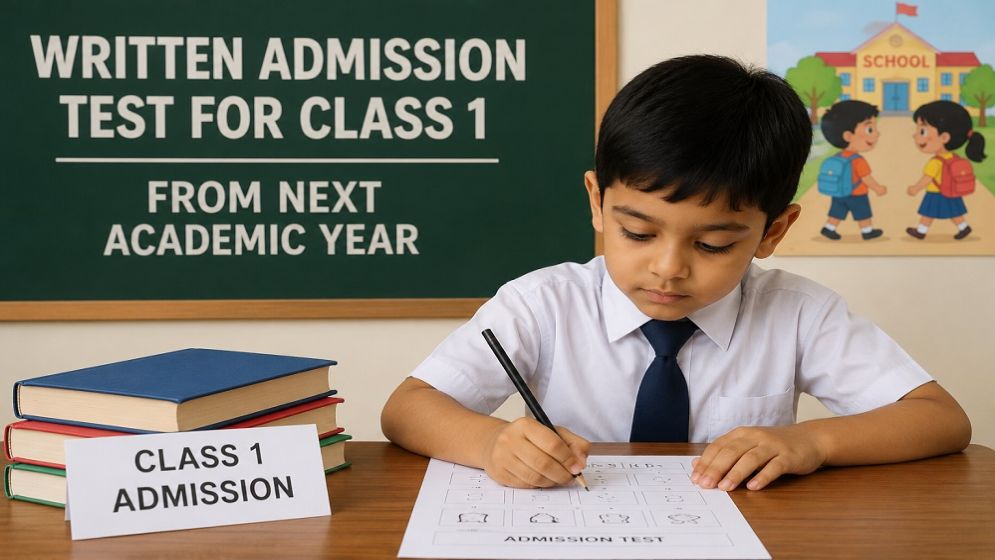
The government’s decision to reintroduce written admission tests for Class 1 from the next academic year. AI generated image
The government’s decision to reintroduce written admission tests for Class 1 from the next academic year has sparked deep concern among parents. As families rush to prepare their children, many have already begun turning to coaching centres and private tutors.
In an attempt to ease these concerns, Education Minister ASM Ehsanul Huq Milon said last month that the admission process for young children would remain simple and that coaching and private tuition would not be encouraged.
Yet visits to several coaching centres in the capital reveal a different reality. Many have already launched special preparatory courses and school-specific guidance for first-grade admission tests. Parents and educationists warn that the move will push children into intense competition before they have even begun their formal education.
Admission tests for Class-1, once again
A lottery-based admission system was introduced in government schools in 2011 to reduce dependence on coaching centres and curb allegations of irregularities in admissions. This year, however, the education minister announced that the lottery system would be scrapped from the next academic session.
According to the Primary School Statistics 2024, a total of 3.546 million children, including 1.748 million boys and 1.799 million girls, were admitted to Class-1 across all types of primary schools. Conducting written examinations for such a vast number of children will be a formidable challenge for both the government and educational institutions.
Another major concern is that parents overwhelmingly prefer only a handful of reputed schools. This is likely to trigger fierce competition for a limited number of seats, leaving the vast majority of children facing rejection at the very beginning of their educational journey. Such an experience could undermine their confidence and dampen their enthusiasm for learning. Is it reasonable to expose children to such pressure at such a young age?
There is no denying that the lottery system suffered from irregularities, corruption and allegations of nepotism. However, abolishing it altogether amounts to using a sledgehammer to crack a nut.
Unfortunately, this is far from the first time Bangladesh’s education system has been subjected to repeated experimentation. In the 55 years since independence, few sectors have experienced as many policy reversals as education. The result has been a steady decline in educational quality, accompanied by a growing number of educated but unemployed young people. An education system lacking clear direction is steadily eroding students’ desire to acquire knowledge.
Constant curriculum changes
Almost every new government introduces sweeping changes to the national curriculum and education policy, and the current administration is no exception. The BNP-led government has initiated a comprehensive overhaul of the education system and plans to introduce a new curriculum in schools from 2028.
The absence of a stable, long-term curriculum has repeatedly harmed students at every stage of their education. In 2013, the Awami League government introduced a new National Curriculum, followed by another curriculum in 2023 that generated widespread controversy across the education sector.
Despite sustained criticism, that curriculum remained in place until 2024. Following the ousting of Sheikh Hasina during the student-led mass uprising, the interim government reverted to the 2012 curriculum and distributed revised textbooks in 2025. Students continue to study under that curriculum this year and are expected to receive another set of new textbooks in 2028.
This means students will have experienced three different curricula within just five to six years—from 2023 to 2028. Such constant policy shifts have created deep uncertainty and instability throughout the education system.
Curriculum reform has too often been driven by political considerations rather than genuine efforts to modernise education in line with international standards. In Bangladesh, educational “development” still largely means constructing school buildings. Successive governments have prioritised building impressive infrastructure in politically favourable areas, while neglecting the quality of teaching and the learning environment.
As a result, many attractive school buildings remain underutilised. Around 40% of government schools lack sufficient enrolment. Increasingly, parents are opting for private schools instead. Analysis of SSC results over the past three years shows that Cadet Colleges, Cantonment Public Schools and private schools have consistently outperformed district-level and government schools.
This raises serious questions about whether the country’s substantial investment in education is delivering meaningful returns. Most of the education budget is absorbed by salaries, allowances and infrastructure, leaving only minimal funding for research, libraries, laboratories and other facilities essential to improving educational standards.
A struggling primary education system
The crisis is particularly acute at the primary level.
Bangladesh’s primary education system is among the largest in the world, serving more than 20.18 million students across 118,607 schools, including 65,569 government and 53,038 private primary schools.
Government primary schools continue to suffer from teacher shortages, inadequate administrative support, limited technological resources and excessive non-teaching responsibilities imposed on teachers. These shortcomings directly affect classroom teaching and learning.
Most worrying is the country’s inability to ensure quality education. Even after completing Class 5, many students are unable to read fluently or fully comprehend texts in their mother tongue.
The deteriorating quality of primary education has prompted many parents to choose either English-medium schools or madrasas. Middle-income families often stretch their finances to afford English-medium education, while lower-income households increasingly favour madrasa education over mainstream primary schools.
Over the past five years, enrolment in English-medium schools has increased by 27%, while enrolment in madrasas has risen by 9%. At the same time, low salaries and limited benefits continue to discourage talented individuals from joining the teaching profession, weakening the education system at its very foundation.
Secondary education under strain
The situation is equally troubling at the secondary level.
While government schools dominate primary education—with 67.1% of students enrolled in public institutions—only 7.3% of secondary students attend government schools. The remaining 92.7% study in privately managed institutions.
By contrast, despite the establishment of 108 private universities, 64.5% of higher education students remain enrolled in public universities.
Teachers at many private secondary institutions receive part of their salaries through the government’s Monthly Pay Order (MPO) scheme. However, MPO teachers generally receive lower benefits and allowances than their counterparts in government schools, while some receive no comparable benefits at all. This has created an unhealthy disparity within the teaching profession.
The World Bank’s Human Capital Index paints an equally worrying picture. It estimates that after 10 years and two months of schooling—equivalent to Class 11—a Bangladeshi student acquires skills comparable to only six years of schooling under international standards.
Earlier editions of the index painted a slightly better picture. In 2017, students completing the same years of schooling achieved learning outcomes equivalent to six years and five months. Education experts believe standards have deteriorated even further since then.
The higher education dilemma
Given the weaknesses in primary and secondary education, the challenges facing higher education are hardly surprising.
Universities are meant not only to award degrees but also to cultivate critical thinking, creativity, empathy and intellectual curiosity. Skills such as collaboration, adaptability and lifelong learning cannot be developed solely through classroom instruction; they require a vibrant academic and social environment.
Yet universities in Bangladesh continue to function largely as centres of theoretical learning, detached from the realities of the labour market. Society expects them to produce ethical, creative and responsible citizens, while employers demand graduates equipped with practical, job-ready skills. Caught between these competing expectations, many universities have lost their direction.
In some private universities, education has effectively become a business centred on selling certificates. In extreme cases, degrees are awarded with minimal teaching, leaving graduates ill-prepared for professional life. The country’s education system is, therefore, drifting into a deep crisis.
Depoliticising education
Much of this decline stems from the politicisation of education.
Successive governments have altered curricula to reflect their own political agendas and appointed loyalists to key educational positions. From primary schools to universities, teacher recruitment has often been influenced by political affiliation, while student and teacher politics have been manipulated to maintain institutional control.
Unless this culture changes, meaningful reform will remain elusive. Without quality education, Bangladesh’s long-term development will also remain out of reach.
Recognising this, the prime minister has called for education to be kept free from political influence. The BNP’s 31-point reform agenda also pledges to end political polarisation in education. Speaking recently at Dhaka University, the prime minister stressed that teacher recruitment based on political considerations must cease. The Ministry of Education should formulate its policies in line with that vision.
Education is a fundamental human right. Improving its quality requires broad political consensus rather than partisan rivalry. Bangladesh must create a stable, high-quality education system with a curriculum that keeps pace with global standards. Above all, it must abandon the practice of rewriting education policies every time governments change.
Quality education cannot be built by repeatedly turning students into guinea pigs.