


 For all latest news, follow the Daily Sun's Google News channel.


Can new distressed asset law finally curb loan defaults?
Experts warn success hinges on governance

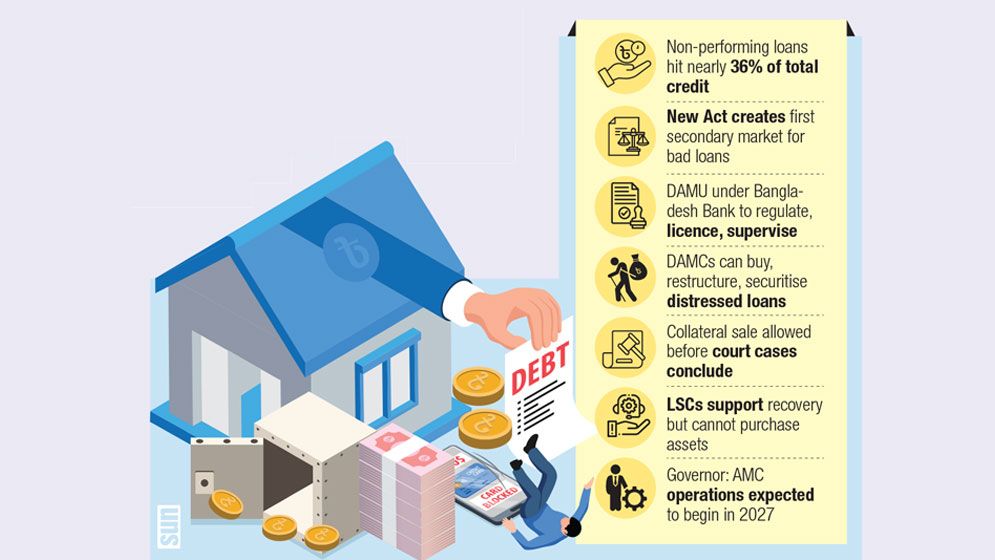
With nearly 36% of total bank loans now classified as defaults, the government has drafted a law to create Bangladesh’s first secondary market for distressed assets – a move regulators hail as transformative, but experts warn could falter without strict governance and honest implementation.
The Distressed Asset Management Act, 2026, would allow specialised institutions to buy, restructure and recover bad loans, freeing banks of toxic assets that have long strained their capital, liquidity and lending capacity.
Years of protracted litigation in loan courts, difficulties in disposing of collateral, and weak recovery mechanisms have compounded the problem, prompting Bangladesh Bank to pursue a structural solution rather than another round of incremental fixes.
The Ministry of Finance and Bangladesh Bank published the draft on their websites on 30 June and closed the comment period on 16 July.
Once finalised, it will provide the country's first comprehensive legal framework for managing non-performing, written-off and other distressed financial assets.
What the draft law proposes
The law would establish a Distressed Asset Management Unit (DAMU) under Bangladesh Bank as regulator, responsible for issuing licences, supervising and inspecting distressed asset management companies, setting policy, and suspending or cancelling licences where necessary.
Licensed Distressed Asset Management Companies (DAMCs) would be empowered to purchase distressed loans from banks and financial institutions, restructure and recover them, manage collateral, pursue legal action, and securitise assets to raise investment. They could pool non-performing loans into asset-backed securities for purchase by domestic and foreign institutional investors, including banks, insurers, mutual funds, private equity firms and alternative investment funds.
Crucially, DAMCs would be allowed to take possession of pledged collateral and sell it before court proceedings conclude, provided borrowers are notified, assets are professionally valued, and borrowers are given an opportunity to settle their dues.
Loan Servicer Companies (LSCs) would play a supporting role – liaising with borrowers, assisting with restructuring and rescheduling, valuing and tracing collateral, and facilitating recovery and legal proceedings.
They would not, however, be permitted to purchase distressed assets in their own name or conduct banking business.
Cautious optimism from experts
Unveiling the monetary policy statement for the first half of FY27, Bangladesh Bank Governor Mostaqur Rahman said the Act would allow asset management companies to strip toxic assets from banks' balance sheets, with operations expected to begin in 2027.
He added that banks should write off unrecoverable loans to present a more accurate financial position, though borrowers would remain legally liable for repayment.
Mustafa K Mujeri, former chief economist of Bangladesh Bank, told the Daily Sun that asset management companies had recovered distressed loans successfully in many countries.
He illustrated the model: if a bank sells a Tk100 crore default loan for Tk80 crore, it immediately reduces its exposure and strengthens its balance sheet; if the buyer subsequently recovers the full amount, it profits, and if not, it absorbs the loss.
He argued the institution would work best as a public-private partnership rather than a wholly state-owned entity, as private participation would encourage quicker decision-making, greater accountability and stronger recovery outcomes – though he cautioned that a robust legal framework and professional management remain essential.
Toufic Ahmad Choudhury, former director general of the Bangladesh Institute of Bank Management, called the initiative a positive policy step, noting that asset management companies have proven successful elsewhere.
But he warned implementation would be the real test: previous Bangladeshi initiatives to curb defaults have faltered due to weak execution, poor governance and inadequate supervision.
Without transparent licensing, proper asset valuation and protection from political interference, he said, the new law risks the same fate.
Syed Mahbubur Rahman, former chairman of the Association of Bankers, Bangladesh, and managing director of Mutual Trust Bank, said the prolonged burden of default loans had weakened banks' capacity to support trade and broader economic activity.
The existing court-based recovery system, he said, had failed to resolve the problem effectively – but a successful law could strengthen the banking sector and generate positive spillover effects across the economy.