


 For all latest news, follow the Daily Sun's Google News channel.


On 22 May, 60-year-old Khalilur Rahman was returning home after Jummah prayers when his son, 30-year-old Minarul Islam, intercepted him on a road in the Moulvirkum area of Chakaria municipality in Cox’s Bazar.
Moments later, Minarul allegedly attacked his father with a machete, severing his left wrist and inflicting fatal injuries. Locals rushed Khalilur to Chakaria Upazila Health Complex, where doctors declared him dead.
According to Chakaria police station Officer-in-Charge (OC) Mohammad Monir Hossain, Minarul was addicted to drugs and his family had become increasingly distressed by his behaviour. His parents had previously filed a complaint against him, leading to a one-month jail term. Police believe he killed his father out of anger after returning home.
Just over a month later, another drug-related killing was reported in Chapainawabganj.
On 24 June, 24-year-old Rajab Ali was allegedly stabbed to death by his friend, Jisan, following a dispute over drugs. Police said Rajab was taken to Chapainawabganj District Hospital after suffering a stab wound to the chest, where doctors pronounced him dead. The two incidents underscore the devastating human cost of drug addiction and drug-related violence in Bangladesh.
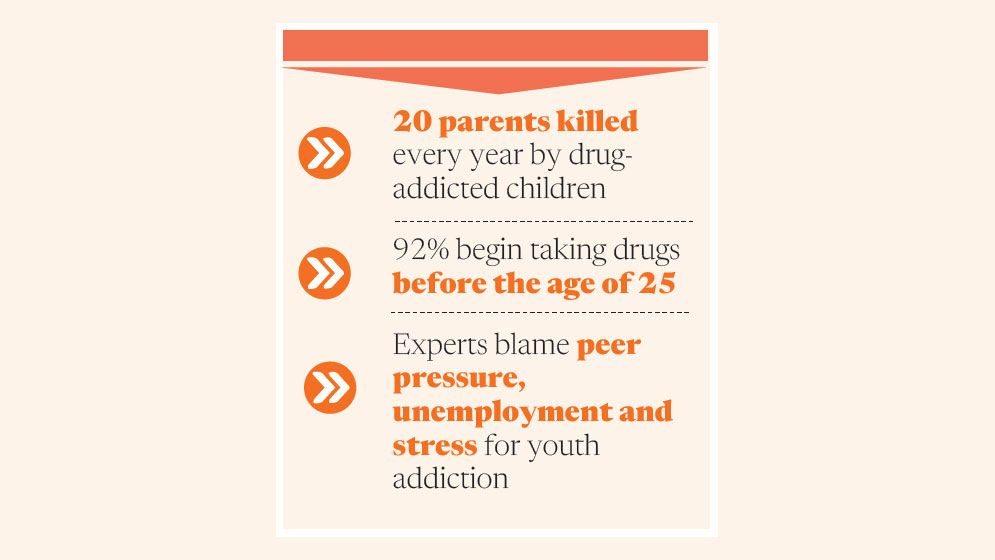
The impact extends well beyond violent crime. Data from the Society for Social Welfare and Development (SKUS) show that, on average, 20 parents are killed each year in Bangladesh by their drug-addicted children. Drug addiction also inflicts severe emotional, social and financial hardship on families.
According to a nationwide study conducted by Bangladesh Medical University (BMU), 68% of drug users reported experiencing stigma and discrimination within their families and communities.
The study estimates that around 82 lakh people in Bangladesh, about 4.88% of the population, currently use one or more illicit drugs, with young people accounting for the largest share. It found that 92% of drug users began taking drugs before the age of 25, highlighting the growing prevalence of addiction among young people.
According to the Department of Narcotics Control's (DNC) 2025 nationwide study, "Estimation of the Number and Category of Persons Abusing Drugs and Associated Factors: A Nationwide Study in Bangladesh", around 47.7% of drug users are aged between 21 and 30. The study also found that nearly one in 10 drug users is a student.
Prof Dr Arup Ratan Choudhury, founder president of MANAS, said curiosity, peer pressure, frustration, unemployment and a lack of family guidance often drive young people towards drug addiction.
He stressed that greater awareness among families, educational institutions and society is essential to prevent addiction among young people.
Meanwhile, nearly 90% of respondents said illicit drugs were easily available, making it easier for youths to become addicted.
Despite the growing number of young people falling into addiction, access to treatment remains limited. The BMU study found that only 13% of drug users had ever received treatment or rehabilitation services.
Although more than half had attempted to quit, most were unsuccessful because of inadequate treatment facilities, counselling, and social and financial support.
The study found that 69% of drug users require rehabilitation services, while 62% need counselling and 41.2% require employment support to recover. Recognising the treatment gap, DNC Director General Md Hasan Maruf said the government had approved a project to establish seven drug addiction treatment and rehabilitation centres, one in each division.
According to the DNC study, an average drug user spends around Tk217 a day on drugs — equivalent to about Tk6,500 a month or more than Tk79,000 a year.
Based on the BMU estimate of 82 lakh drug users and the DNC finding that 47.7% are aged between 21 and 30, it is estimated that around 39.1 lakh young adults spend nearly Tk31,000 crore on illicit drugs annually. Dr Md Tawohidul Haque, criminologist and associate professor at the University of Dhaka, said drug addiction places a heavy financial burden on families, often leading to economic hardship and social instability.
He said addiction had become a broader social challenge, with the easy availability of drugs, inadequate rehabilitation facilities, unemployment, family problems and social pressures continuing to fuel the crisis.
He called for stronger rehabilitation programmes and evidence-based measures to combat drug addiction and drug-related crime.