



 For all latest news, follow the Daily Sun's Google News channel.


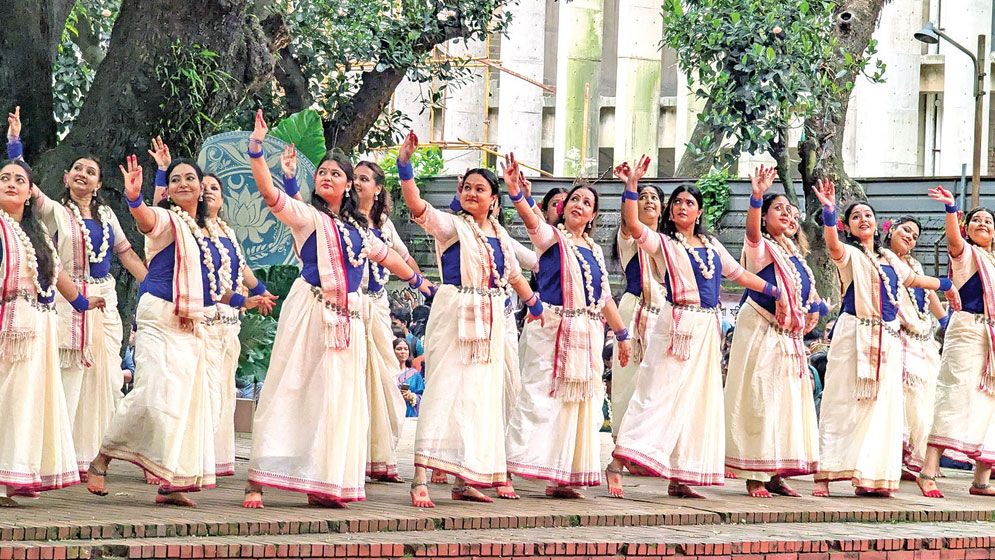
The skies were draped in monsoon clouds, the air carried the scent of rain, and streams of people dressed in white, blue and shades of green sarees walked towards the Faculty of Fine Arts at the University of Dhaka on Friday morning. From Shahbagh to Charukola, the colourful procession transformed the streets into a living canvas of Bengal’s monsoon. Men in traditional panjabis joined the celebration, while a long queue formed at the entrance of Charukola as hundreds gathered to celebrate the rainy season through music, dance and poetry at the open-air festival “Ghonoghota 2”.
Jointly organised by the Arthy Ahmed Dance Academy and the Faculty of Fine Arts of the University of Dhaka, the second edition of the monsoon dance festival began at 11:00am at Charukola, Bokultola. The 90-minute programme blended the beauty of the season with a humanitarian message, as the organisers also raised funds for people affected by the recent floods in the Chattogram Hill Tracts.
The event marked the first major production directed by renowned dancer Arthy Ahmed after receiving the prestigious Ekushey Padak, Bangladesh's second-highest civilian honour, earlier this year.
Addressing the audience at the opening ceremony, Arthy Ahmed reflected on how the meaning of the monsoon has changed in urban life.
“For many city dwellers, the rainy season has become synonymous with waterlogging and traffic congestion. But the monsoon has long been celebrated as an integral part of Bengali culture. The overwhelming response to the first edition of Ghonoghota inspired us to organise this year’s festival on a much larger scale,” she said.
She added that preparations had been underway for nearly four months, but the organisers felt they could not overlook the suffering caused by the recent floods.
“As artists, we have a responsibility towards society. Alongside celebrating the beauty of the monsoon, we also want to stand beside those affected by the floods,” she said.
More than 300 performers, ranging in age from just 3 to 70 years, took part in 16 dance presentations. The participants represented diverse backgrounds, including children, first-time dancers, doctors, engineers, teachers, journalists, researchers and homemakers, demonstrating that art knows no age or profession.
The performances celebrated the rich musical heritage of Bengal through timeless compositions by Rabindranath Tagore, Kazi Nazrul Islam and folk traditions. Dancers moved gracefully to beloved songs including Jalaluddin Khan’s “Allah Megh De Pani De”, Tagore’s “Megh Bolechhe Jabo Jabo” and “Aji Jhoro Jhoro Mukhoro Badoro Dine”, as well as Nazrul’s “Rim Jhim Rim Jhim” and “Rum Jhum”. As dark clouds gathered overhead and light rain fell, the performances echoed the mood of the season, creating an atmosphere that captivated the audience.
Among the audience was Sajia Irin, a housewife, who said the festival offered a refreshing escape from the city’s routine. “Watching hundreds of performers dance under the cloudy sky while the rain gently fell created a magical atmosphere. It reminded me that the monsoon is not just a season of inconvenience but also a beautiful part of our cultural identity,” she said.
Tahmina Taher Sonya, a university student, who attended the festival with her friends, praised the event’s inclusiveness. “It was inspiring to see people of all ages; from little children to senior citizens; performing on the same stage with equal enthusiasm. The performances, the music and the natural surroundings of Charukola made the experience unforgettable,” she said.
Beyond its artistic appeal, the festival also served a humanitarian purpose. Members of the Arthy Ahmed Dance Academy pledged personal donations, while two booths operated by the Jaago Foundation collected contributions from visitors for flood victims in the Chattogram Hill Tracts. Festival-goers responded generously, making voluntary donations throughout the programme.
The first edition of “Ghonoghota”, held at the same venue last year, featured around 110 performers aged between 18 and 70. This year’s expanded edition, with more than 300 participants, reflected the festival’s growing popularity and its emergence as one of Dhaka’s most vibrant celebrations of the rainy season.