



 For all latest news, follow the Daily Sun's Google News channel.


Dhaka University has come under sharp criticism from students and academics after key commemorative dates marking the second anniversary of the July uprising passed without visible observance, with many accusing the administration of failing to preserve the movement's legacy through meaningful commemorations, research and institutional support.
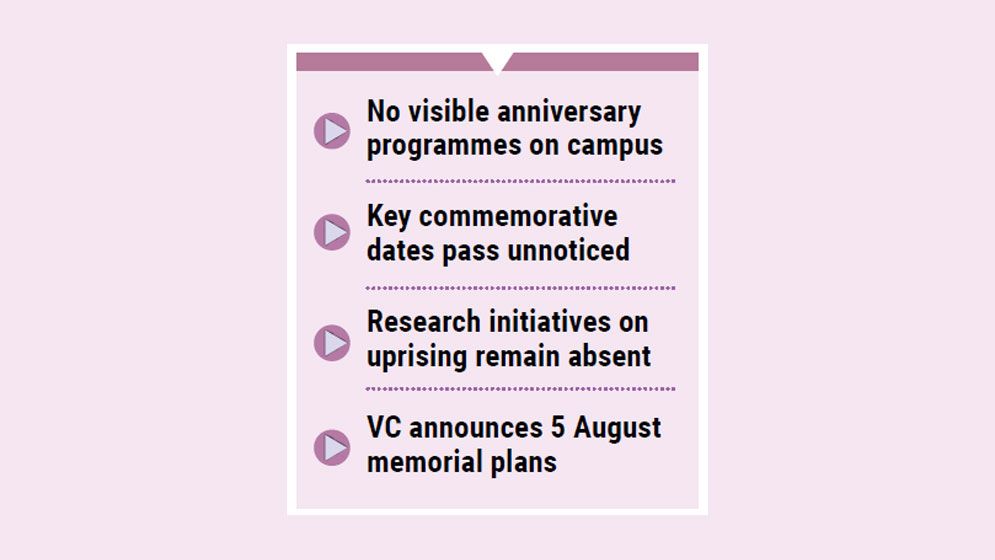
A visit to the campus found little sign of activities marking key dates linked to the uprising. Women’s Students’ Day on 14 July, July Martyrs’ Day and Anti-Terrorism Day passed without public programmes, banners or digital displays, while murals and protest graffiti that became symbols of the movement are fading without preservation.
Professor Samina Lutfa Nitra of the Department of Sociology publicly criticised the university administration for its silence.
"Is the Dhaka University administration not making any arrangements for July? That is a very short-sighted act," she wrote on social media, arguing that the uprising had paved the way for the current administration to assume office.
She also criticised both the state and the university for failing to protect female students and teachers from online harassment following their participation in the protests.
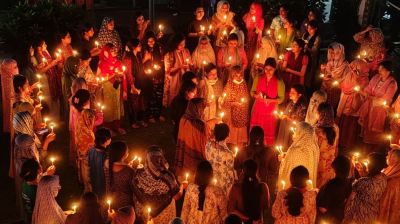
The subdued atmosphere contrasts sharply with last year's observance, when the university marked Women’s Students’ Day with rallies at the Raju Sculpture, reopened female residential halls and displayed footage of the uprising on digital screens across the campus.
Former student leader Faruk Siddik recalled the vibrant celebrations, describing them as "one of the most beautiful nights of university life", and said this year's silence had disappointed many who took part in the movement.
Academics have also expressed concern over the absence of sustained research into the uprising.
Former vice-chancellor Professor Niaz Ahmed Khan said that during his tenure the university collaborated with Kent State University in the United States on research related to the movement and established a Democracy Lab.
However, Pro Vice-Chancellor (Administration) Professor Mohammad Almojaddede Alfesanee acknowledged that no new research initiatives had been launched under the current administration. He said the university would prioritise funding for research proposals on the July Uprising in the next fiscal year.
The administration is also facing criticism over support for students injured during the movement.
According to university records, 326 Dhaka University students were injured during the uprising. Many have yet to receive fee waivers, with students blaming bureaucratic complications after numerous victims were omitted from the Ministry of Education's official gazette.
Khan Jasim, who lost an eye during the movement, said the university had yet to waive the academic fees of injured students.
"The university administration has not yet taken the initiative to waive the fees of the injured students," he told the Daily Sun. He said discrepancies between the ministry's gazette and the university's internal records had left many deserving students without support.
Abdul Kader, a student coordinator who announced the movement's historic nine-point demand, accused the administration of showing a "careless attitude" and alleged there was an effort to erase the uprising from public memory.
Rejecting the criticism, Vice-Chancellor Professor ABM Obaidul Islam said the university had already begun preparations for commemorative events on 5 August.
"The university administration has already started preparations," he said, adding that plans include the inauguration of a July memorial on campus, the establishment of a memorial corner in the central library and discussion programmes at the Student-Teacher Centre. He also said the university would continue to observe 14 July as Women’s Day with due dignity in the coming years.
According to United Nations estimates, the July Uprising claimed around 1,400 lives and injured more than 30,000 people nationwide. Students say commemorative speeches alone are insufficient, urging the university to institutionalise research, preserve historical sites and provide lasting support for those who sacrificed during the movement.