


 For all latest news, follow the Daily Sun's Google News channel.


BB tightens loan write-off rules for finance companies
New policy mandates legal action before write-offs, strengthens governance
Daily Sun Report, Dhaka
Published: 17 Jul 2026, 12:00 AM
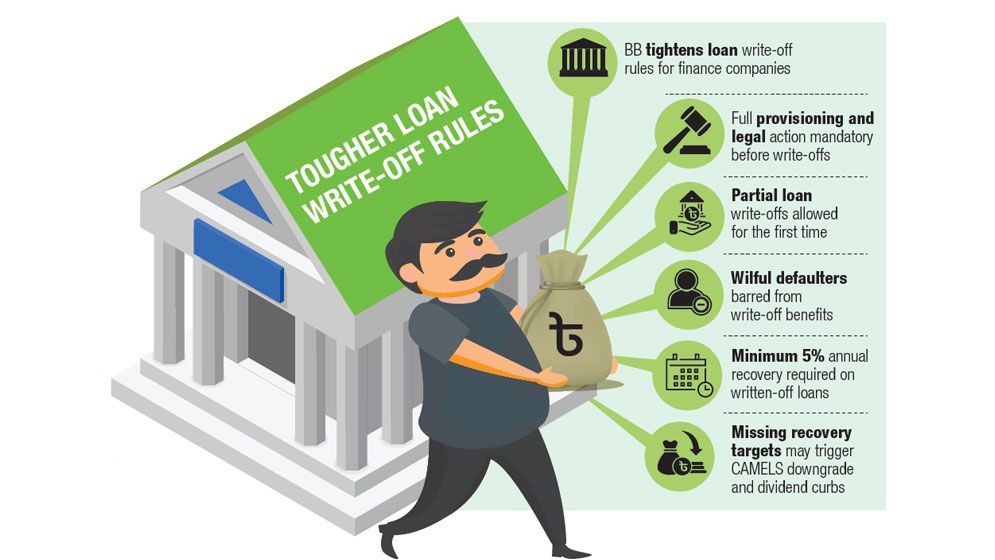
The Bangladesh Bank has updated its rules on how finance companies write off bad loans, leases, and investments.
The changes aim to reduce defaulted loans and clean up the sector’s financial health by requiring tougher oversight and stronger recovery efforts. The new guidelines bring Bangladesh’s framework in line with global standards.
Under the policy, finance companies can only write off an account if they meet three conditions at the same time: the loan is officially marked as a “bad/loss”, the company has set aside funds to cover 100% of the unpaid amount, and there is no realistic chance of getting the money back.
The central bank now requires legal action before any write-off.
Finance companies must first sue the borrower and try to sell any pledged collateral. They can only write off the debt if the collateral cannot be sold and the guarantors are unable to pay.
Where no legal action has been initiated, finance companies must file a case under the Money Loan Court Act, 2003 before writing off the account.
However, loans of up to Tk5 lakh that are not legally required to be pursued through the Money Loan Court may be written off without filing a lawsuit, provided all other conditions are met.
The policy further tightens provisioning requirements by requiring finance companies to maintain provisions equal to the outstanding balance after deducting suspended interest.
Any shortfall must be covered by charging the current year’s profit and loss account before a write-off is allowed.
For the first time, Bangladesh Bank has introduced a framework for partial write-offs.
Loans classified as bad/loss may be partially written off after excluding the portion covered by eligible collateral, which will continue to be treated as recoverable.
Finance companies may conduct their own valuation of collateral securing loans of up to Tk50 lakh, while loans exceeding that threshold must be valued by professional valuation firms enlisted by Bangladesh Bank.
Any manipulation of collateral values to obtain write-off benefits will result in the permanent blacklisting of the responsible officials and valuation firms, along with criminal proceedings.
Under the partial write-off framework, accrued interest must be written off before the principal, while any subsequent recoveries must first be adjusted against the written-off amount before reducing the balance-sheet loan.
The revised policy also significantly strengthens governance requirements.
Before any write-off proposal is placed before the board of directors, the chief executive officer must prepare a comprehensive justification report incorporating the opinion of the head of Internal Control and Compliance (ICC).
The report must include details of the loan approval process, approving officials, board involvement, related-party exposure, recovery efforts, reasons the loan is considered unrecoverable, legal actions taken, and whether the account involved fraud, forgery or fund diversion.
It must also document notices, reminders and legal correspondence served on the borrower.
The ICC head must submit a personal declaration certifying that neither the loan sanction nor the write-off process violated any law, regulation or ethical standard.
Borrowers must also be notified at least 10 working days before the write-off, informing them that although the account will be removed from the balance sheet, legal recovery proceedings and the finance company’s claim on the debt will continue.
To strengthen post-write-off recovery, every finance company must establish a dedicated Written-off Loan Recovery Unit under the direct supervision of the managing director or chief executive officer.
The revised policy also introduces several new restrictions.
Written-off loans cannot be rescheduled or restructured except under the One-Time Exit (OTE) Policy, while loans belonging to wilful defaulters identified under the Finance Company Act, 2023 are ineligible for write-off.
Finance companies are also prohibited from writing off newer bad loans while retaining older eligible bad loans unless prevented by legal restrictions or court orders.
Where borrowers are current or former directors, or their related persons, entities or close relatives, finance companies must conduct an internal audit, obtain board approval and secure prior approval from Bangladesh Bank before proceeding with the write-off.
The policy also requires finance companies to recover at least 5% of their outstanding written-off loan portfolio annually.
Failure to meet the minimum recovery target for two consecutive years will automatically downgrade the management component of the institution’s CAMELS rating and result in restrictions on dividend declarations.